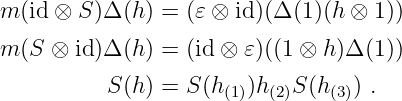
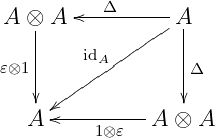
One is also motivated by numerous, important quantum physics examples to introduce a
framework for quantum symmetry breaking in terms of either locally compact quantum groupoid, or
related algebroid, representations, such as those of weak Hopf C*-algebroids with convolution; the
latter are usually realized in the context of rigged Hilbert spaces (Bohm and Gadella,
1989).
Furthermore, with regard to a unified and global framework for symmetry breaking, as well as
higher order quantum symmetries, one needs to look towards the double groupoid structures of
Brown and Spencer (1976), to enable one to introduce the concepts of quantum and graded Lie
bi–algebroids which are expected to carry a distinctive C*–algebroid convolution structure. The
extension to supersymmetry leads then naturally to superalgebra, superfield symmetries and their
involvement in supergravity or quantum gravity (QG) theories for intense gravitational fields in
fluctuating, quantized spacetimes. Their mathematical/quantum algebraic classification then
involves superstructures with such supersymmetries that can only be appropriately studied in
(quantum) supercategories.
One can refer here to the example given by Bais et al. (2002). Let G be a non–Abelian
group and H ⊂ G a discrete subgroup. Let F(H) denote the space of functions on H and
ℂH the group algebra (which consists of the linear span of group elements with the
group structure). The quantum double D(H) (Drinfel’d, 1987) is defined by the eqn
:
For the second example, consider the example provided by Mack and Schomerus (1992) using a
more general notion of the Drinfel’d construction–the notion of a quasi triangular quasi–Hopf
algebra (QTQHA) which was developed with the aim of studying a range of essential
symmetries with special properties, such as the quantum group algebra Uq(sl2) with
|q| = 1 . If qp = 1, then it was shown that a QTQHA is canonically associated with
Uq(sl2). Such QTQHAs are claimed as the true symmetries of minimal conformal field
theories.
[1] A. Abragam and B. Bleaney.: Electron Paramagnetic Resonance of Transition Ions.
Clarendon Press: Oxford, (1970).
[2] E. M. Alfsen and F. W. Schultz: Geometry of State Spaces of Operator Algebras,
Birkhäuser, Boston–Basel–Berlin (2003).
[3] J.C. Baez and L. Langford. Higher-dimensional algebra. IV. 2-tangles. Adv. Math.
180 (no.2): 705-764 (2003).
[4] I. Baianu : Categories, Functors and Automata Theory: A Novel Approach to
Quantum Automata through Algebraic–Topological Quantum Computations., Proceed.
4th Intl. Congress LMPS, (August-Sept. 1971).
[5] I.C. Baianu: X–ray scattering by partially disordered membrane systems, Acta Cryst.
A34: 751-753 (1978).
[6] I.C. Baianu, K.A. Rubinson and J. Patterson. 1979. Ferromagnetic Resonance and
Spin–Wave Excitations in Metallic Glasses., J. Phys. Chem. Solids, 40: 940–951.
[7] I.C. Baianu, N. Boden,Y.K. Levine and D. Lightowlers. 1978. Dipolar Coupling
between Groups of Three Spin–1/2 undergoing Hindered Reorientation in Solids.,
Solid-State Communications. 27: 474-478.
[8] I.C. Baianu, N. Boden, Y.K.Levine and S.M.Ross. 1978. Quasi–quadrupolar NMR
Spin–Echoes in Solids Containing Dipolar Coupled Methyl Groups., J. Phys. (C) Solid
State Physics., 11: L37–41.
[9] I.C. Baianu, K.A. Rubinson and J. Patterson. 1979. The Observation of Structural
Relaxation in a FeNiPB Glass by X–ray Scattering and Ferromagnetic Resonance.,
Physica Status Solidi(a), 53 K:133–135.
[10] I.C. Baianu, N. Boden and D. Lightowlers.1981. NMR Spin–Echo Responses of
Dipolar–Coupled Spin–1/2 Triads in Solids., J. Magnetic Resonance, 43:101-111.
[11] I. C. Baianu, J. F. Glazebrook and R. Brown.: A Non-Abelian, Categorical Ontology
of Spacetimes and Quantum Gravity., Axiomathes 17,(3-4): 353-408(2007).
[12] I.C.Baianu, J.F. Glazebrook, and R. Brown.: On Physical Applications of
Non-Abelian Algebraic Topology in Quantum Field Theories in preparation, (2008).
[13] I.C.Baianu, R. Brown J.F. Glazebrook, and G. Georgescu, Towards Quantum
Non-Abelian Algebraic Topology. in preparation, (2008).
[14] F.A. Bais, B. J. Schroers and J. K. Slingerland: Broken quantum symmetry and
confinement phases in planar physics, Phys. Rev. Lett. 89 No. 18 (1–4): 181-201 (2002).
[15] J.W. Barrett.: Geometrical measurements in three-dimensional quantum gravity.,
in: Proceedings of the Tenth Oporto Meeting on Geometry, Topology and Physics (2001).
Intl. J. Modern Phys. A 18 , October, suppl., 97-113 (2003)
[16] A. D. Blaom : Lie Algebroids and Cartan’s Method of Equivalence.,
arXiv:math/0509071v2 [math.DG], (12 Jan 2007).
[17] G. Böhm, F. Nill, and K. Szlachányi: Weak Hopf algebras I, Integral theory and
C*–structure, J. Algebra 221 (2): 385–438 (1999).
[18] A. Bohm and M. Gadella: Dirac kets, Gamow vectors and Gel’fand triples, Lect.
Notes in Physics 348 Springer Verlag, 1989.
[19] Borceux,F. and G. Janelidze: Galois Theories, Cambridge Studies in Advanced
Mathematics 72, Cambridge (UK): Cambridge University Press, 2001.
[20] R. Brown R, K. Hardie, H. Kamps, T. Porter T.: The homotopy double groupoid of
a Hausdorff space., Theory Appl. Categories, 10:71-93 (2002).
[21] R. Brown: Topology and Groupoids, BookSurge LLC (2006).
[22] R. Brown R, P.J. Higgins, and R. Sivera.: 2008. Non–Abelian Algebraic Topology,
PDF file download.
[23] R. Brown, J. F. Glazebrook and I. C. Baianu: A categorical and higher dimensional
algebra framework for complex systems and spacetime structures, Axiomathes
17:409–493. (2007).
[24] R. Brown and P. Higgins: tensor products and homotopies for ω–groupoids and
crossed complexes, J. Pure Appl. Algebra 47 (1987), 1–33.
[25] R. Brown and G. Janelidze.: Galois Theory and a new homotopy double groupoid
of a map of spaces, Applied Categorical Structures. 12: 63–80(2004).
[26] R. Brown and G. Janelidze: Van Kampen theorems for categories of covering
morphisms in lextensive categories, J. Pure Appl. Algebra, 119: 255-263, ISSN 0022–4049
(1997).
[27] R. Brown and J.-L. Loday: Homotopical excision, and Hurewicz theorems, for
n–cubes of spaces, Proc. London Math. Soc., 54:(3), 176- 192, (1987).
[28] R. Brown and J.-L. Loday: Van Kampen Theorems for diagrams of spaces, Topology,
26: 311–337 (1987).
[29] R. Brown and G. H. Mosa: Double algebroids and crossed modules of algebroids,
University of Wales–Bangor, Maths Preprint, 1986.
[30] R. Brown and C.B. Spencer: Double groupoids and crossed modules, Cahiers Top.
Géom.Diff. 17 (1976), 343-362.
[31] M. R. Buneci.: Groupoid Representations., Ed. Mirton: Timisoara (2003).
[32] J. Butterfield and C. J. Isham : A topos perspective on the Kochen–Specker theorem
I - IV, Int. J. Theor. Phys, 37 (1998) No 11., 2669–2733 38 (1999) No 3., 827–859, 39
(2000) No 6., 1413–1436, 41 (2002) No 4., 613-639.
[33] J. Butterfield and C. J. Isham : Some possible roles for topos theory in quantum
theory and quantum gravity, Foundations of Physics., 4, 820—837 (2004).
[34] J.S. Carter and M. Saito. Knotted surfaces, braid moves, and beyond. Knots and
quantum gravity (Riverside, CA, 1993), 191-229, Oxford Lecture Ser. Math. Appl., 1,
Oxford Univ. Press, New York, 1994.
[35] M. Chaician and A. Demichev: Introduction to Quantum Groups, World Scientific
(1996).
[36] Coleman and De Luccia: Gravitational effects on and of vacuum decay., Phys. Rev.
D 21: 3305 (1980).
[37] A. Connes: Noncommutative Geometry, Academic Press. 1994.
[38] L. Crane and I.B. Frenkel. Four-dimensional topological quantum field theory, Hopf
categories, and the canonical bases. Topology and physics. J. Math. Phys. 35 (no. 10):
5136-5154 (1994).
[39] L. Crane; L.H. Kauffman; D.N. Yetter. State-sum invariants of 4-manifolds. J. Knot
Theory Ramifications 6, (no. 2): 177–234 1997).
[40] Day, B. J. and Street, R.: Monoidal bicategories and Hopf algebroids. Advances in
Mathematics, 129: 99–157 (1997)
[41] W. Drechsler and P. A. Tuckey: On quantum and parallel transport in a Hilbert
bundle over spacetime., Classical and Quantum Gravity, 13:611–632 (1996). doi:
10.1088/0264–9381/13/4/004
[42] V. G. Drinfel’d: Quantum groups, In Proc. Int. Cong. of Mathematicians, Berkeley
1986, (ed. A. Gleason), Berkeley, 798–820 (1987).
[43] G. J. Ellis: Higher dimensional crossed modules of algebras, J. of Pure Appl. Algebra
52 (1988), 277–282.
[44] P.. I. Etingof and A. N. Varchenko, Solutions of the Quantum Dynamical
Yang-Baxter Equation and Dynamical Quantum Groups, Comm.Math.Phys., 196:
591–640 (1998)
[45] P. I. Etingof and A. N. Varchenko: Exchange dynamical quantum groups, Commun.
Math. Phys. 205 (1): 19–52 (1999)
[46] P. I. Etingof and O. Schiffmann: Lectures on the dynamical Yang–Baxter equations,
in Quantum Groups and Lie Theory (Durham, 1999), pp. 89–129, Cambridge University
Press, Cambridge, 2001.
[47] B. Fauser: A treatise on quantum Clifford Algebras. Konstanz, Habilitationsschrift.,
arXiv.math.QA/0202059 (2002).
[48] B. Fauser: Grade Free product Formulae from Grassman-Hopf Gebras. Ch. 18
in R. Ablamowicz, Ed., Clifford Algebras: Applications to Mathematics, Physics and
Engineering, Birkhäuser: Boston, Basel and Berlin, (2004).
[49] J. M. G. Fell.: The Dual Spaces of C*-Algebras, Transactions of the American
Mathematical Society, 94: 365-403 (1960).
[50] F.M. Fernandez and E. A. Castro.: (Lie) Algebraic Methods in Quantum Chemistry
and Physics., Boca Raton: CRC Press, Inc (1996).
[51] R. P. Feynman: Space–Time Approach to Non–Relativistic Quantum Mechanics,
Reviews of Modern Physics, 20: 367-387 (1948). [It is also reprinted in (Schwinger 1958).]
[52] A. Fröhlich, Non-Abelian Homological Algebra. I. Derived functors and satellites.,
Proc. London Math. Soc. (3), 11: 239–252 (1961).
[53] Gel’fand, I. and Naimark, M., 1943, On the Imbedding of Normed Rings into the
Ring of Operators in Hilbert Space, Recueil Mathématique [Matematicheskii Sbornik]
Nouvelle Série, 12 [54]: 197–213. [Reprinted in C*–algebras: 1943–1993, in the series
Contemporary Mathematics, 167, Providence, R.I. : American Mathematical Society,
1994.]
[54] G. Georgescu: N–Valued Logics and Łukasiewicz-Moisil Algebras., Axiomathes,
16(1-2): 123-136 (March 2006).
[55] G. Georgescu, and D. Popescu.: On Algebraic Categories. Rev. Roum. Math. Pures
et Appl.,24(13):337–342 (1968).
[56] G. Georgescu, and C. Vraciu: On the Characterization of Łukasiewicz Algebras., J.
Algebra, 16(4): 486-495 (1970).
[57] R. Gilmore: “Lie Groups, Lie Algebras and Some of Their Applications.”, Dover
Publs., Inc.: Mineola and New York, 2005.
[58] J. Grabowski and G. Marmo: Generalized Lie bialgebroids and Jacobi structures, J.
Geom Phys. 40, no. 2, 176–199 (2001).
[59] M. Grandis and L. Mauri: Cubical sets and their site, Theor. Appl. Categories 11
no. 38 (2003), 185–211.
[60] M. T. Grisaru and H. N. Pendleton: Some properties of scattering amplitudes in
supersymmetric theories, Nuclear Phys. B 124: 81–92(1977).
[61] Grothendieck, A.: 1957, Sur quelque point d-algébre homologique. , Tohoku Math.
J., 9: 119-121.
[62] Grothendieck, A. and J. Dieudoné.: 1960, Eléments de geometrie algébrique.,
Publ. Inst. des Hautes Etudes de Science, 4; and Vol. III, Publ. Math. Inst. des Hautes
Etudes , 11: 1-167 (1961).
[63] A. Grothendieck: Technique de descente et théorèmes d’existence en géométrie
algébrique. II, Séminaire Bourbaki 12 (1959/1960), exp. 195, Secrétariat
Mathématique, Paris, 1961.
[64] A. Grothendieck: Technique de construction en géométrie analytique. IV.
Formalisme général des foncteurs reprêsentables, Séminaire H. Cartan 13
(1960/1961), exp. 11, Secrétariat Mathématique, Paris, 1962.
[65] Grothendieck, A.: 1971, Revêtements Étales et Groupe Fondamental (SGA1),
chapter VI: Catégories fibrées et descente, Lecture Notes in Math. 224,
Springer–Verlag: Berlin.
[66] P. Hahn: Haar measure for measure groupoids., Trans. Amer. Math. Soc. 242:
1–33(1978).
[67] P. Hahn: The regular representations of measure groupoids., Trans. Amer. Math.
Soc. 242:34–72(1978).
[68] R. Heynman and S. Lifschitz. 1958. “Lie Groups and Lie Algebras”., New York and
London: Nelson Press.
[69] C. Heunen, N. P. Landsman, B. Spitters.: A topos for algebraic quantum theory,
(2008) arXiv:0709.4364v2 [quant–ph]
[70] P. J. Higgins, ‘Presentations of Groupoids, with Applications to Groups’, Proc.
Camb. Phil. Soc.60: 7–20 (1964).
[71] P. J. Higgins: Categories and Groupoids, van Nostrand: New York (1971).
[72] A. M. Hindeleh and R. Hosemann: Paracrystals representing the physical state of
matter, Solid State Phys. 21: 4155–4170 (1988).
[73] R. Hosemann and R. N. Bagchi: Direct Analysis of Diffraction by Matter,
North–Holland Publs.: Amsterdam–New York (1962).
[74] R. Hosemann, W. Vogel, D. Weick and F. J. Balta-Calleja: Novel aspects of the real
paracrystal, Acta Cryst. A37: 85–91 (1981).
[75] G. Janelidze.: ‘Precategories and Galois theory’, Springer Lecture Notes in Math.
1488: 157-173(1991).
[76] G. Janelidze.: ‘Pure Galois theory in categories’, J. Algebra, 132: 270-286 (1990).
[77] V. Kac: Lie superalgebras, Advances in Math. 26 (1): 8–96 (1977).
[78] K.H. Kamps and T. Porter.: ‘A homotopy 2-groupoid from a fibration’, Homotopy,
homology and applications, 1: 79-93(1999) .
[79] G. Karaali: On Hopf algebras and their generalizations. (2007)
arXiv:math/07/03441v2
[80] J. Kustermans and S. Vaes: The operator algebra approach to quantum groups.
Proc. Natl. Acad. USA, 97, (2): 547-552, (2000).
[81] E. C. Lance: Hilbert C*–Modules. London Math. Soc. Lect. Notes 210, Cambridge
Univ. Press., (1995).
[82] N. P. Landsman: Mathematical topics between classical and quantum mechanics.
Springer Verlag, New York, (1998).
[83] N. P. Landsman: Compact quantum groupoids, in ‘Quantum Theory and
Symmetries’ (Goslar, 18–22 July 1999) eds. H.-D. Doebner et al., World Scientific, (2000).
arXiv:math-ph/9912006
[84] N. P. Landsman and B. Ramazan: Quantization of Poisson algebras associated to Lie
algebroids. , In R. Kaminker et al, eds., Proc. Conf. on Groupoids in Physics, Analysis
and Geometry, Contemporary Mathematics series, E–print: math–ph/001005.
[85] A. Levin and M. Olshanetsky.: Hamiltonian Algebroids and deformations of complex
structures on Riemann curves., (2003, 2008).arXiv : hep −−th∕0301078v1
[86] J.-H. Lu: Hopf algebroids and quantum groupoids, Int. J. Math. 7: 47–70 (1996).
[87] G. W. Mackey: The Scope and History of Commutative and Noncommutative
Harmonic Analysis, Amer. Math. Soc., Providence, RI, (1992).
[88] G. Mack and V. Schomerus: Quasi Hopf quantum symmetry in quantum theory,
Nucl. Phys. B 370 (1) (1992), 185–230.
[89] K. C. H. Mackenzie: General Theory of Lie Groupoids and Lie Algebroids, London
Math. Soc. Lecture Notes Series, 213, Cambridge University Press, Cambridge, (2005).
[90] S. MacLane: “Categorical algebra.”, Bull. Amer. Math. Soc. 71, Number 1:
40-106(1965).
[91] S. MacLane and I. Moerdijk: “Sheaves in Geometry and Logic - A first Introduction
to Topos Theory”., Springer Verlag, New York (1992).
[92] S. Majid: Foundations of Quantum Group Theory, Cambridge Univ. Press (1995).
[93] G. Maltsiniotis.: Groupoïdes quantiques., C. R. Acad. Sci. Paris, 314: 249 –
252.(1992)
[94] J.P. May: A Concise Course in Algebraic Topology. Chicago and London: The
Chicago University Press. (1999).
[95] B. Mitchell: The Theory of Categories, Academic Press, London, (1965).
[96] B. Mitchell: Rings with several objects., Adv. Math. 8: 1 - 161 (1972).
[97] B. Mitchell: Separable Algebroids., Memoirs American Math. Soc. 333:1x-1xx
(1985).
[98] G. H. Mosa: Higher dimensional algebroids and Crossed complexes, PhD thesis,
University of Wales, Bangor, (1986).
[99] G. Moultaka, M. Rausch de Traubenberg and A. Tanasă: Cubic supersymmetry
and abelain gauge invariance, Intl. J. Modern Phys. A 20 no. 25 (2005), 5779-5806.
[100] J. Mrčun : On spectral representation of coalgebras and Hopf algebroids, (2002)
preprint.
http://arxiv.org/abs/math/02081994.
[101] P. Muhli, J. Renault and D. Williams: Equivalence and isomorphism for groupoid
C*–algebras., J. Operator Theory, 17: 3-22 (1987).
[102] D. A. Nikshych and L. Vainerman: J. Funct. Anal. 171 (2000) No. 2, 278–307
[103] H. Nishimura.: Logical quantization of topos theory., International Journal of
Theoretical Physics, Vol. 35,(No. 12): 2555–2596 (1996).
[104] M. Neuchl, PhD Thesis, University of Munich (1997).
[105] V. Ostrik.: Module Categories over Representations of SL-q(2) in the Non–simple
Case. (2006). http://arxiv.org/PS–cache/math/pdf/0509/0509530v2.pdf
[106] A. L. T. Paterson: The Fourier-Stieltjes and Fourier algebras for locally compact
groupoids., Contemporary Mathematics 321: 223-237 (2003)
[107] R. J. Plymen and P. L. Robinson : Spinors in Hilbert Space. Cambridge Tracts in
Math. 114, Cambridge Univ. Press (1994).
[108] N. Popescu.: The Theory of Abelian Categories with Applications to Rings and
Modules. New York and London: Academic Press (1968).
[109] A. Ramsay: Topologies on measured groupoids., J. Functional Analysis, 47: 314-343
(1982).
[110] A. Ramsay and M. E. Walter: Fourier-Stieltjes algebras of locally compact
groupoids., J. Functional Analysis, 148: 314-367 (1997).
[111] I. Raptis and R. R. Zapatrin : Quantisation of discretized spacetimes and the
correspondence principle, Int. Jour. Theor. Phys. 39,(1), (2000).
[112] T. Regge.: General relativity without coordinates. Nuovo Cimento (10) 19: 558-571
(1961).
[113] H.–K. Rehren: Weak C*–Hopf symmetry, Quantum Group Symposium at Group
21, Proceedings, Goslar (1996, Heron Ptess, Sofia BG : 62–69(1997).
[114] J. Renault: A groupoid approach to C*–algebras. Lecture Notes in Maths. 793,
Berlin: Springer–Verlag,(1980).
[115] J. Renault: Representations de produits croises d’algebres de groupoides. , J.
Operator Theory, 18:67–97 (1987).
[116] J. Renault: The Fourier algebra of a measured groupoid and its multipliers., J.
Functional Analysis, 145: 455–490 (1997).
[117] M. A. Rieffel: Group C*–algebras as compact quantum metric spaces, Documenta
Math. 7: 605–651 (2002).
[118] M. A. Rieffel: Induced representations of C*–algebras, Adv. in Math. 13: 176-254
(1974).
[119] J. E. Roberts : More lectures on algebraic quantum field theory (in: A. Connes, et
al., ’Non–commutative Geometry’), Springer: Berlin (2004).
[120] J. Roberts.: Skein theory and Turaev-Viro invariants. Topology 34( no. 4): 771-S787
(1995).
[121] J. Roberts. Refined state-sum invariants of 3- and 4-manifolds. Geometric topology
(Athens, GA, 1993), 217-234, AMS/IP Stud. Adv. Math., 2.1, Amer. Math.Soc.,
Providence, RI, (1997).
[122] Rovelli, C.: 1998, Loop Quantum Gravity , in N. Dadhich, et al. “Living Reviews
in Relativity”
http:www.livingreviews.org/Articles/Volume1/1998–1–rovelli
[123] Schwartz, L.: Generalisation de la Notion de Fonction, de Derivation, de
Transformation de Fourier et Applications Mathematiques et Physiques., Annales de
l’Universite de Grenoble, 21: 57–74 (1945).
[124] Schwartz, L.: Theorie des Distributions, Publications de l’Institut de Mathematique
de l’Université de Strasbourg, Vols 9–10, Paris: Hermann (1951–1952).
[125] A. K. Seda: Haar measures for groupoids, Proc. Roy. Irish Acad. Sect. A 76 No.
5, 25–36 (1976).
[126] A. K. Seda: On the Continuity of Haar measures on topological groupoids, Proc.
Amer Mat. Soc. 96: 115–120 (1986).
[127] A. K. Seda: Banach bundles of continuous functions and an integral representation
theorem, Trans. Amer. Math. Soc. 270 No.1 : 327–332(1982).
[128] I.E. Segal.: Irreducible Representations of Operator Algebras. , Bulletin of the
American Mathematical Society, 53: 73–88 (1947a).
[129] I. E. Segal.: Postulates for General Quantum Mechanics, Annals of Mathematics,
4: 930–948 (1947b).
[130] E.K. Sklyanin: Some Algebraic Structures Connected with the Yang-Baxter
equation, Funct. Anal.Appl., 16: 263–270 (1983).
[131] Some Algebraic Structures Connected with the Yang-Baxter equation.
Representations of Quantum Algebras, Funct. Anal.Appl., 17: 273–284 (1984).
[132] K. Szlachányi: The double algebraic view of finite quantum groupoids, J. Algebra
280 (1) , 249–294 (2004).
[133] M. E. Sweedler: Hopf algebras. W.A. Benjamin, INC., New York (1996).
[134] A. Tanasă: Extension of the Poincaré symmetry and its field theoretical
interpretation, SIGMA Symmetry Integrability Geom. Methods Appl. 2 (2006), Paper
056, 23 pp. (electronic).
[135] J. Taylor, Quotients of Groupoids by the Action of a Group, Math. Proc. Camb.
Phil. Soc., 103, (1988), 239–249.
[136] A. P. Tonks, 1993, Theory and applications of crossed complexes, Ph.D. thesis,
University of Wales, Bangor.
[137] V.G. Turaev and O.Ya. Viro. State sum invariants of 3–manifolds and quantum
6j–symbols. Topology 31 (no. 4): 865–902 (1992).
[138] E. H. van Kampen, On the Connection Between the Fundamental Groups of some
Related Spaces, Amer. J. Math., 55, (1933), 261–267.
[139] P. Xu.: Quantum groupoids and deformation quantization. (1997)
arxiv.org/pdf/q–alg/9708020.pdf.
[140] D.N. Yetter.: TQFT’ s from homotopy 2-types. J. Knot Theor. 2: 113–123(1993).
[141] S. Weinberg.: The Quantum Theory of Fields. Cambridge, New York and Madrid:
Cambridge University Press, Vols. 1 to 3, (1995–2000).
[142] A. Weinstein : Groupoids: unifying internal and external symmetry, Notices of the
Amer. Math. Soc. 43 (7): 744–752 (1996).
[143] J. Wess and J. Bagger: Supersymmetry and Supergravity, Princeton University
Press, (1983).
[144] J. Westman: Harmonic analysis on groupoids, Pacific J. Math. 27: 621-632. (1968).
[145] J. Westman: Groupoid theory in algebra, topology and analysis., University of
California at Irvine (1971).
[146] S. Wickramasekara and A. Bohm: Symmetry representations in the rigged Hilbert
space formulation of quantum mechanics, J. Phys. A 35 (2002), no. 3, 807–829.
[147] Wightman, A. S., 1956, Quantum Field Theory in Terms of Vacuum Expectation
Values., Physical Review, 101: 860–866.
[148] Wightman, A.S.: 1976, Hilbert’s Sixth Problem: Mathematical Treatment of the
Axioms of Physics., In: Proceedings of Symposia in Pure Mathematics,
textbf28: 147–240.
[149] Wightman, A.S. and Gårding, L., 1964, Fields as Operator–Valued Distributions
in Relativistic Quantum Theory , Arkiv fur Fysik, 28: 129–184.
[150] S. L. Woronowicz: Twisted SU(2) group : An example of a non–commutative
differential calculus, RIMS, Kyoto University 23 (1987), 613–665.