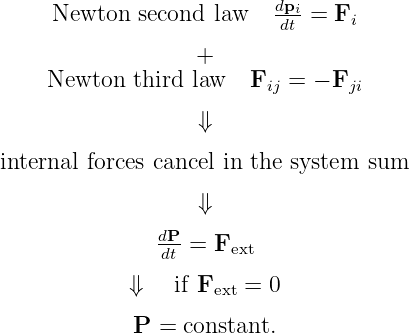
Newton’s Third Law and Conservation of Linear Momentum
Newton’s third law and conservation of linear momentum are closely connected in Classical
Mechanics, but they are not merely two different wordings of the same statement. Newton’s third
law describes the forces exchanged by interacting bodies. Momentum conservation describes the
evolution of an entire chosen system. The bridge between them is built using Newton’s second law
and a careful separation of internal and external forces.
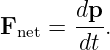
The PhysicsLibrary entry on Newton’s laws gives the third law in the familiar equal-and-opposite
form,
while the momentum entry emphasizes that, when only internal forces are present, these paired
forces cancel in the equation for the total momentum of the system. This article develops that
connection explicitly and also explains its limits.
1. Momentum and Newton’s second law
For a particle of constant mass m, the linear momentum is
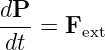
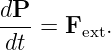
A particularly useful form of Newton’s second law is
This form is more fundamental for the present discussion than F = ma because conservation of
momentum is a statement about the time derivative of momentum.
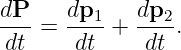
For two particles,
will denote the total linear momentum of the two-particle system. Differentiating gives
Newton’s second law can then be applied to each particle separately.
2. Newton’s third law as an interaction-pair statement
Suppose particle 1 and particle 2 interact. Let
denote the force exerted on particle 1 by particle 2, and let
denote the force exerted on particle 2 by particle 1.
For an ordinary Newtonian interaction satisfying the third-law form,
The two forces therefore have equal magnitudes and opposite directions, but they act on different
bodies. They do not cancel in the Free-body diagram of either one particle. They cancel only after
the two bodies are treated as one larger system.
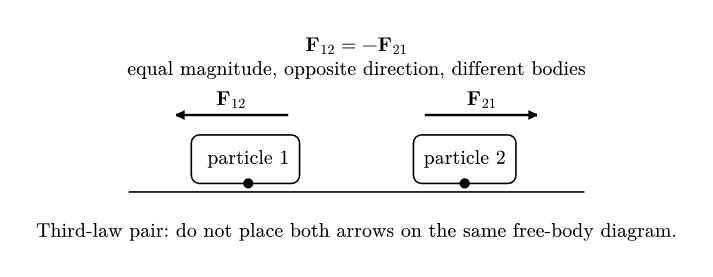
Figure 1. A third-law pair. The force on particle 1 due to particle 2 and the force on particle 2
due to particle 1 are equal and opposite, but they act on different particles.
This distinction prevents a common error. If particle 1 accelerates because particle 2 pushes it, one
should not draw both F12 and F21 on particle 1. Only F12 belongs on particle 1’s free-body
diagram.
3. Two particles: the cancellation that produces momentum conservation
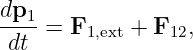
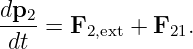
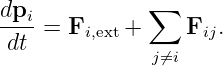
Let external forces F1,ext and F2,ext also act on the two particles. Newton’s second law
gives
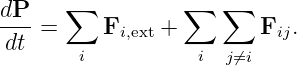
Add the equations:
Newton’s third law gives
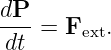
Therefore
conceptually, where
This is the central result. Internal forces can transfer momentum from one particle to another, but
in the Newtonian third-law model they cannot change the total momentum of the complete
system.
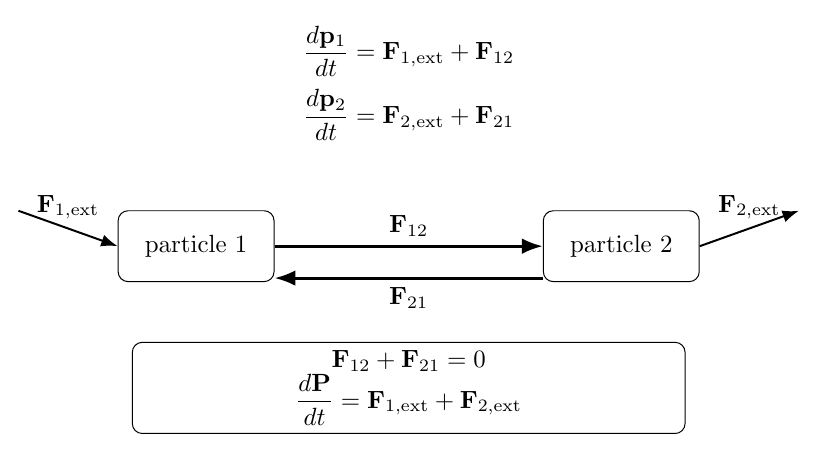
Figure 2. Momentum bookkeeping for a two-particle system. Internal forces redistribute
momentum between the particles; only the net external force changes the total momentum.
4. Isolated system: conservation of total momentum
If the system is isolated so that
then
Hence
and therefore
For constant masses,
This familiar collision equation is therefore not an unrelated rule that must be memorized
separately. Within Newtonian particle mechanics it follows from three steps:
- Newton’s second law relates force to momentum change.
- Newton’s third law makes internal interaction forces occur in equal-and-opposite pairs.
- An isolated system has zero net external force.
Together these imply constant total momentum.
5. Momentum exchange: what the third law means dynamically
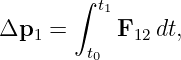
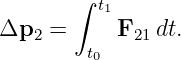
Suppose the particles interact for a time interval from t0 to t1 and external forces are negligible.
Integrating Newton’s second law gives
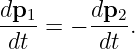
Since
we obtain
Thus one particle’s momentum gain is exactly the other particle’s momentum loss:
This is the impulse-level version of the connection between Newton’s third law and momentum
conservation.
6. Worked example: two skaters push apart
Two skaters initially rest on nearly frictionless ice. Let
After pushing apart, skater 1 moves at
Initially,
With negligible external horizontal force,
Thus
Solving,
The lighter skater moves faster. During the push the skaters exert equal-and-opposite forces on one
another for the same interaction time, so their impulses are equal and opposite. The individual
momenta change, but their vector sum remains zero.
7. Many particles
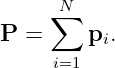
For a system of N particles, define
For particle i,
Summing over all particles gives
The internal sum contains paired terms
For Newtonian third-law interactions,
Thus all internal forces cancel pair by pair, leaving
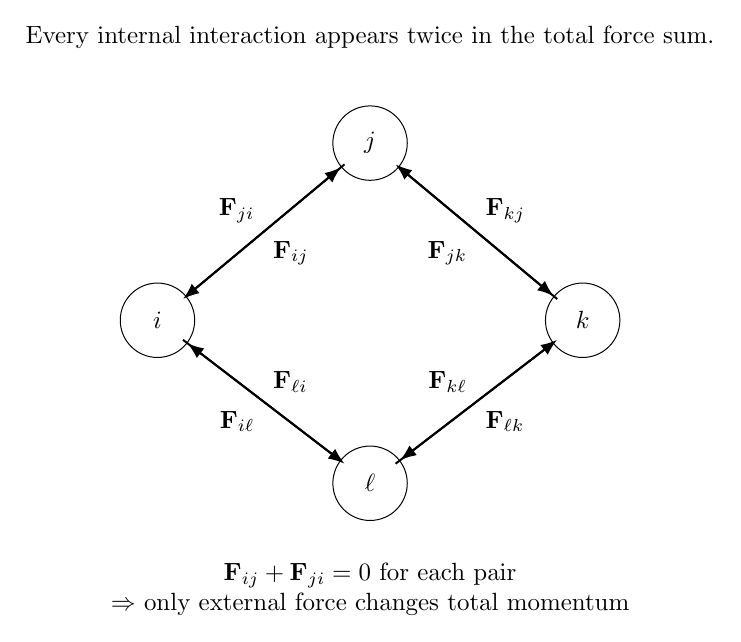
Figure 3. In a many-particle system, every internal pair appears twice in the total force sum with
opposite signs. Pairwise cancellation leaves only the net external force.
8. Connection with the center of mass
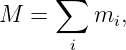
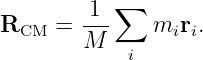
For particles of total mass
the center of mass is
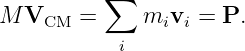
For constant masses,
Therefore
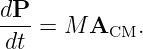
Combining this with the system momentum equation gives
Internal interactions can make the particles move violently relative to the center of mass, but they
do not accelerate the center of mass of an isolated Newtonian system.
This is another expression of the same idea: internal forces redistribute momentum internally;
external force controls the momentum of the system as a whole.
9. System boundaries matter
Momentum conservation is always a statement about a specified system. Consider a
ball bouncing from a wall. The ball’s momentum changes, so the ball alone does not
have conserved momentum during impact. The wall exerts an external force on the
ball.
If the system is enlarged to include the ball, wall, and Earth, the contact forces between ball and
wall become internal. The momentum transferred to Earth is usually too small to notice because
Earth’s mass is enormous, but it is part of the total momentum balance.
This example illustrates a useful procedure:
- choose the system;
- identify which interactions are internal;
- identify external forces;
- apply dP∕dt = Fext to that system.
Changing the system boundary can change which forces are called internal or external, but it does
not change the physics.
10. Third law and conservation are closely related, but not identical
In elementary Newtonian mechanics it is natural to say that Newton’s third law leads to
momentum conservation. That statement is correct for a system of particles whose internal forces
occur as simultaneous equal-and-opposite pairs.
However, momentum conservation is the broader principle.
There are two important reasons to distinguish them.
10.1 Momentum conservation can be formulated without pairwise force language
In Lagrangian and hamiltonian mechanics, conservation of total momentum is associated with
invariance under spatial translations. Noether’s theorem makes this relation systematic: continuous
spatial-translation symmetry leads to conserved linear momentum.
Thus modern mechanics can derive momentum conservation from symmetry rather than taking
pairwise third-law cancellation as the deepest explanation.
10.2 Fields can carry momentum
In Electromagnetism, momentum need not reside only in material particles. Electromagnetic fields
themselves carry momentum. A simple instantaneous relation
between the mechanical forces on two charged bodies need not account for the entire momentum
balance at every instant.
The correct conserved quantity is then schematically
Momentum can move temporarily into or out of the electromagnetic field while total momentum
remains conserved.
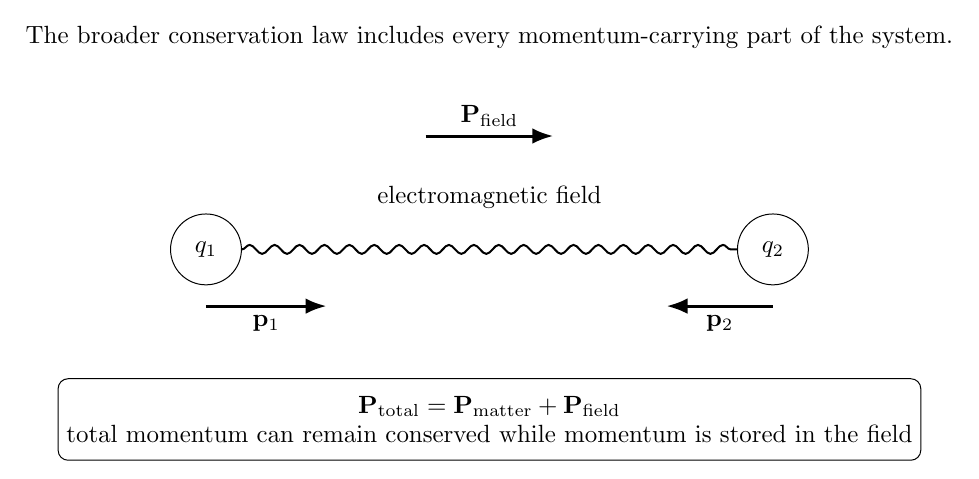
Figure 4. Beyond elementary particle mechanics, momentum may be stored in fields. Mechanical
particle momenta need not by themselves form an equal-and-opposite pair at every instant;
matter plus field momentum obeys the complete balance.
This is why momentum conservation survives as a central principle even in theories where the
elementary Newtonian third-law picture must be generalized.
11. Does momentum conservation imply Newton’s third law?
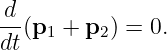
For an isolated two-particle Newtonian system,
Therefore
If Newton’s second law identifies these momentum rates with the mutual forces,
then
So, under these assumptions, conservation of the total momentum of an isolated two-particle
system implies an equal-and-opposite force relation.
But the assumptions matter. If momentum can also be carried by fields or other degrees of
freedom omitted from the two-particle description, conservation of the complete system
does not require the two mechanical forces alone to be equal and opposite at every
instant.
12. Strong and weak forms of the third law
The relation
is sometimes called the weak form of Newton’s third law: the forces are equal and opposite.
A stronger condition additionally requires the two forces to lie along the line joining the particles.
Central Newtonian gravity is an example. The distinction becomes important for angular
momentum: equal-and-opposite forces cancel total internal force, but conservation of
orbital angular momentum from pair forces also requires the internal torques to cancel
appropriately.
For linear momentum conservation, equal-and-opposite internal forces are the relevant
ingredient.
13. Collisions and explosions
Momentum conservation is especially useful when internal forces are large but difficult to model.
During a collision, contact forces can vary rapidly and may be unknown in detail. Nevertheless, if
the collision time is short enough that external impulse is negligible,
The same reasoning applies to explosions and recoil. Internal forces may dramatically alter the
momenta of individual pieces while leaving the vector sum unchanged.
This explains why momentum methods often solve collision problems more easily than direct force
integration.
14. External impulse and the generalized momentum balance
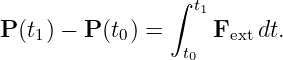
If external forces are not negligible,
Integrating from t0 to t1 gives
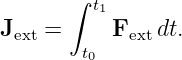
Define the external impulse
Then
Momentum conservation is the special case
This formulation is often more useful experimentally than asking whether the external force is
exactly zero at every instant.
15. Concept map
The logical relationship can be summarized as
The conceptual lesson is equally important:
Newton’s third law describes how momentum is exchanged internally between
interacting parts of a Newtonian system. Conservation of momentum describes
the balance of the complete system.
16. Connections to later physics
This bridge leads naturally to several deeper topics:
- center-of-mass motion: MACM = Fext;
- collisions and impulse: conservation laws avoid detailed contact-force histories;
- angular momentum: internal torque cancellation provides the rotational analogue;
- Lagrangian mechanics and Noether’s theorem: spatial-translation symmetry
explains conserved momentum;
- electromagnetism: fields possess momentum and complete the force-momentum
balance;
- relativity and field theory: energy and momentum become components of a unified
energy-momentum structure.
These topics generalize rather than discard the elementary Newtonian result.
References
References
[1] PhysicsLibrary, Newton’s laws of motion.
[2] PhysicsLibrary, Conservation of momentum.
[3] PhysicsLibrary, Momentum.
[4] John R. Taylor, Classical Mechanics, University Science Books, 2005.
[5] Stephen T. Thornton and Jerry B. Marion, Classical Dynamics of Particles and
Systems, 5th ed., Brooks/Cole, 2004.
[6] Herbert Goldstein, Charles Poole, and John Safko, Classical Mechanics, 3rd ed.,
Addison-Wesley, 2002.
[7] David J. Griffiths, Introduction to Electrodynamics, 4th ed., Pearson, 2013.

![[parent]](https://images.physicslibrary.org/images/uparrow.png)