Modern conventions
We use generalized coordinates qi, generalized velocities qi, and for a natural mechanical system
the Lagrangian
The canonical momenta are
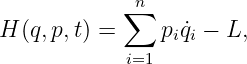
When the Legendre transform is regular, the hamiltonian is
with the velocities expressed in terms of (q,p,t).
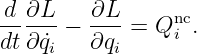
If generalized nonconservative forces are present, they are denoted by Qinc. Then Hamilton’s
equations take the form
In the conservative case Qinc = 0.
Relation with Lagrange’s equations
Start from the Euler–Lagrange equations with nonconservative generalized forces,
Because pi = ∂L∕∂qi, these become
Now differentiate the Hamiltonian,
Therefore
Combining (1) and (2) yields Hamilton’s equations
Autonomous natural systems
If the coordinate transformation is time-independent and
then the Hamiltonian coincides with the total energy,
This is the standard case behind many of Byerly’s examples, even though he originally formulated
the discussion in terms of a momentum-version of the kinetic energy alone.
Interpretation
Hamilton’s equations replace n second-order Euler–Lagrange equations by 2n first-order equations
in phase-space variables (qi,pi). They are not usually computationally shorter for elementary
problems, but they are the natural entrance to canonical transformations, phase space, Poisson
brackets, and modern analytical mechanics.
Modern notation references
The notation and terminology in this modernized transcription follow standard analytical
mechanics conventions, especially:
- H. Goldstein, C. Poole, and J. Safko, Classical Mechanics, 3rd ed., Addison–Wesley,
2002.
- C. Lanczos, The Variational Principles of Mechanics, 4th ed., Dover, 1986.
- J. R. Taylor, Classical Mechanics, University Science Books, 2005.
Source
This article is a modernized restatement of the corresponding portion of William Elwood Byerly,
An Introduction to the Use of Generalized Coördinates in Mechanics and Physics, Ginn and
Company, 1916, Chapter II. The 1916 source work is in the public domain in the United
States.