GRE Physics Companion: Variable Acceleration Motion
This companion is designed for rapid review after M01-06. The emphasis is on recognizing whether
a derivative, an area, or the chain rule relation a = v dv∕dx is the fastest route.
1 Fast triage
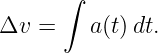
If acceleration is given as a function of time,
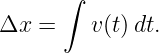
If velocity is then needed for displacement,
If acceleration is supplied as a function of position and time is absent, try
If a graph is supplied, remember that area under a(t) gives change in velocity, while area under
v(t) gives displacement.
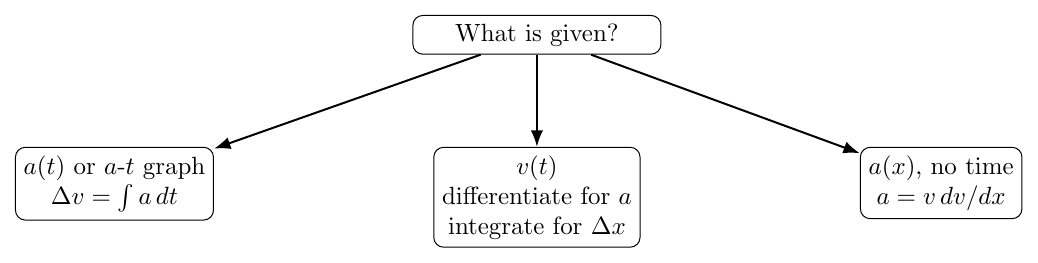
Figure 1. GRE speed triage for variable acceleration: identify which variable the acceleration
depends on before choosing the calculus relation.
2 Common traps
A variable acceleration cannot be replaced by one instantaneous value in a constant acceleration
formula unless the problem explicitly justifies that approximation.
The area under an acceleration time graph is Δv, not v itself. Initial velocity must still be
added.
When an integrated equation gives v2, the square root gives speed magnitude. The physical
direction determines the sign of velocity.
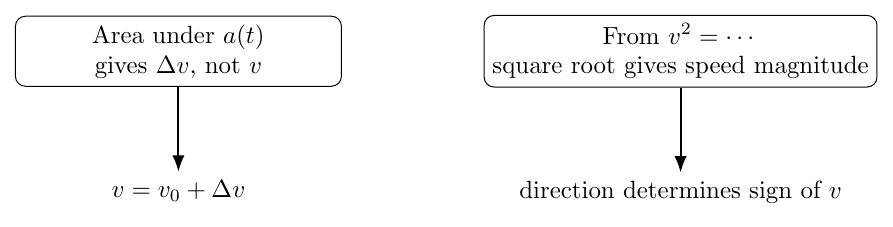
Figure 2. Two recurring test traps: integration requires the initial value, and a result for v2 does
not by itself determine the sign of velocity.
3 Worked GRE example 1: area under acceleration
A particle has v(0) = 4 m/s. Its acceleration rises linearly from 0 to 6 m/s2 during the first 3 s.
Find v(3).
The change in velocity is the triangular area under the acceleration time graph:
Therefore
4 Worked GRE example 2: position dependent acceleration
A particle has
It starts from rest at x0 = 2 m. What is its speed when it reaches x = 0?
Use
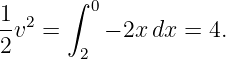
Integrating,
Thus
so the speed is
5 GRE speed questions
M01-06G-Q01
A particle has a(t) = 4t m/s2 and v(0) = 1 m/s. Its velocity at t = 2 s is
(A) 5 m/s (B) 8 m/s (C) 9 m/s (D) 12 m/s (E) 17 m/s.
M01-06G-Q02
The signed area under an acceleration time graph between t1 and t2 equals
(A) displacement; (B) distance; (C) change in velocity; (D) average velocity; (E) jerk.
M01-06G-Q03
For one-dimensional motion with acceleration specified as a(x), which identity is most useful for
eliminating time?
(A) a = dx∕dt; (B) a = v dv∕dx; (C) v = ada∕dx; (D) v = xdx∕dt; (E) a = d2v∕dx2.
M01-06G-Q04
A particle satisfies a(t) = 6t m/s2 and starts from rest. Which expression gives its velocity?
(A) v = 6t; (B) v = 3t2; (C) v = 6t2; (D) v = 2t3; (E) v = t3.
6 Answers and rationales
Q01: (C). Integrate: Δv = ∫
024tdt = 8 m/s, then add v
0 = 1 m/s.
Q02: (C). Since a = dv∕dt, integration over time gives Δv.
Q03: (B). The chain rule gives a = (dv∕dx)(dx∕dt) = v dv∕dx.
Q04: (B). v = ∫
6tdt = 3t2 + C and v(0) = 0 gives C = 0.
References
[1] J. R. Taylor, Classical Mechanics, University Science Books, 2005. Used as a scope
and notation reference.
[2] University of California, Davis, Physics 9A: Classical Mechanics, LibreTexts, CC
BY-SA 4.0.

![[parent]](https://images.physicslibrary.org/images/uparrow.png)