Physics Library
 An open source physics library
Encyclopedia | Forums | Docs | Random  

[parent] GRE Physics Companion: Rotational Kinematics of Rigid Bodies

(Example)

GRE Physics Companion: Rotational Kinematics of Rigid Bodies

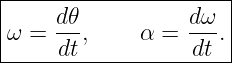
For fixed-axis rotation,

|---------------------|
ω =  d𝜃,     α =  dω. |
-----dt-----------dt---
(1)

For a point at perpendicular radius r⊥,

|-----------------------------------------|
v = r  |ω |,     a =  r |α|,    a  =  r ω2. |
-----⊥----------t----⊥----------n----⊥-----
(2)

PIC

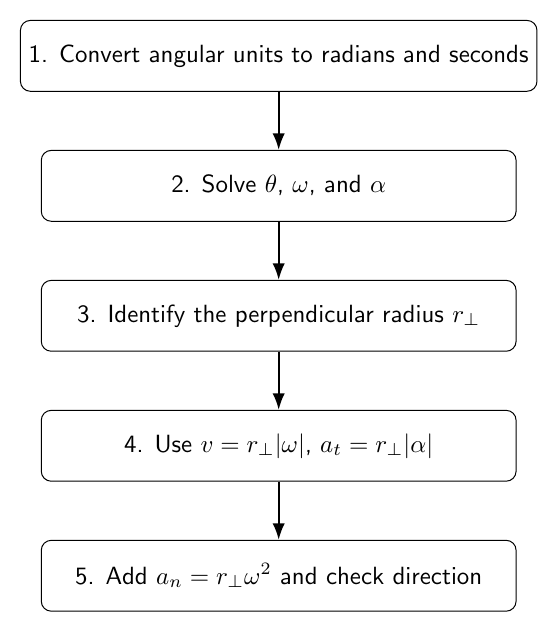
Figure 1. A compact strategy for fixed-axis rotational-kinematics problems. Work in radians, solve the angular motion first, then convert to point motion using the perpendicular radius.

1 High-value GRE facts

  1. One revolution is 2π radians.
  2. ω = d𝜃∕dt and α = dω∕dt.
  3. Under constant α, rotational kinematics mirrors one-dimensional constant-acceleration motion.
  4. All points on a rigid body share the same ω and α in fixed-axis rotation.
  5. Linear speed increases with perpendicular radius: v = r⊥|ω|.
  6. Tangential acceleration is at = r⊥|α|.
  7. Normal acceleration is an = r⊥ω2.
  8. A point on the fixed axis has zero linear speed.
  9. Constant angular speed still produces nonzero normal acceleration away from the axis.
  10. Positive α does not always mean increasing angular speed.

Part I: Original GRE-style problems

Problem 1: revolutions to radians

A wheel rotates through 3 complete revolutions. Its angular displacement is

  1. 3 rad
  2. 3π rad
  3. 6π rad
  4. 9π rad
  5. 12π rad

Problem 2: frequency and angular speed

A rotor spins at 10 Hz. Its angular speed is

  1. 5π rad∕s
  2. 10π rad∕s
  3. 20π rad∕s
  4. 40π rad∕s
  5. 100π rad∕s

Problem 3: constant angular acceleration

A wheel starts from rest with constant angular acceleration 4 rad∕s2. After 3 s its angular speed is

  1. 4 rad∕s
  2. 7 rad∕s
  3. 8 rad∕s
  4. 12 rad∕s
  5. 36 rad∕s

Problem 4: angular displacement

For the wheel in Problem 3, the angular displacement after 3 s is

  1. 6 rad
  2. 12 rad
  3. 18 rad
  4. 24 rad
  5. 36 rad

Problem 5: two radii

Points A and B lie on the same rotating disk at radii r and 2r. The ratio of their speeds is

  1. vB∕vA = 1∕2
  2. vB∕vA = 1
  3. vB∕vA = 2
  4. vB∕vA = 4
  5. vB∕vA = 8

Problem 6: normal acceleration

A point is 0.50 m from the axis of a wheel rotating at 6 rad∕s. Its normal acceleration is

  1. 3 m∕s2
  2. 6 m∕s2
  3. 12 m∕s2
  4. 18 m∕s2
  5. 36 m∕s2

Problem 7: tangential acceleration

A point at radius 0.40 m has angular acceleration magnitude 5 rad∕s2. Its tangential acceleration magnitude is

  1. 1 m∕s2
  2. 2 m∕s2
  3. 4 m∕s2
  4. 5 m∕s2
  5. 12.5 m∕s2

Problem 8: constant angular speed

A point away from the axis of a rigid body rotates with constant nonzero angular speed. Its acceleration is

  1. zero
  2. purely tangential
  3. purely inward normal
  4. parallel to its velocity
  5. always outward

Problem 9: sign of angular acceleration

A wheel has ω = −8 rad∕s and α = −2 rad∕s2. Its angular speed is

  1. increasing
  2. decreasing
  3. constant
  4. zero
  5. impossible to determine

Problem 10: point on axis

A material point lies exactly on a fixed rotation axis. Its tangential speed is

  1. |ω|
  2. ω2
  3. r⊥|ω|
  4. zero
  5. infinite

Problem 11: radial scaling of acceleration

Two points on the same disk have radii r and 3r. At one instant the disk has the same ω and α for both points. The ratio of their total acceleration magnitudes is

  1. 1∕3
  2. 1
  3. 3
  4. 9
  5. depends on the signs of ω and α

Problem 12: angular graph

The area under an angular-velocity-versus-time graph equals

  1. angular acceleration
  2. angular displacement
  3. tangential speed
  4. normal acceleration
  5. torque

Part II: Complete worked solutions

Solution 1

Each revolution is 2π radians:

Δ 𝜃 = 3(2π) = 6π rad.
(3)

Answer: (C).

Solution 2

ω = 2πf  = 20π  rad ∕s.
(4)

Answer: (C).

Solution 3

ω  = ω0 + αt = 0 + (4)(3) = 12 rad∕s.
(5)

Answer: (D).

Solution 4

Δ𝜃 = ω0t + 1
--
2αt2 (6)
= 1-
2(4)(9) (7)
= 18 rad. (8)

Answer: (C).

Solution 5

All points share the same angular speed:

v = r |ω |.
(9)

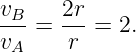
Thus

v     2r
-B- = ---=  2.
vA     r
(10)

Answer: (C).

Solution 6

an = r ω2 = (0.50)(36) = 18 m∕s2.
(11)

Answer: (D).

Solution 7

a  = r|α| = (0.40)(5) = 2.0 m ∕s2.
  t
(12)

Answer: (B).

Solution 8

Constant angular speed means

α = 0,
(13)

so tangential acceleration is zero. Normal acceleration remains

        2
an = rω  .
(14)

Answer: (C).

Solution 9

The signed angular velocity is negative and becomes more negative because α < 0. Therefore |ω| increases. Answer: (A).

Solution 10

On the axis,

r⊥ = 0.
(15)

Hence

v = r⊥|ω| = 0.
(16)

Answer: (D).

Solution 11

At fixed ω and α,

     √ --------
a = r  α2 + ω4.
(17)

Thus total acceleration magnitude is proportional to radius:

aB-=  3.
aA
(18)

Answer: (C).

Solution 12

Since

ω = d-𝜃,
     dt
(19)

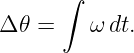
integration gives

      ∫

Δ 𝜃 =    ω dt.
(20)

Answer: (B).

2 GRE checklist

  1. Convert revolutions and degrees to radians before using rotational-kinematics equations.
  2. Solve angular motion first when all points share the same fixed-axis rotation.
  3. Convert to point motion using r⊥.
  4. Keep tangential and normal acceleration distinct.
  5. Constant ω does not mean zero acceleration away from the axis.
  6. Check signs of both ω and α before deciding whether angular speed increases.
  7. For constant α, use the same algebraic structure as constant-acceleration translation.
  8. Distinguish common angular velocity from position-dependent linear velocity.

References

References

[1]   J. R. Taylor, Classical Mechanics, University Science Books, 2005.

[2]   D. Kleppner and R. Kolenkow, An Introduction to Mechanics, 2nd ed., Cambridge University Press, 2014.

[3]   OpenStax, University Physics, Volume 1, Rice University, 2016.


"GRE Physics Companion: Rotational Kinematics of Rigid Bodies" is owned by bloftin.
(view preamble)
View style:
Other names:  M05-01G
Keywords:  GRE physics, rigid body, rotational kinematics, angular displacement, angular velocity, angular acceleration, tangential speed, centripetal acceleration, fixed-axis rotation

This object's parent.

Cross-references: algebraic, angular velocity, graph, material point, velocity, magnitude, angular acceleration, spins, angular displacement, Normal, acceleration, speed, rigid body, kinematics, motion, work, fixed-axis rotation

This is version 1 of GRE Physics Companion: Rotational Kinematics of Rigid Bodies, born on 2026-10-05.
Object id is 1419, canonical name is GREPhysicsCompanionRotationalKinematicsOfRigidBodies.
Accessed 2 times total.

Classification:
Physics Classification: 45.40.-f (Dynamics and kinematics of rigid bodies)
 45.20.Dd (Newtonian mechanics)

Pending Errata and Addenda

None.

Discussion

No messages.

Interact