|
|
|
|||||||
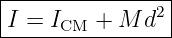
for a shifted parallel axis, and
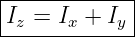
for a planar lamina with mutually perpendicular axes through the same point.
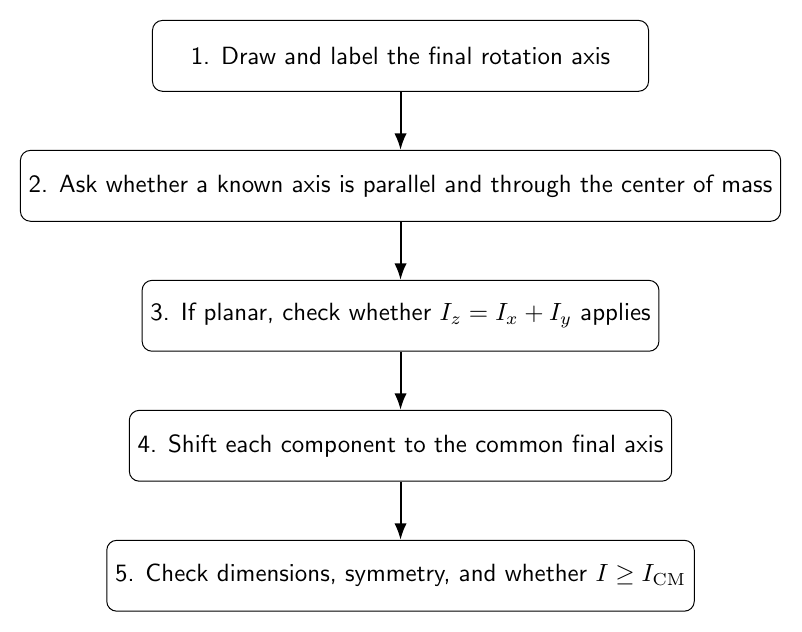
Figure 1. A compact strategy for axis-theorem problems. Identify the body geometry and the final axis before deciding whether the parallel-axis theorem, perpendicular-axis theorem, both, or direct integration applies.
1 High-value GRE facts
Part I: Original GRE-style problems
Problem 1: shifted axisA body has ICM = 2I0 about an axis through its center of mass. A parallel axis is displaced by d, and Md2 = 3I 0. The shifted-axis moment is
Problem 2: minimum parallel-axis inertiaAmong all axes parallel to a chosen direction, the smallest moment of inertia occurs for the axis
Problem 3: rod about an endA uniform thin rod of mass M and length L has moment of inertia about a perpendicular axis through one end equal to
Problem 4: disk tangent normal axisA uniform disk of mass M and radius R rotates about an axis perpendicular to the disk and tangent to its rim. Its moment of inertia is
Problem 5: disk diameterA uniform thin disk has moment of inertia about any diameter equal to
Problem 6: ring diameterA thin ring has moment of inertia about any diameter equal to
Problem 7: applicabilityWhich body permits direct use of the perpendicular-axis theorem?
Problem 8: rectangular plateA thin rectangular plate has central in-plane moments Ix = 2I0 and Iy = 5I0. Its perpendicular central moment is
Problem 9: disk tangent in-plane axisA thin disk rotates about a tangent line lying in its plane. Its moment of inertia is
Problem 10: inverse shiftA body has I = 10 kg m2 about a shifted axis. Its mass is M = 8 kg and the parallel-axis separation is d = 0.50 m. The center of mass moment is
Problem 11: radius of gyrationIf kg,CM = 0.30 m and a parallel axis is displaced by d = 0.40 m, the new radius of gyration is
Problem 12: wrong theoremA student tries to use Iz = Ix + Iy for a solid sphere. The main error is that
Part II: Complete worked solutions
Solution 1The parallel-axis theorem gives
Answer: (D).
Solution 2Since
and Md2 ≥ 0, the minimum occurs at d = 0, which is the center of mass axis. Answer: (B).
Solution 3
Answer: (D).
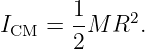
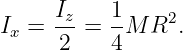
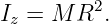
Solution 4For the central perpendicular axis,
Shift by R:
Answer: (E).
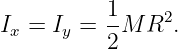
Solution 5For a thin disk,
Symmetry gives Ix = Iy, so
Answer: (B).
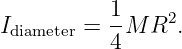
Solution 6For a thin ring,
By symmetry,
Answer: (B).
Solution 7The perpendicular-axis theorem requires a planar lamina. A thin rectangular plate satisfies that condition. Answer: (C).
Solution 8
Answer: (C).
Solution 9First use the perpendicular-axis theorem to obtain the central diameter moment:
Then shift by R:
Answer: (D).
Solution 10
Answer: (D).
Solution 11Use
Then
Answer: (C).
Solution 12The perpendicular-axis theorem relies on all mass lying in one plane. A solid sphere is three-dimensional. Answer: (B).
2 GRE checklist
References
References
"GRE Physics Companion: Parallel-Axis and Perpendicular-Axis Theorems" is owned by bloftin.
This object's parent. Cross-references: theorem, radius of gyration, shifted axis, solid, speed, mass, moment of inertia, center of mass, perpendicular-axis theorem, parallel-axis theorem, relations This is version 1 of GRE Physics Companion: Parallel-Axis and Perpendicular-Axis Theorems, born on 2026-10-17. Object id is 1473, canonical name is GREPhysicsCompanionParallelAxisAndPerpendicularAxisTheorems. Accessed 4 times total. Classification:
|
|
|
|
Pending Errata and AddendaNone.
|
DiscussionNo messages.
|
Interact |
![[parent]](https://images.physicslibrary.org/images/uparrow.png)