
|
|
|
|||||||
The field is related to potential by
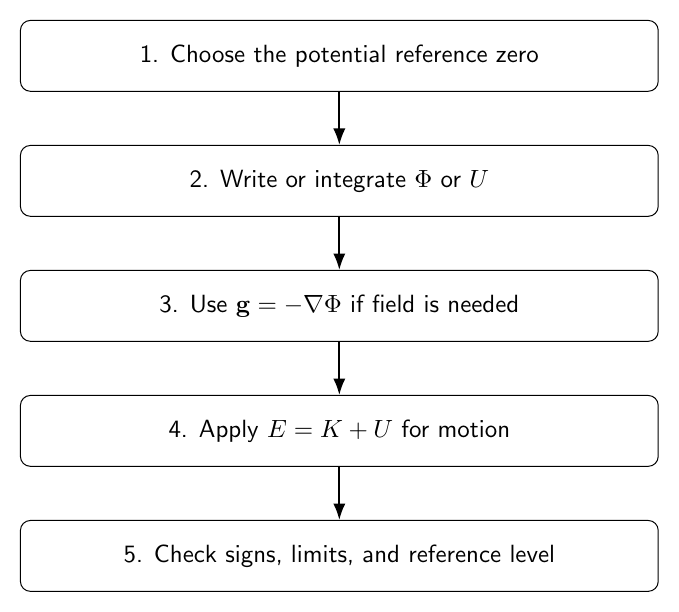
Figure 1. A compact potential strategy: choose the reference zero, write or integrate the potential, differentiate to recover the field when needed, and use energy conservation for motion.
1 High-value GRE facts
Part I: Original GRE-style problems
Problem 1: sign of point-mass potential energyWith U(∞) = 0, the gravitational potential energy of two positive masses at finite separation is
Problem 2: gravitational potentialThe gravitational potential of a point mass M is
Problem 3: field from potentialThe Gravitational Field is related to gravitational potential by
Problem 4: interior shell potentialInside a thin uniform spherical shell of radius R and mass M, the gravitational potential is
Problem 5: uniform-sphere center potentialAt the center of a uniform solid sphere,
equals
Problem 6: near-surface approximationThe approximation
is best when
Problem 7: escape speedThe minimum Newtonian escape speed from radius r is
Problem 8: circular versus escape speedAt the same radius,
is
Problem 9: equipotential geometryThe equipotential surfaces of an isolated point mass are
Problem 10: zero fieldAt a point where the gravitational field is zero, the gravitational potential
Problem 11: scalar superpositionFor several point masses, gravitational potential is found by
Problem 12: pair countingFor three point masses, the number of distinct pairwise gravitational-potential-energy terms is
Part II: Complete worked solutions
Solution 1With zero at infinity,
for finite positive r. Answer: (C).
Solution 2Potential is potential energy per unit test mass:
Answer: (A).
Solution 3A conservative gravitational field points toward decreasing potential:
Answer: (B).
Solution 4The shell interior field is zero, so the potential is constant and equals its surface value:
Answer: (C).
Solution 5For a uniform sphere,
Answer: (B).
Solution 6The constant-g approximation is accurate when the height change is small compared with the body’s radius. Answer: (C).
Solution 7Set the minimum escape energy equal to zero:
Thus
Answer: (B).
Solution 8Since
Answer: (C).
Solution 9Point-mass potential depends only on radius, so constant-potential surfaces are spheres. Answer: (C).
Solution 10Zero field means zero gradient of potential, not necessarily zero potential itself. Answer: (C).
Solution 11Potential is a scalar, so individual potentials add algebraically. Answer: (B).
Solution 12The distinct pairs are (1, 2), (1, 3), and (2, 3). Answer: (C).
2 GRE checklist
References
References
"GRE Physics Companion: Gravitational Potential Energy and Gravitational Potential" is owned by bloftin.
This object's parent. Cross-references: gradient, escape energy, gravitational field, unit, potential energy, vector addition, escape speed, solid, spherical shell, The Gravitational Field, gravitational potential energy, masses, system, energy, scalar, gravitational potential, energy conservation This is version 1 of GRE Physics Companion: Gravitational Potential Energy and Gravitational Potential, born on 2026-10-31. Object id is 1556, canonical name is GREPhysicsCompanionGravitationalPotentialEnergyAndGravitationalPotential. Accessed 3 times total. Classification:
|
|
|
|
Pending Errata and AddendaNone.
|
DiscussionNo messages.
|
Interact |


 .


