GRE Physics Companion: Free-Body Diagrams
This companion focuses on rapid force-model recognition. The central rule is simple:
A Free-body diagram contains only the external forces acting on the chosen body
or system.
Once the FBD is correct, apply
1 Fast triage
A fast GRE workflow is:
- choose the body;
- list the external interactions;
- draw one force for each interaction;
- choose useful axes;
- write the component equations.
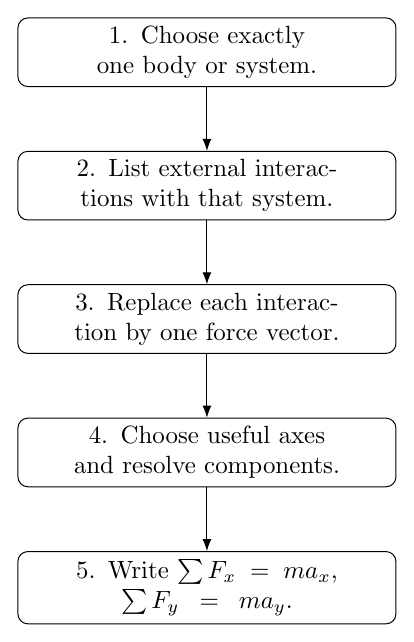
Figure 1. GRE-speed FBD workflow. The system choice comes before force identification and
component equations.
2 Common traps
A velocity arrow is not a force. An acceleration arrow is not a force. A vector such as ma is not an
additional physical interaction.
Do not place both members of a Newton-third-law pair on one body’s FBD.
Do not assume
unless the force equation actually gives that result.
Do not assume
for static friction. Static friction adjusts to the value required, up to its maximum.
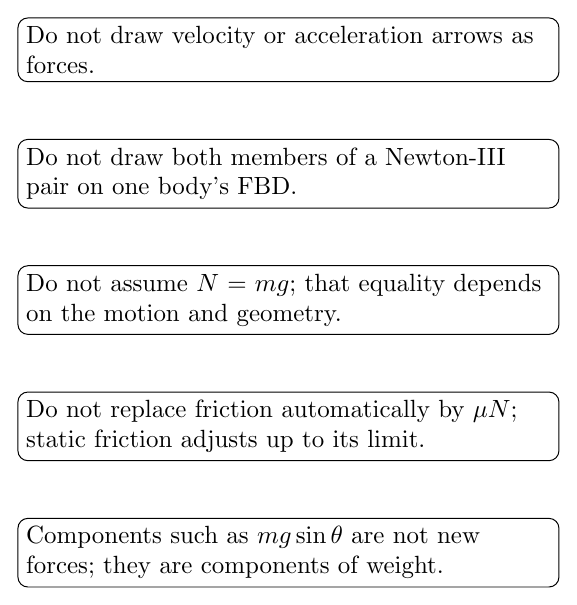
Figure 2. Common FBD traps: kinematic arrows are not forces, Newton-third-law partners act on
different bodies, normal force need not equal weight, and static friction need not equal its limiting
value.
3 Worked GRE example 1: elevator scale
A person of mass m stands on a scale in an elevator accelerating upward with magnitude a. Which
expression gives the scale reading?
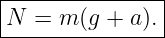
The FBD contains the upward normal force N and downward weight mg.
Taking upward as positive,
Thus
The scale reading is larger than the person’s weight.
4 Worked GRE example 2: block on a frictionless incline
A block rests on a frictionless incline of angle 𝜃. Which force component accelerates the block down
the plane?
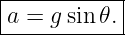
The actual forces are the weight mg and the normal force N. Choosing an axis along the plane, the
component of weight parallel to the plane is
Therefore
so
The quantity mg sin 𝜃 is a component of the weight, not a separate force.
5 GRE-speed questions
- A book rests on a horizontal table. Which pair of forces belongs on the book’s FBD?
(A) weight and the book’s force on the table (B) weight and the table’s normal force
on the book (C) the two members of the table-book Newton-III pair (D) normal force
only.
- A person in an elevator accelerates upward. The normal force from the floor is (A) less
than mg (B) equal to mg (C) greater than mg (D) zero.
- A block slides right on a rough horizontal floor. Kinetic friction on the block points
(A) right (B) left (C) upward (D) downward.
- A CAR moves at constant speed around a level circular turn. Which statement is
correct? (A) a separate centripetal force must be added to the FBD (B) the net inward
force is supplied by real interactions such as friction (C) the net force is zero because
speed is constant (D) velocity points inward.
- A block is at rest while a horizontal 8 N force acts to the right. Static friction is
sufficient to prevent motion. The static friction magnitude is (A) 0 (B) 8 N (C) μsN
necessarily (D) mg.
- A block rests on a frictionless incline. Which vector should be drawn directly downward
on the FBD? (A) normal force (B) mg sin 𝜃 (C) mg cos 𝜃 (D) weight mg.
- Two blocks are analyzed as one combined system. Their mutual contact forces are (A)
external and must be added separately (B) internal and cancel in the combined force
sum (C) absent physically (D) equal to the total external force.
- Which arrow does not belong on a standard FBD of a projectile after release when
air resistance is neglected? (A) weight (B) velocity (C) neither weight nor velocity (D)
both weight and velocity are forces.
6 Answers and rationales
- B. Both forces act on the book.
- C. N − mg = ma with a > 0 gives N > mg.
- B. Kinetic friction opposes relative sliding at the contact.
- B. “Centripetal” describes the inward net-force requirement rather than an extra force.
- B. Static friction adjusts to 8 N to balance the applied force.
- D. The actual gravitational force points vertically downward; the sine and cosine terms
are components.
- B. Internal Newton-third-law interaction forces cancel when the bodies are included in
one system.
- B. Velocity is kinematic information, not a force. Weight remains on the FBD.
References
[1] PhysicsLibrary, M02-02, Free-Body Diagrams.
[2] J. Moore et al., Mechanics Map, free-body-diagram materials, CC BY-SA 4.0.

![[parent]](https://images.physicslibrary.org/images/uparrow.png)