|
|
|
|||||||
and
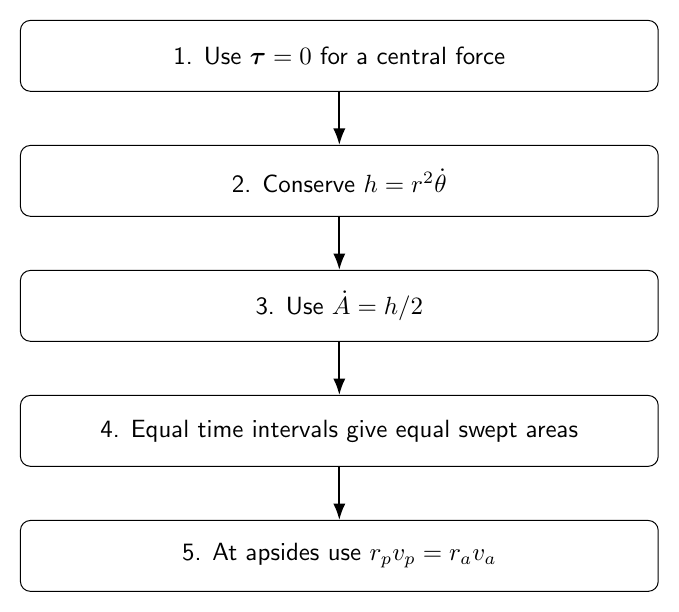
Figure 1. A compact area-law strategy: use zero torque to conserve angular momentum, convert h to areal velocity, and apply equal areas over equal time intervals.
1 High-value GRE facts
Part I: Original GRE-style problems
Problem 1: central force torqueFor a central force, the torque about the force center is
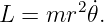
Problem 2: angular momentumFor planar motion, the angular-momentum magnitude is
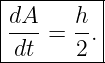
Problem 3: areal velocityIf specific angular momentum is h, the areal velocity is
Problem 4: angular rateFor fixed h, the angular rate is
Problem 5: equal areasKepler’s second law states that equal swept areas correspond to equal
Problem 6: periapsis versus apoapsisIf ra = 2rp, then the apsidal speeds satisfy
Problem 7: generality of the area lawConstant areal velocity follows from
Problem 8: doubled radiusAt one point on an orbit the radius is twice that at another point. With the same h, the angular-rate ratio is
Problem 9: radial motionFor purely radial central force motion,
Problem 10: ellipse periodFor a known ellipse of area πab and specific angular momentum h, the period is
Problem 11: apsidal velocity directionAt periapsis of a nonradial orbit, the instantaneous velocity is
Problem 12: two-body relative motionIn the exact two-body problem, the relative areal velocity is
Part II: Complete worked solutions
Solution 1A central force is parallel or antiparallel to r, so
Answer: (B).
Solution 2The transverse contribution gives
Answer: (B).
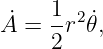
Solution 3Since
and
we obtain
Answer: (C).
Solution 4Angular-momentum conservation gives
Answer: (B).
Solution 5Constant areal velocity means area is proportional to elapsed time. Answer: (D).
Solution 6At the apsides,
If ra = 2rp, then vp = 2va. Answer: (C).
Solution 7The proof requires only zero torque, which is true for every central force. Answer: (C).
Solution 8Because
doubling radius divides angular rate by four. Answer: (B).
Solution 9Pure radial motion has
Therefore
Answer: (A).
Solution 10One orbit sweeps the full area:
Thus
Answer: (B).
Solution 11At periapsis,
so the velocity is transverse. Answer: (B).
Solution 12The relative angular momentum is
Thus
Answer: (B).
2 GRE checklist
References
References
"GRE Physics Companion: Angular Momentum, Areal Velocity, and Kepler's Second Law" is owned by bloftin.
This object's parent. Cross-references: mass, relations, formula, velocity, period, energy, angular displacements, speeds, specific angular momentum, magnitude, Kepler's second law, swept areas, force, areal velocity, angular momentum, torque, central force This is version 1 of GRE Physics Companion: Angular Momentum, Areal Velocity, and Kepler's Second Law, born on 2026-10-31. Object id is 1562, canonical name is GREPhysicsCompanionAngularMomentumArealVelocityAndKeplersSecondLaw. Accessed 6 times total. Classification:
|
|
|
|
Pending Errata and AddendaNone.
|
DiscussionNo messages.
|
Interact |