|
|
|
|||||||
The pressure and particle-velocity amplitudes satisfy
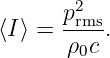
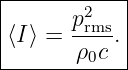
for positive-direction propagation. The average intensity is
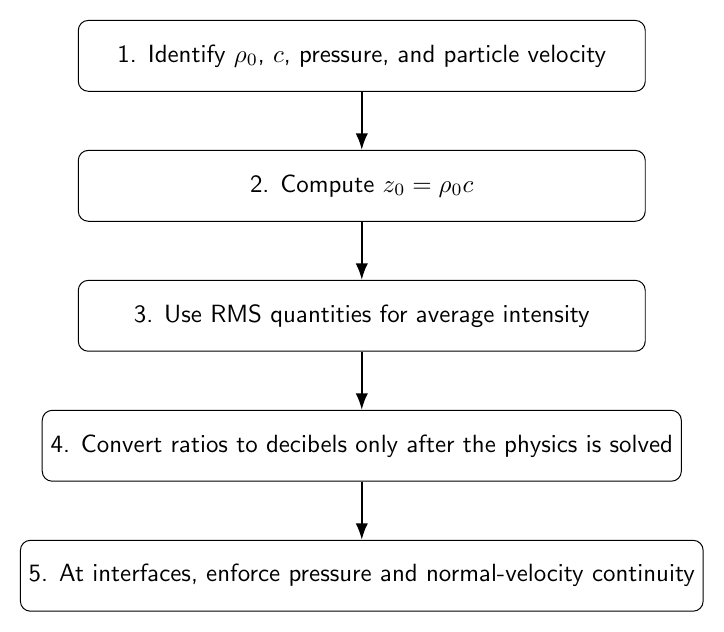
Figure 1. A compact acoustics strategy: identify the medium properties, compute c and ρ0c, connect pressure to particle velocity, use RMS quantities for intensity, and apply pressure and velocity continuity at an interface.
1 High-value GRE facts
Part I: Original GRE-style problems
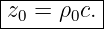
Problem 1: characteristic impedanceFor a progressive plane wave in a fluid, the characteristic specific acoustic impedance is
Problem 2: intensityThe average intensity of a harmonic plane wave is
Problem 3: right-moving pressure and velocityFor a right-moving progressive plane wave,
Problem 4: intensity levelIncreasing intensity by a factor of
changes the sound intensity level by
Problem 5: pressure levelIncreasing RMS pressure by a factor of
at fixed impedance changes sound pressure level by
Problem 6: distance doublingFor an ideal isotropic point source in a lossless free field, doubling distance changes the intensity level by approximately
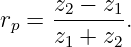
Problem 7: pressure reflectionAt Normal incidence from medium 1 to medium 2, the pressure reflection coefficient is
Problem 8: matched interfaceIf
then the pressure reflection coefficient is
Problem 9: rigid wallAt an ideal rigid wall,
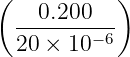
Problem 10: air intensityTake
and
The intensity is closest to
Problem 11: pressure levelFor
and
the sound pressure level is
Problem 12: two equal incoherent sourcesTwo independent incoherent sources each produce intensity
Together they increase the level by approximately
Part II: Complete worked solutions
Solution 1For a progressive plane wave,
Answer: (B).
Solution 2Using RMS pressure,
Answer: (B).
Solution 3For positive-direction propagation,
Thus pressure and particle velocity are in phase. Answer: (B).
Solution 4
Answer: (C).
Solution 5
Answer: (D).
Solution 6Ideal spherical spreading gives
Doubling distance gives
Answer: (B).
Solution 7Pressure and normal particle-velocity continuity give
Answer: (B).
Solution 8If
then
Answer: (C).
Solution 9A rigid wall requires
Thus particle velocity is a node and pressure is an antinode. Answer: (B).
Solution 10First,
Then
Answer: (B).
Solution 11
Answer: (D).
Solution 12The total intensity is
Thus
Answer: (B).
2 GRE checklist
References
References
[1] PhysicsLibrary, M06-10, Fourier Analysis, Wave Packets, and Dispersion. [2] PhysicsLibrary, M06-09, Waves on Strings: Reflection, Transmission, and Mechanical Impedance. [3] A. P. French, Vibrations and Waves, W. W. Norton, 1971. [4] L. E. Kinsler, A. R. Frey, A. B. Coppens, and J. V. Sanders, Fundamentals of Acoustics, 4th ed., Wiley, 2000. "GRE Physics Companion: Acoustic Waves, Sound Intensity, and Acoustic Impedance" is owned by bloftin.
This object's parent. Cross-references: displacement, acoustic pressure, formula, speed, Normal, sound pressure level, impedance, sound intensity level, frequencies, phase, harmonic, specific acoustic impedance, node, antinode, velocity, particle velocity, amplitudes, acoustic wave This is version 1 of GRE Physics Companion: Acoustic Waves, Sound Intensity, and Acoustic Impedance, born on 2026-10-23. Object id is 1524, canonical name is GREPhysicsCompanionAcousticWavesSoundIntensityAndAcousticImpedance. Accessed 5 times total. Classification:
|
|
|
|
Pending Errata and AddendaNone.
|
DiscussionNo messages.
|
Interact |


 .