
|
|
|
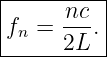
|||||||
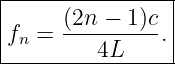
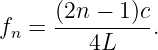
For an ideal closed-open pipe,
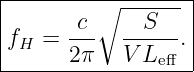
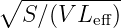
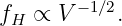
For a Helmholtz resonator,
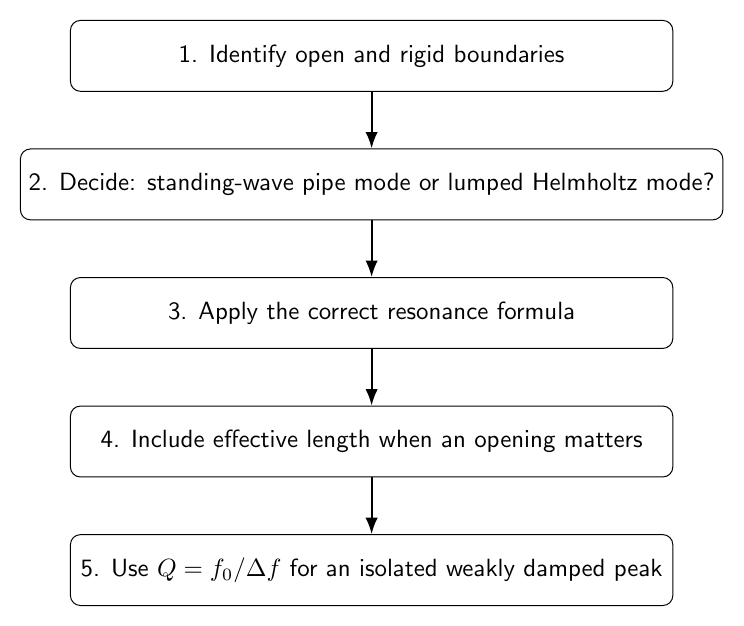
Figure 1. A compact resonance strategy: identify the boundary conditions, determine whether the system is distributed or lumped, choose the correct resonance formula, then include end correction or damping when required.
1 High-value GRE facts
Part I: Original GRE-style problems
Problem 1: open-open fundamentalAn ideal pipe of length
is open at both ends. Its fundamental frequency is
Problem 2: closed-open fundamentalA pipe of length
is rigidly closed at one end and open at the other. Its fundamental frequency is
Problem 3: open-end boundaryAt an ideal open pipe end,
Problem 4: closed-open harmonic contentThe first three ideal resonances of a closed-open pipe are proportional to
Problem 5: end correctionIncluding a positive open-end correction generally
Problem 6: numerical open pipeFor
the ideal open-open fundamental is closest to
Problem 7: Helmholtz scaling with volumeIf the cavity volume of a Helmholtz resonator is increased by a factor of
with all other parameters fixed, its resonance frequency becomes
Problem 8: Helmholtz scaling with neck areaIf neck area is increased by a factor of
while cavity volume and effective neck length remain fixed, the Helmholtz frequency becomes
Problem 9: effective neck massThe effective moving mass in the elementary Helmholtz model is
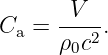
Problem 10: acoustic complianceThe acoustic compliance of the cavity is
Problem 11: numerical Helmholtz resonanceA resonator has
and
Take
The resonance frequency is closest to
Problem 12: quality factorA resonance has
and half-power frequencies
and
Its quality factor is
Part II: Complete worked solutions
Solution 1For an open-open pipe,
Answer: (B).
Solution 2For a closed-open quarter-wave resonator,
Answer: (A).
Solution 3An ideal open end is approximately a pressure node and particle-velocity antinode. Answer: (B).
Solution 4The closed-open spectrum is
Thus the sequence is
times the fundamental. Answer: (B).
Solution 5A positive end correction increases the effective acoustic length. Since
the resonance frequency decreases. Answer: (A).
Solution 6
Answer: (C).
Solution 7For a Helmholtz resonator,
Therefore multiplying
by
divides the frequency by
Answer: (D).
Solution 8Since
multiplying
by
doubles the resonance frequency. Answer: (D).
Solution 9The neck plug has approximate volume
Thus
Answer: (B).
Solution 10The cavity pressure-volume relation gives
Answer: (B).
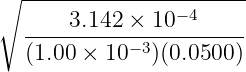
Solution 11
Answer: (C).
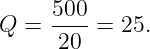
Solution 12The bandwidth is
Thus
Answer: (D).
2 GRE checklist
References
References
[1] PhysicsLibrary, M06-11, Acoustic Waves, Sound Intensity, and Acoustic Impedance. [2] PhysicsLibrary, M06-03, Driven Harmonic Motion and Resonance. [3] A. P. French, Vibrations and Waves, W. W. Norton, 1971. [4] L. E. Kinsler, A. R. Frey, A. B. Coppens, and J. V. Sanders, Fundamentals of Acoustics, 4th ed., Wiley, 2000. "GRE Physics Companion: Acoustic Resonance in Pipes and Helmholtz Resonators" is owned by bloftin.
This object's parent. Cross-references: relation, spectrum, acoustic compliance, mass, effective neck length, parameters, volume, speed, frequency, particle velocity, fundamental frequency, resonance frequency, harmonics, antinode, node, end correction, formula, system, boundary, resonance, Helmholtz resonator This is version 1 of GRE Physics Companion: Acoustic Resonance in Pipes and Helmholtz Resonators, born on 2026-10-23. Object id is 1526, canonical name is GREPhysicsCompanionAcousticResonanceInPipesAndHelmholtzResonators. Accessed 4 times total. Classification:
|
|
|
|
Pending Errata and AddendaNone.
|
DiscussionNo messages.
|
Interact |

 .



















 .