An electric dipole is the simplest source with zero total charge and a nonzero first moment.
It illustrates how cancellation changes the distance dependence of a field. The same
source-to-observer geometry then carries over to extended charge distributions.
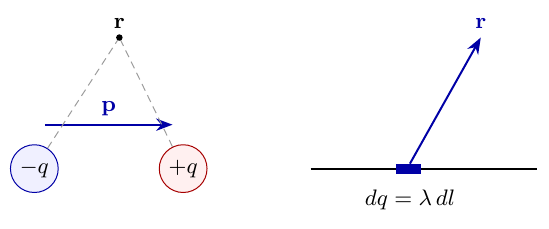
Figure 1. A dipole consists of two source points. For a continuous source, divide the charge into
elements before adding their fields.
1 The dipole moment
For charges qi at positions ri measured from an origin, define p = ∑
iqiri. For a pair +q,−q with
d = r+ − r−, this gives p = qd. It has units of C m. If a new origin is at a, the new moment
is
Neutral sources have the same dipole moment for every origin. This also holds for a continuous
source with p = ∫
r′dq. ES02E1 works the translation in components.
2 Torque and force on a dipole
In a uniform external E, the two forces are qE and −qE. They sum to zero. Taking the torque
about the midpoint gives
The orientation energy is U = −p ⋅ E up to a constant. Parallel alignment is a minimum. If the
field varies little over the separation, Taylor expand the two fields about the midpoint. Their
difference gives the leading force F = (p ⋅∇)E. For an electrostatic external field, equality of the
cross derivatives of its potential also gives F = ∇(p ⋅ E) for a fixed moment.
3 The exact pair and its far field
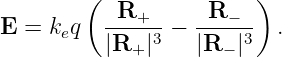
Put the two charges at ±d∕2, and let R± = r ∓ d∕2. Exact superposition gives
To see the cancellation at large r, expand 1∕|r − s| = r−1 + (s ⋅r)r−2 +  for each source. The
monopole terms cancel. The first surviving potential and its field are
On the positive dipole axis the field magnitude is 2kep∕r3. On the equator the field is −k
ep∕r3,
although the potential there is zero. These formulas require r ≫|d|. ES02E3 derives the angular
field and estimates the approximation error.
4 From a sum to a source integral
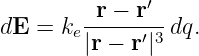
At observation point r each element dq at r′ adds
Choose dq = λdl, σ dA, or ρdV to match the source dimension. For a wire, λ is charge per unit
length. Parametrize the source, write dq, and specify the bounds before integrating. Use reflection
or rotational symmetry to drop a component only when the charge distribution also has that
symmetry.
For a uniformly charged ring at height z on its axis, every source element is at distance
 , and its surviving projection is dEz = kez dq∕(a2 + z2)3∕2. Integrating leaves
Ez = keQz∕(a2 + z2)3∕2. ES02A develops the source-integral method. ES02E4–ES02E8 work the
rod, arcs, ring, and disk.
Self-check.
What changes if half the ring is discharged? The distance factor in the axial component remains
constant and the new axial field scales with the remaining charge. The missing half generally leaves
a nonzero transverse component because diametrically opposite elements no longer cancel
it.
References
- P. Dourmashkin et al., Electricity and Magnetism, MIT TEAL, chapter 2.
- D. J. Griffiths, Introduction to Electrodynamics, 4th ed., chapters 2–3.