1 Introduction
Many physical systems are governed by nonlinear equations whose exact solutions are
unavailable. Nevertheless, when the system operates near a point of equilibrium or
symmetry, its behavior may be approximated using a power series expansion. The
Maclaurin series, a Taylor series expanded about the origin, is especially useful when the
relevant physical variable is naturally small.
Such expansions underpin approximations ranging from the small angle pendulum to
harmonic oscillator limits in quantum mechanics and field theory. The power of the
Maclaurin series lies not merely in computational convenience, but in its ability to expose
the hierarchical structure of physical effects.
2 The Maclaurin Series
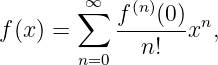
Let f(x) be infinitely differentiable at x = 0. The Maclaurin series of f is given
by
provided the series converges to f(x) within some radius of convergence.
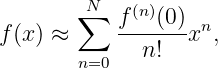
Truncating the series at finite order N yields an approximation
whose accuracy depends both on x and on the neglected higher order terms.
3 Small Angle Approximation of the Simple Pendulum
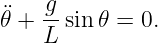
Consider a simple pendulum of length L under gravity g. The exact equation of motion
is
The nonlinearity arises from the sine term. Expanding sin 𝜃 about 𝜃 = 0 using its
Maclaurin series,
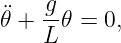
we obtain, to lowest order,
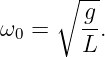
which describes a simple harmonic oscillator with angular frequency
This approximation is valid when |𝜃|≪ 1 (in radians). Retaining the cubic term
introduces an anharmonic correction, leading to amplitude dependent oscillation
periods.
4 Maclaurin Expansion of a Nonlinear Potential
More generally, consider a particle of mass m moving in a one dimensional potential V (x)
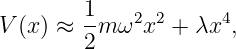
with a stable equilibrium at x = 0. The potential may be expanded as
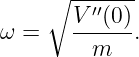
The absence of a linear term reflects equilibrium. The quadratic term defines an effective
harmonic oscillator with angular frequency
Higher order terms introduce anharmonic effects, modifying both classical trajectories and
quantum energy levels. The Maclaurin expansion thus provides a systematic route from
exact dynamics to effective models.
5 Quantum Mechanical Application
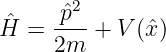
In quantum mechanics, the hamiltonian
may be approximated near equilibrium by truncating the Maclaurin expansion of V (x).
Retaining only the quadratic term yields the harmonic oscillator, whose eigenstates and
spectrum are exactly solvable.
Including quartic corrections,
leads to perturbative shifts in the energy levels. These corrections can be computed using
standard perturbation theory, illustrating how Maclaurin expansions connect directly to
observable physical effects.
6 Validity and Limitations
The Maclaurin series is local by construction. Its validity is constrained by both
convergence and physical relevance. Even when the series converges mathematically,
truncation may fail to capture qualitative behavior such as bifurcations or chaotic
dynamics.
Thus, Maclaurin expansions should be interpreted as controlled approximations, whose
domain of applicability must be justified physically, not merely algebraically.
7 Conclusion
The Maclaurin series is far more than a mathematical curiosity; it is a foundational tool in
physical modeling. By expanding physical laws about equilibrium points, one obtains
effective theories that isolate dominant behavior while systematically accounting for
corrections. From classical mechanics to quantum theory, the Maclaurin series provides a
bridge between exact laws and practical predictions.
References
[1] G. B. Arfken, H. J. Weber, and F. E. Harris, Mathematical Methods for
Physicists, 7th ed., Academic Press, 2013.
[2] H. Goldstein, C. Poole, and J. Safko, Classical Mechanics, 3rd ed.,
Addison-Wesley, 2002.
[3]
L. D. Landau and E. M. Lifshitz, Mechanics, 3rd ed., Butterworth-Heinemann,
1976.
[4] D. J. Griffiths, Introduction to Quantum Mechanics, 2nd ed., Pearson
Prentice Hall, 2005.
[5] J. J. Sakurai and J. Napolitano, Modern Quantum Mechanics, 2nd ed.,
Pearson, 2011.
[6] M. L. Boas, Mathematical Methods in the Physical Sciences, 3rd ed., Wiley,
2006.

![[parent]](https://images.physicslibrary.org/images/uparrow.png)