Newton’s law of universal gravitation describes gravity as a force by stating that every particle
attracts every other particle in the universe with a force that is proportional to the product of their
masses and inversely proportional to the square of the distance between their centers of mass.
Separated objects attract and are attracted as if all their mass were concentrated at their centers.
The publication of the law has become known as the ”first great unification”, as it marked the
unification of the previously described phenomena of gravity on Earth with known astronomical
behaviors.[1][2][3]
This is a general physical law derived from empirical observations by what Isaac Newton called
inductive reasoning.[4] It is a part of Classical Mechanics and was formulated in Newton’s work
Philosophiae Naturalis Principia Mathematica (Latin for ’Mathematical Principles of Natural
Philosophy’ (the Principia)), first published on 5 July 1687.
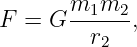
The equation for universal gravitation thus takes the form:
where F is the gravitational force acting between two objects, m1 and m2 are the masses of the
objects, r is the distance between the centers of their masses, and G is the gravitational constant.
The first test of Newton’s law of gravitation between masses in the laboratory was the Cavendish
experiment conducted by the British scientist Henry Cavendish in 1798.[5] It took place 111 years
after the publication of Newton’s Principia and approximately 71 years after his death.
Newton’s law of gravitation resembles Coulomb’s law of electrical forces, which is used to
calculate the magnitude of the electrical force arising between two charged bodies. Both are
inverse-square laws, where force is inversely proportional to the square of the distance
between the bodies. Coulomb’s law has charge in place of mass and a different constant.
Newton’s law was later superseded by Albert Einstein’s theory of general relativity, but the
universality of the gravitational constant is intact and the law still continues to be used as an
excellent approximation of the effects of gravity in most applications. Relativity is required only
when there is a need for extreme accuracy, or when dealing with very strong gravitational fields,
such as those found near extremely massive and dense objects, or at small distances (such as
Mercury’s orbit around the Sun).
This article is a derivative work of the creative commons share alike with attribution.[6]
References
[1] Fritz Rohrlich (25 August 1989). From Paradox to Reality: Our Basic Concepts of
the Physical World. Cambridge University Press. pp. 28ff. ISBN 978-0-521-37605-1.
[2] Mainzer, Klaus (2 December 2013). Symmetries of Nature: A Handbook for
Philosophy of Nature and Science. Walter de Gruyter. pp. 8ff. ISBN 978-3-11-088693-1
[3] ”Physics: Fundamental Forces and the Synthesis of Theory”. Encyclopedia.com.
[4] Isaac Newton: ”In [experimental] philosophy particular propositions are inferred
from the phenomena and afterwards rendered general by induction”: Principia, Book 3,
General Scholium, at p.392 in Volume 2 of Andrew Motte’s English translation published
1729.
[5] Hodges, Laurent. ”The Michell-Cavendish Experiment”. Indiana State University.
[6] Wikipedia contributors, ”Newton’s law of universal gravitation,” Wikipedia, The Free
Encyclopedia.