|
|
|
|||||||
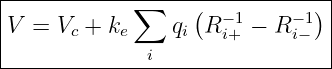
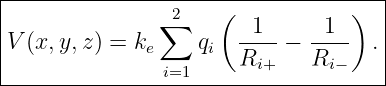
The potential in z > 0 is
It vanishes on the plane because each real/image pair cancels separately. It contains exactly the two specified physical sources, and it decays at infinity. Uniqueness therefore confirms the solution.
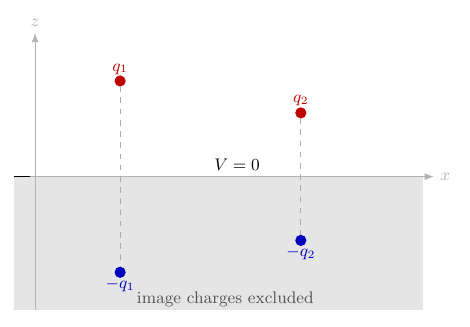
Figure 1. Two real point charges of arbitrary sign at different heights, together with their opposite-sign images. Each pair separately satisfies the grounded-plane condition.
2 Worked example 2: induced charge density for two sourcesDifferentiate Equation (2) at z = 0. For each charge, the result matches the translated one-source profile. Thus
The integral of each term over the infinite plane is −qi. Consequently
If q1 = −q2, the net induced charge is zero, but the density generally has positive and negative regions. The result holds for prescribed real point sources over an ideal infinite grounded plane and should not be transferred without modification to finite or isolated conductors.
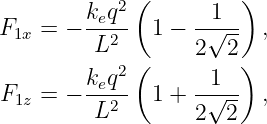
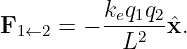
3 Worked example 3: force on the first sourceQuestion. Let d1 = d2 = d and both q1,q2 be positive. Derive the full force on q1 from the second real charge and both images, excluding the charge’s own free-space self field. At q1 = (0, 0,d), the real q2 is at (L, 0,d). The Coulomb displacement is −Lx, so
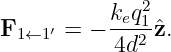
The image of q1 is −q1 at (0, 0,−d) and attracts vertically:
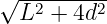
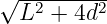
The image of q2 is −q2 at (L, 0,−d). Its displacement from q1 is −Lx + 2dz, with length
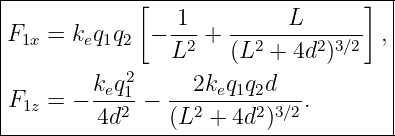
The total components are
For positive q1,q2, the net horizontal component on q1 is negative (the real source repulsion dominates the image’s horizontal attraction), and the vertical component is negative. If one of the real charges reverses sign, repeat the signs carefully rather than relying on a diagram alone.
4 Worked example 4: numerical cross-check of the plane limitTake q1 = q2 = 1.0 nC, d = 2.0 cm and L = 4.0 cm. The elementary force scale is keq2∕L2. The
cross-image separation is
where the first vertical term equals −keq2∕L2 because L = 2d. This example is useful for checking the relative size and sign of the force contributions, without inserting rounded constants until the final arithmetic.
5 Worked example 5: nonzero conductor potentialSuppose the same plane is held at a uniform constant V c instead of zero, while the reference at spatial infinity is allowed to approach V c. Then
solves the field equations and has V = V c on the plane. Adding a constant changes neither E = −∇V nor σ; it only changes the potential reference. One must not demand both V → 0 at infinity and a nonzero constant V c on an infinite plane without supplying another physical boundary or an applied field. The exact reference constraints are part of the problem.
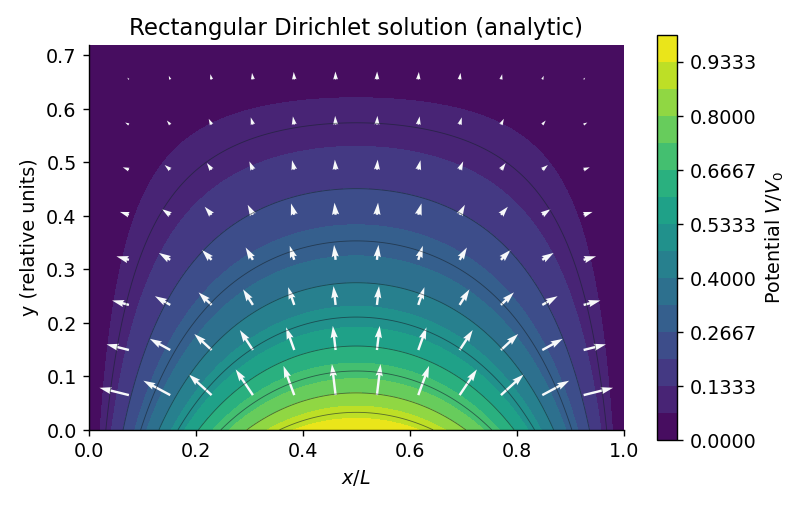
6 Worked example 6: a finite rectangular boundary-value comparisonThe image method is not always the easiest tool. Consider a source-free rectangle 0 < x < L, 0 < y < H, with three sides grounded and the bottom held at
A simple separated trial solution is
Prove it rather than trusting its appearance. Define k = π∕L, f(x) = sin(kx) and g(y) = sinh[k(H − y)]. Then f′′ = −k2f and g′′ = +k2g, so
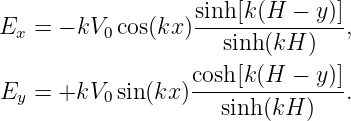
(up to the common normalization). At y = 0 the hyperbolic-sine ratio is one; at y = H it is zero; at x = 0,L the sine vanishes. Therefore it meets all four boundary values, and Dirichlet uniqueness proves it is the solution. The fields follow by differentiation:
This is a preview of ES07 separation of variables, not an image construction.
Figure 2. The separated harmonic solution in a finite rectangle. Three boundaries are grounded and the lower edge has a sinusoidal prescribed voltage. Field vectors point toward decreasing potential.
7 Exercises with complete solutions1. Superposition. If q1 = 2q and q2 = −q, what is the total induced charge on the infinite grounded plane? Solution. Qinduced = −(2q − q) = −q. 2. Sign check. For q1 = q2 > 0 at equal height d, can F1x in Equation (8) be positive? Solution. No. Since L∕(L2 + 4d2)3∕2 < 1∕L2, the bracket is strictly negative. 3. Boundary verification. Substitute y = H∕2 and x = L∕2 into Equation (12). Solution. Because sin(π∕2) = 1, the potential is V 0 sinh(πH∕(2L))∕ sinh(πH∕L). It lies between 0 and V 0 for V 0 > 0, consistent with the maximum principle. 4. Potential shift. Does adding the same constant to every conductor and external reference potential change the forces? Solution. No. Gradients of constants vanish, so E and the Coulomb force are unchanged. Relative conductor potentials and fields, not an arbitrary zero, are physical.
References
[1] D. J. Griffiths, Introduction to Electrodynamics, 5th ed., Cambridge University Press, 2023. [2] J. D. Jackson, Classical Electrodynamics, 3rd ed., Wiley, 1999. [3] University of Virginia, The Image Method in Electrostatics, https://galileoandeinstein.phys.virginia.edu/Elec_Mag/2022_Lectures/EM_08_Images.html. "Mixed Sources and Conductor Boundary Potentials" is owned by bloftin.
This object's parent. Cross-references: gradients, reference potential, maximum principle, superposition, vectors, voltage, harmonic, separation of variables, Dirichlet uniqueness, potential reference, diagram, displacement, charges, conductor, energy, forces, method of images, boundary This is version 1 of Mixed Sources and Conductor Boundary Potentials, born on 2026-11-28. Object id is 1650, canonical name is MixedSourcesAndConductorBoundaryPotentials. Accessed 7 times total. Classification:
|
|
|
|
Pending Errata and AddendaNone.
|
DiscussionNo messages.
|
Interact |




 . Therefore

 =
 . Equation (