Physics Library
 An open source physics library
Encyclopedia | Forums | Docs | Random  

[parent] GRE Physics Companion: The Inertia Tensor and Products of Inertia

(Example)

GRE Physics Companion: The Inertia Tensor and Products of Inertia

The core relation is

|--------|
-L-=-Iω,--
(1)

with

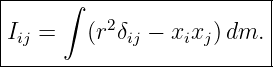
|-----∫-------------------|
Iij =   (r2δij − xixj)dm.  |
---------------------------
(2)

For an arbitrary unit axis,

|-----------|
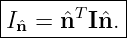
Iˆn = ˆnT Iˆn. |
-------------
(3)

PIC

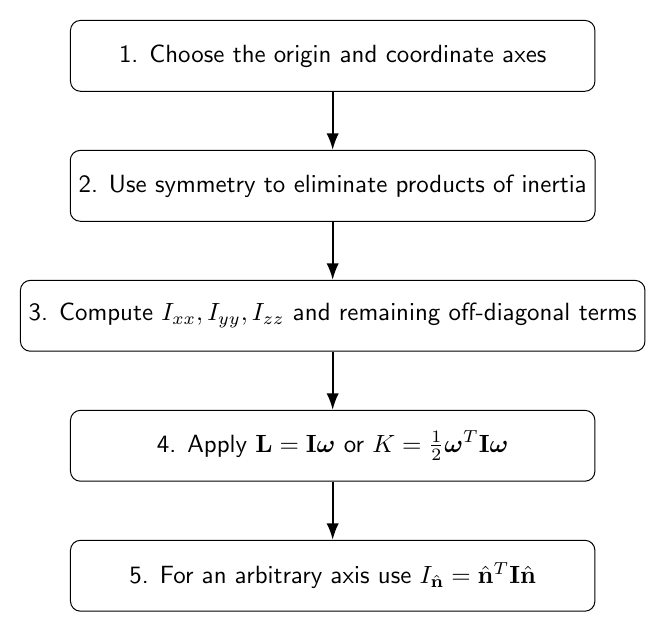
Figure 1. A compact inertia-tensor strategy: define the origin and axes, exploit symmetry first, compute diagonal moments and products of inertia, then use the tensor to obtain angular momentum, energy, or an arbitrary-axis moment.

1 High-value GRE facts

  1. The inertia tensor is real and symmetric.
  2. Diagonal entries are scalar moments about coordinate axes.
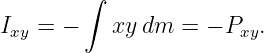
  3. In this article, Pxy = ∫ xy dm but Ixy = −Pxy.
  4. Reflection symmetry often makes products of inertia vanish.
  5. L need not be parallel to ω.
  6. A diagonal inertia tensor does not imply equal principal moments.
  7. The moment about unit axis n is nT In.
  8. rotational kinetic energy is 12ωT Iω.
  9. For a planar lamina, Izz = Ixx + Iyy.
  10. Principal axes diagonalize the inertia tensor.

Part I: Original GRE-style problems

Problem 1: tensor symmetry

For a mass inertia tensor in Cartesian coordinates,

  1. Ixy = −Iyx always
  2. Ixy = Iyx
  3. all off-diagonal entries are positive
  4. all diagonal entries vanish
  5. the tensor must be antisymmetric

Problem 2: product sign

Using the convention Pxy = ∫ xy dm, the tensor component is

  1. Ixy = Pxy
  2. Ixy = −Pxy
  3. Ixy = Pxy2
  4. Ixy = 0 always
  5. Ixy = Ixx + Iyy

Problem 3: reflection symmetry

A body is symmetric under x →−x. Which products must vanish?

  1. Pxy and Pxz
  2. Pxy and Pyz
  3. Pxz and Pyz
  4. only Pyz
  5. none

Problem 4: planar lamina

For a lamina in the xy plane,

  1. Izz = Ixx − Iyy
  2. Izz = Ixx + Iyy
  3. Ixx = Iyy + Izz
  4. Izz = 0
  5. all three moments are equal

Problem 5: angular momentum

If

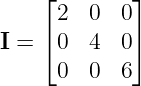
   ⌊ 2  0  0⌋
   ⌈        ⌉
I =  0  4  0
     0  0  6
(4)

and

    ⌊  ⌋
      1
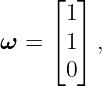
ω = ⌈ 1⌉ ,
      0
(5)

then

L
(6)

is

  1. (1, 1, 0)
  2. (2, 2, 0)
  3. (2, 4, 0)
  4. (4, 2, 0)
  5. (6, 6, 0)

Problem 6: parallelism

For the tensor and angular velocity in Problem 5,

  1. L is parallel to ω
  2. L is perpendicular to ω
  3. L is not parallel to ω
  4. L = 0
  5. ω = 0

Problem 7: arbitrary-axis moment

For

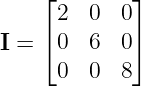
   ⌊        ⌋
     2  0  0
I = ⌈ 0 6  0⌉

     0  0  8
(7)

and unit axis

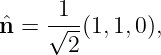
ˆn = √1--(1,1,0),
      2
(8)

the scalar moment is

  1. 2
  2. 3
  3. 4
  4. 6
  5. 8

Problem 8: rotational energy

For the tensor in Problem 5 and

ω  = (1,1,0),
(9)

the rotational kinetic energy is

  1. 1
  2. 2
  3. 3
  4. 4
  5. 6

Problem 9: trace

The trace of the inertia tensor equals

  1. ∫ r2 dm
  2. 2 ∫ r2 dm
  3. 3 ∫ r2 dm
  4. total mass only
  5. zero

Problem 10: coordinate rotation

If vector components transform as r′ = Qr with orthogonal Q, then the inertia tensor transforms as

  1. I′ = QIQT
  2. I′ = I + Q
  3. I′ = QT Q
  4. I′ = I−1
  5. I′ = QI

Problem 11: shift along an axis

A center of mass inertia tensor is diagonal. The origin is shifted distance d along the x axis. Which center of mass moment is unchanged by the tensor parallel-axis shift?

  1. Ixx
  2. Iyy
  3. Izz
  4. all three increase equally
  5. all three remain unchanged

Problem 12: principal axis

If e is an eigenvector of I with eigenvalue Ip, and

ω = ω ˆe,
(10)

then

  1. L is perpendicular to ω
  2. L = Ipω
  3. L = 0
  4. L has arbitrary direction
  5. Ip = 0 necessarily

Part II: Complete worked solutions

Solution 1

The inertia tensor is symmetric because

xixj = xjxi.
(11)

Thus

I  =  I  .
 xy    yx
(12)

Answer: (B).

Solution 2

With

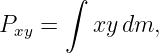
      ∫
Pxy =    xy dm,
(13)

the off-diagonal tensor component is

        ∫

Ixy = −    xydm  =  − Pxy.
(14)

Answer: (B).

Solution 3

Under x →−x, both xy and xz change sign. Their paired contributions cancel:

Pxy =  Pxz = 0.
(15)

Answer: (A).

Solution 4

For z = 0,

Ixx = ∫ y2 dm, (16)
Iyy = ∫ x2 dm, (17)
Izz = ∫ (x2 + y2) dm. (18)

Therefore

Izz = Ixx + Iyy.
(19)

Answer: (B).

Solution 5

Multiply:

          ⌊  ⌋
            2
          ⌈  ⌉
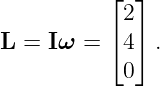
L = Iω  =   4  .
            0
(20)

Answer: (C).

Solution 6

The vectors

(1,1,0)
(21)

and

(2,4,0)
(22)

are not scalar multiples of each other. Answer: (C).

Solution 7

In = nT In (23)
= 1-
2(2) + 1-
2(6) (24)
= 4. (25)

Answer: (C).

Solution 8

K = 1
--
2ωT Iω (26)
= 1-
2(1, 1, 0) ⋅ (2, 4, 0) (27)
= 3. (28)

Answer: (C).

Solution 9

Adding the diagonal entries gives

         ∫
            2
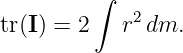
tr(I) = 2   r  dm.
(29)

Answer: (B).

Solution 10

For an orthogonal coordinate transformation,

 ′       T
I =  QIQ   .
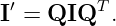
(30)

Answer: (A).

Solution 11

A shift along the x axis leaves all perpendicular distances to the x axis unchanged. Thus Ixx is unchanged. Answer: (A).

Solution 12

The eigenvector equation is

Iˆe = Ipˆe.
(31)

Therefore

L = I(ωe) (32)
= Ip(ωe) (33)
= Ipω. (34)

Answer: (B).

2 GRE checklist

  1. State the origin and coordinate axes before writing an inertia tensor.
  2. Check the sign convention used for products of inertia.
  3. Use symmetry before performing integrals.
  4. Do not assume L ∥ ω.
  5. Use In = nT In for arbitrary axes.
  6. Use K = 12ωT Iω for rotational energy.
  7. Remember that tensor components change when the coordinate axes rotate.
  8. Principal axes are eigenvector directions of the symmetric inertia tensor.

References

References

[1]   J. R. Taylor, Classical Mechanics, University Science Books, 2005.

[2]   H. Goldstein, C. Poole, and J. Safko, Classical Mechanics, 3rd ed., Addison-Wesley, 2002.

[3]   K. R. Symon, Mechanics, 3rd ed., Addison-Wesley, 1971.


"GRE Physics Companion: The Inertia Tensor and Products of Inertia" is owned by bloftin.
(view preamble)
View style:
Other names:  M05-09G
Keywords:  GRE physics, inertia tensor, products of inertia, angular momentum, angular velocity, rigid body, arbitrary axis, symmetry, principal axes, rotational kinetic energy

This object's parent.

Cross-references: center of mass, vector, trace, angular velocity, Cartesian coordinates, mass, rotational kinetic energy, scalar, inertia tensor, energy, angular momentum, tensor, products of inertia, unit, relation

This is version 1 of GRE Physics Companion: The Inertia Tensor and Products of Inertia, born on 2026-10-17.
Object id is 1481, canonical name is GREPhysicsCompanionTheInertiaTensorAndProductsOfInertia.
Accessed 7 times total.

Classification:
Physics Classification: 45.40.-f (Dynamics and kinematics of rigid bodies)
 45.20.Dd (Newtonian mechanics)

Pending Errata and Addenda

None.

Discussion

No messages.

Interact