Physics Library
 An open source physics library
Encyclopedia | Forums | Docs | Random  

[parent] GRE Physics Companion: Angular Momentum, Areal Velocity, and Kepler's Second Law

(Example)

GRE Physics Companion: Angular Momentum, Areal Velocity, and Kepler’s Second Law

For planar central force motion,

|--------|
-h-=-r2𝜃˙|
(1)

and

|---------|
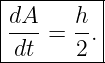
|dA-   h- |
-dt-=--2.-|
(2)

PIC

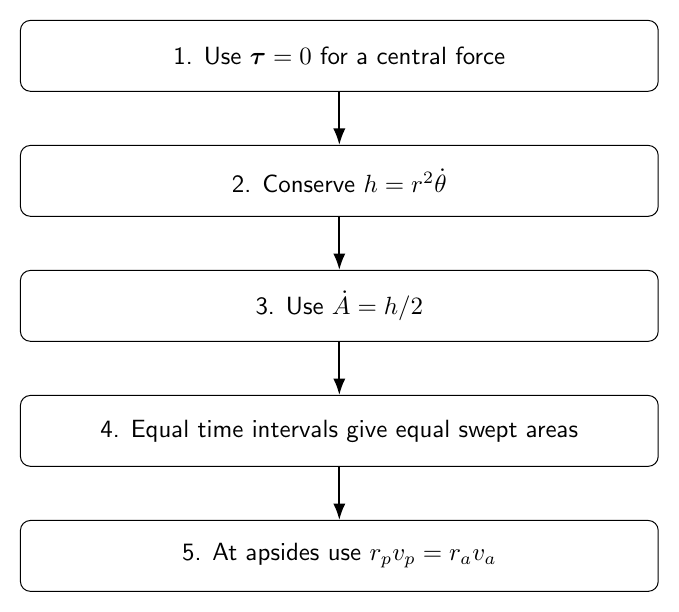
Figure 1. A compact area-law strategy: use zero torque to conserve angular momentum, convert h to areal velocity, and apply equal areas over equal time intervals.

1 High-value GRE facts

  1. A central force gives zero torque about the force center.
  2. Zero torque gives constant angular momentum.
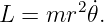
  3. L = mr2𝜃.
  4. h = L∕m = r2𝜃.
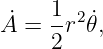
  5. dA = 12r2d𝜃.
  6. Ȧ = h∕2 = L∕(2m).
  7. Equal times imply equal swept areas.
  8. Kepler’s second law applies to every central force.
  9. At apsides, rpvp = rava.
  10. Radial motion with L = 0 has zero areal velocity.

Part I: Original GRE-style problems

Problem 1: central force torque

For a central force, the torque about the force center is

  1. constant and nonzero
  2. zero
  3. proportional to r
  4. proportional to 1∕r2
  5. undefined

Problem 2: angular momentum

For planar motion, the angular-momentum magnitude is

  1. mr𝜃
  2. mr2𝜃
  3. mṙ2
  4. mrṙ
  5. m∕r2

Problem 3: areal velocity

If specific angular momentum is h, the areal velocity is

  1. h
  2. 2h
  3. h∕2
  4. h2∕2
  5. 1∕(2h)

Problem 4: angular rate

For fixed h, the angular rate is

  1. h∕r
  2. h∕r2
  3. hr
  4. hr2
  5. 1∕(hr2)

Problem 5: equal areas

Kepler’s second law states that equal swept areas correspond to equal

  1. distances
  2. speeds
  3. angular displacements
  4. time intervals
  5. radii

Problem 6: periapsis versus apoapsis

If ra = 2rp, then the apsidal speeds satisfy

  1. vp = va∕2
  2. vp = va
  3. vp = 2va
  4. vp = 4va
  5. vp = √ --
  2va

Problem 7: generality of the area law

Constant areal velocity follows from

  1. inverse-square gravity only
  2. circular motion only
  3. any central force
  4. constant speed
  5. zero energy

Problem 8: doubled radius

At one point on an orbit the radius is twice that at another point. With the same h, the angular-rate ratio is

  1. 1∕2
  2. 1∕4
  3. 1
  4. 2
  5. 4

Problem 9: radial motion

For purely radial central force motion,

  1. areal velocity is zero
  2. areal velocity is infinite
  3. angular momentum is nonzero
  4. angular rate is constant and nonzero
  5. Kepler’s second law fails

Problem 10: ellipse period

For a known ellipse of area πab and specific angular momentum h, the period is

  1. πab∕h
  2. 2πab∕h
  3. h∕(2πab)
  4. 2h∕(πab)
  5. πh∕(ab)

Problem 11: apsidal velocity direction

At periapsis of a nonradial orbit, the instantaneous velocity is

  1. purely radial
  2. purely transverse
  3. zero
  4. parallel to angular momentum
  5. undefined

Problem 12: two-body relative motion

In the exact two-body problem, the relative areal velocity is

  1. Lrel∕μr
  2. Lrel∕(2μr)
  3. 2Lrel∕μr
  4. G(m1 + m2)
  5. zero

Part II: Complete worked solutions

Solution 1

A central force is parallel or antiparallel to r, so

r × F  = 0.
(3)

Answer: (B).

Solution 2

The transverse contribution gives

       2 ˙
L = mr  𝜃.
(4)

Answer: (B).

Solution 3

Since

     2 ˙
h = r 𝜃
(5)

and

     1 2
˙A =  -r ˙𝜃,
     2
(6)

we obtain

A˙ = h∕2.
(7)

Answer: (C).

Solution 4

Angular-momentum conservation gives

˙       2
𝜃 = h∕r  .
(8)

Answer: (B).

Solution 5

Constant areal velocity means area is proportional to elapsed time. Answer: (D).

Solution 6

At the apsides,

rpvp = rava.
(9)

If ra = 2rp, then vp = 2va. Answer: (C).

Solution 7

The proof requires only zero torque, which is true for every central force. Answer: (C).

Solution 8

Because

𝜃˙∝ 1∕r2,
(10)

doubling radius divides angular rate by four. Answer: (B).

Solution 9

Pure radial motion has

L =  h = 0.
(11)

Therefore

 ˙
A  = 0.
(12)

Answer: (A).

Solution 10

One orbit sweeps the full area:

πab = (h∕2 )T.
(13)

Thus

T  = 2πab ∕h.
(14)

Answer: (B).

Solution 11

At periapsis,

˙r = 0,
(15)

so the velocity is transverse. Answer: (B).

Solution 12

The relative angular momentum is

Lrel = μr |r × ˙r|.
(16)

Thus

 ˙
Arel = Lrel∕(2μr ).
(17)

Answer: (B).

2 GRE checklist

  1. Start with zero central torque.
  2. Convert angular momentum to h = r2𝜃.
  3. Keep the factor 1∕2 in the area formula.
  4. Use apsidal speed relations only where ṙ = 0.
  5. Remember that the area law is more general than inverse-square gravity.
  6. For exact two-body motion, use the relative coordinate and reduced mass.

References

References

[1]   PhysicsLibrary, M07-07, Angular Momentum, Areal Velocity, and Kepler’s Second Law.

[2]   PhysicsLibrary, M07-06, Effective Potential and Radial Motion in Central Gravity.

[3]   J. R. Taylor, Classical Mechanics, University Science Books, 2005.


"GRE Physics Companion: Angular Momentum, Areal Velocity, and Kepler's Second Law" is owned by bloftin.
(view preamble)
View style:
Other names:  M07-07G
Keywords:  GRE physics, angular momentum, areal velocity, Kepler's second law, equal areas, periapsis, apoapsis

This object's parent.

Cross-references: mass, relations, formula, velocity, period, energy, angular displacements, speeds, specific angular momentum, magnitude, Kepler's second law, swept areas, force, areal velocity, angular momentum, torque, central force

This is version 1 of GRE Physics Companion: Angular Momentum, Areal Velocity, and Kepler's Second Law, born on 2026-10-31.
Object id is 1562, canonical name is GREPhysicsCompanionAngularMomentumArealVelocityAndKeplersSecondLaw.
Accessed 5 times total.

Classification:
Physics Classification: 45.20.Dd (Newtonian mechanics)
 45.50.-j (Dynamics and kinematics of a particle and a system of particles)

Pending Errata and Addenda

None.

Discussion

No messages.

Interact