Friction
Friction is a contact force that acts tangent to the interface between two bodies. In
elementary mechanics, friction is usually modeled by empirical relations involving the Normal
force. The model is simple, but using it correctly requires more care than merely writing
f = μN.
The most important distinction is between static and kinetic friction. Static friction acts when the
contacting surfaces do not slide relative to one another. Its magnitude adjusts to whatever value is
required by the equations of motion, up to a limiting value. Kinetic friction acts when the surfaces
slide relative to one another and is commonly approximated by a nearly constant magnitude
proportional to the normal force.
This article develops the standard dry friction model, explains its physical meaning and
limitations, and shows how it enters Newton’s second law problems.
1 Friction is a contact interaction
At a rough interface, the total contact force can be decomposed into a component normal to the
surface and a component tangent to the surface. The normal component is the normal force N.
The tangential component is the friction force f.
For a horizontal block pulled to the right, a friction force may act to the left:
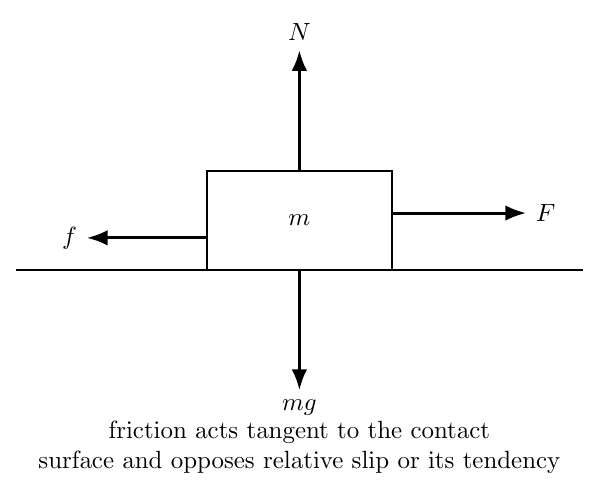
Figure 1. Friction acts tangent to the contact surface. Its direction is determined by the relative
sliding, or the tendency to slide, at the interface.
Friction does not have a universally fixed direction. The correct statement is:
This is more precise than saying that friction “opposes motion.” Friction can accelerate an object.
For example, a moving conveyor belt can exert friction on a box and speed the box
up.
2 Static friction
Suppose a block rests on a rough horizontal surface and a horizontal applied force F is increased
gradually from zero. If the block remains at rest, Newton’s second law in the horizontal direction
requires
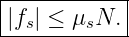
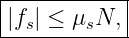
Thus static friction is not automatically equal to μsN. Instead, it adapts to the force needed to
prevent relative slipping, subject to the inequality
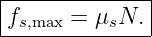
The largest possible static friction magnitude is
The equality applies only at the threshold of impending motion.
If the equations require a static friction magnitude greater than μsN, the assumed no-slip state is
physically impossible. The surfaces must begin to slide, and the kinetic friction model then
becomes appropriate.
3 Kinetic friction
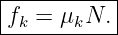
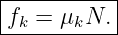
For two surfaces sliding relative to one another, the elementary Coulomb model uses
The kinetic friction force points opposite the relative tangential velocity of the surfaces at the
contact.
For many common dry surface pairs,
although the coefficients are empirical properties of the contacting materials and surface condition
rather than universal constants.
The idealized transition is often represented schematically as follows:
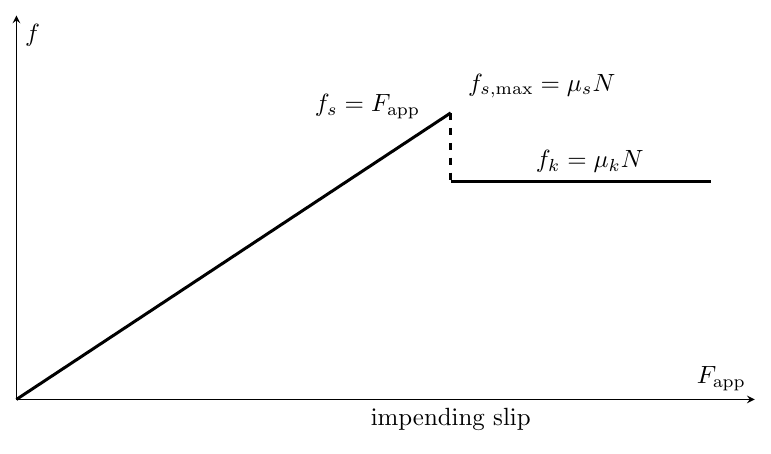
Figure 2. Static friction increases as needed until its limiting value μsN is reached. Once sliding
begins, the elementary model uses kinetic friction fk = μkN. The graph is schematic rather than
a microscopic force law.
4 Why the coefficient of friction is dimensionless
Both friction and normal force have units of force. Therefore
is dimensionless.
The coefficient of friction summarizes complicated microscopic interactions into one empirical
number. Real friction can depend on surface contamination, temperature, speed, wear,
deformation, lubrication, and many other effects. The elementary model is most useful when those
effects can be neglected over the range of interest.
5 The normal force must be found first
Because the friction model contains N, one should normally determine the normal force before
calculating friction.
For a block on a horizontal surface with no other vertical forces and no vertical acceleration,
But this is not a universal relation. If an applied force has a vertical component, the normal force
changes.
For an applied force F directed upward at angle α above the horizontal, vertical force balance
gives
so
The upward component of the pull reduces the normal force and therefore reduces the available
friction.
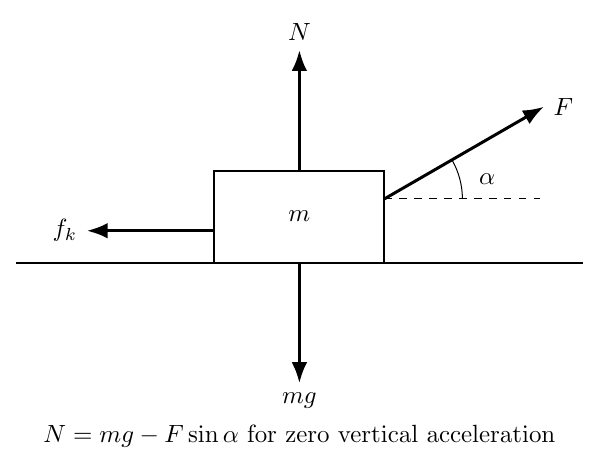
Figure 3. Pulling upward at an angle reduces the normal force. Since kinetic friction is modeled as
fk = μkN, the friction magnitude also decreases.
If instead the force is directed downward into the surface, its vertical component increases N and
increases the friction magnitude.
6 A reliable static friction procedure
Static friction problems are safest when solved in two stages.
First, assume no slipping and use Newton’s second law to determine the friction force required by
that assumption. Call the result freq.
Second, compare that required magnitude with the maximum available static friction:
If the inequality is satisfied, the static solution is possible and
If
the static solution is impossible and the body begins to slide.
This procedure prevents one of the most common errors in mechanics: setting
in every static problem.
7 Friction on an inclined plane
For a block on a plane inclined at angle 𝜃, choose axes parallel and perpendicular to the plane. If
no other forces have components normal to the plane,
The component of gravity down the plane is
If the block is at rest, static friction must oppose the tendency to slide downhill. The required
magnitude is
The largest available static friction is
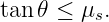
Therefore static equilibrium is possible only when
Canceling mg cos 𝜃 gives
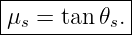
At the limiting angle 𝜃s at which slipping is about to begin,
This angle is often called the angle of repose for a simple block-surface model.
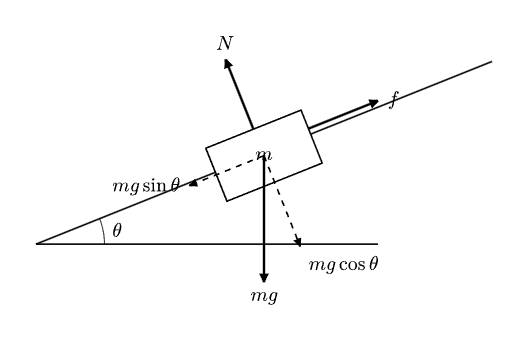
Figure 4. On an incline, the normal force is mg cos𝜃. If gravity tends to make the block slide
downhill, static or kinetic friction acts uphill.
8 Sliding down an incline
If the block slides downhill, kinetic friction acts uphill with magnitude
Taking downhill as positive,
Therefore
and
The mass cancels. In this idealized model, blocks of different mass but the same friction coefficient
have the same acceleration on the same incline.
9 Friction direction must come from the tendency to slip
Consider a block resting on an incline. Gravity tends to move the block downhill, so static friction
points uphill.
But suppose an external force pulls the block strongly uphill while the block remains at rest. The
tendency to slip may then be uphill, so static friction points downhill.
Thus the direction of static friction cannot be determined solely from the direction of
gravity or from the current velocity of the center of mass. One must determine which
way the contacting surfaces would tend to slide relative to each other if friction were
absent.
10 Friction in connected body systems
Friction often appears together with strings and Pulleys. The basic procedure remains the
same:
- identify whether the surfaces are static or sliding;
- find the normal force;
- determine the friction model and direction;
- write the string constraint if bodies are connected;
- apply Newton’s second law to each body or to a useful combined system.
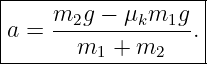
For a block m1 sliding on a horizontal table with kinetic friction and connected over an ideal pulley
to a hanging mass m2, the kinetic friction magnitude is
If m2 moves downward and m1 moves toward the pulley, the system equation is
Therefore
The direction assumed in the derivation must still be checked against the sign of the
result.
11 Common misconceptions
- Static friction is not always μsN. It satisfies |fs|≤ μsN and only reaches equality
at impending slip.
- Friction is not always opposite the object’s velocity. It opposes relative sliding
or the tendency to slide at the contact.
- The normal force is not always mg. Angled applied forces, curved motion,
elevators, and other effects can change N.
- A friction coefficient is not a force. It is a dimensionless empirical ratio used in
the model.
- Friction need not always slow an object. A moving surface can exert friction that
accelerates another body.
- The elementary model is not exact. Real friction is more complicated than the
constant-coefficient Coulomb model.
12 Worked example 1: static friction adjusts to the applied force
A 10.0 kg block rests on a horizontal surface with
First, a horizontal force of 30.0 N is applied. Determine whether the block moves and find the
friction force.
The normal force is
The maximum static friction is
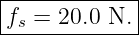
To remain at rest, the required friction is only 30.0 N. Since
the static solution is valid:
Now increase the applied force to 50.0 N. Static friction cannot supply 50.0 N because its
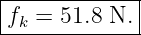
maximum is only 39.2 N. The block slides, so
Newton’s second law gives
so
13 Worked example 2: block on a rough incline
An 8.00 kg block is placed on a 25.0∘ incline. The coefficients are
Determine whether the block remains at rest. If it slides, find its acceleration.
The static criterion is
Here
Static friction is insufficient, so the block slides downhill.
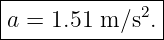
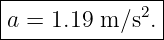
The acceleration is
Therefore
Notice that the mass did not enter the final acceleration.
14 Worked example 3: pulling upward at an angle
A 20.0 kg crate slides on a horizontal floor with μk = 0.25. It is pulled by a force of 80.0 N
at 30.0∘ above the horizontal. Find the normal force, kinetic friction, and horizontal
acceleration.
Vertical acceleration is zero, so
Thus
which gives
The kinetic friction is
The horizontal component of the applied force is
Therefore
so
15 Worked example 4: connected bodies with friction
A 6.00 kg block rests on a horizontal table and is connected by a massless inextensible string over
an ideal pulley to a hanging 3.00 kg mass. For the table contact,
Determine whether the system moves. If it does, find the acceleration and Tension.
The largest static friction on the table block is
If the system were at rest, the hanging mass would require
The table block would then require 29.4 N of static friction, which exceeds the available 14.7 N.
Therefore the system moves.
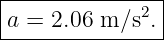
Once sliding begins,
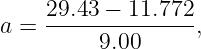
For the two-body system,
Hence
so
For the table block,
so
16 Practice problems
- A 12.0 kg block rests on a horizontal floor with μs = 0.50. A horizontal force of 20.0
N is applied. Find the actual static friction force.
- For the block in Problem 1, what is the largest horizontal applied force that can be
exerted without causing sliding?
- A 5.00 kg block slides across a horizontal surface with μk = 0.20. A horizontal force of
18.0 N acts in the direction of motion. Find the acceleration.
- A 15.0 kg crate is pulled by a 60.0 N force at 25.0∘ above horizontal on a surface with
μk = 0.30. Find N, fk, and the horizontal acceleration.
- The same 15.0 kg crate is instead pushed by a 60.0 N force at 25.0∘ below horizontal.
Find N and fk. Explain why the friction differs from Problem 4.
- A block rests on an incline with μs = 0.40. What is the largest incline angle for which
the block can remain at rest in the simple dry friction model?
- A block slides down a 30.0∘ incline with μ
k = 0.20. Find its acceleration.
- A block is held at rest on an incline by an external force directed uphill. Explain why
static friction can point downhill if the external force is sufficiently large.
- A 7.00 kg block on a horizontal table is connected over an ideal pulley to a hanging
2.00 kg mass. If μs = 0.35, determine whether the system can remain at rest.
- A block just begins to slide when an incline reaches 18.0∘. Estimate μ
s.
- A box initially at rest is placed on a conveyor belt moving to the right. Assuming
slipping initially occurs, which direction does kinetic friction on the box point? Does
friction initially speed up or slow down the box?
- Two blocks of different mass slide down the same incline with the same μk. According
to the elementary kinetic friction model, do they have different accelerations? Explain
from the equations.
17 Answer check
- The required friction is 20.0 N, and the maximum available is (0.50)(12.0)(9.81) = 58.9 N.
Therefore
-
-
-
-
The downward force component increases the normal force, so the kinetic friction magnitude
increases.
-
-
- If the applied uphill force would make the block tend to slip uphill in the absence of friction,
static friction must act downhill to oppose that tendency.
- The hanging Weight is
The maximum static friction is
Therefore the system can remain at rest.
-
- The belt slips to the right relative to the box, so kinetic friction on the box points to the
right. Friction initially speeds the box up.
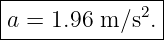
- No. Since
the mass cancels in the elementary model.
18 Summary
The elementary dry friction model is built around two different regimes. Static friction
satisfies
while kinetic friction during sliding is modeled as
Static friction should normally be solved as an unknown force and checked against its maximum
allowed magnitude. The normal force must be determined from the perpendicular dynamics rather
than assumed to equal mg. Friction direction is determined by relative slipping or the tendency to
slip at the contact.
For a simple block on an incline, the threshold for static equilibrium is
and a block sliding downhill has acceleration
The next article, M02-08, develops inclined-plane dynamics more broadly, including combinations
of friction, tension, and externally applied forces.
References
[1] PhysicsLibrary, M02-01, Newton’s Laws of Motion.
[2] PhysicsLibrary, M02-02, Free Body Diagrams.
[3] PhysicsLibrary, M02-04, Weight and Normal Force.
[4] J. Moore et al., Mechanics Map, CC BY-SA 4.0. Used as an open reference for dry
friction models and Newton’s second law applications.
[5] University of California, Davis, Physics 9A: Classical Mechanics, CC BY-SA 4.0.
[6] Archived 2016 revision of University Physics, Volume 1, CC BY 4.0.