|
|
|
|||||||
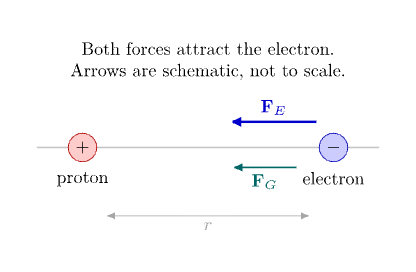
Both are attractive. Their force-strength ratio is
This is a separation-independent force ratio: the factors r−2 cancel exactly when the same pair of particles and classical inverse-square model are used for both interactions. It is not a statement that atomic dynamics are independent of distance.
Figure 1. The electron is attracted toward the proton by both interactions. The force-arrow lengths are schematic, since the actual electrical force is enormously larger than gravity.
2 2. Worked example 1: electron–proton at 0.100 nmUse r = 1.00 × 10⁻¹⁰ m, e = 1.602176634 × 10⁻¹⁹ C, m e = 9.10938 × 10⁻³¹ kg, m p = 1.67262 × 10⁻²⁷ kg, G = 6.6743 × 10⁻¹¹ N m2∕kg2 and k e = 8.98755 × 10⁹ N m2∕C2. Electrical force
Gravitational force
Divide the unrounded expressions:
The ratio is dimensionless. The force direction on the proton is opposite the force direction on the electron for each interaction, as Newton’s third law requires. 3 3. Worked example 2: change the separationDouble the distance to r = 0.200 nm. Each inverse-square force becomes one quarter of its previous value:
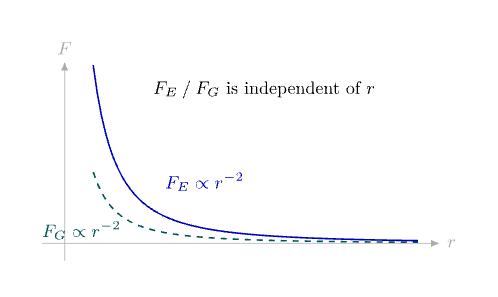
But F′E∕F′G = FE∕FG. More generally, scaling distance by a factor s > 0 scales both forces by s−2. The comparison does not require selecting the Bohr radius or any particular atomic orbit.
Figure 2. Schematic inverse-square falloff. Both force magnitudes have the same power of separation, so their vertical ratio is fixed for a given particle pair. The axes are not logarithmically calibrated.
4 4. Worked example 3: compare three types of particle pairsFor two identical particles of mass m and equal charge magnitude e, the ratio has the same form but with m2 in the denominator:
For two electrons, the electrical force is repulsive and gravity is attractive; the magnitudes satisfy FE∕FG ≃ 4.17 × 1042. For two protons the same signs apply, with ratio F E∕FG ≃ 1.24 × 1036. Comparing these values with the electron–proton ratio reveals that the changing mass, rather than the shared elementary charge, controls much of the numerical difference. 5 5. Worked example 4: the associated potential-energy scaleThe potential energy of the opposite-sign pair with zero at infinite separation is
The negative sign means bringing the particles together from infinity can release energy. At r = 0.100 nm,
where 1 eV = 1.602176634 × 10⁻¹⁹ J. The same ratio of magnitudes appears for the energies:
This energy is a classical potential-energy value at a specified separation, not the hydrogen ground-state energy. Atomic binding energies, spectra, and stationary states require quantum mechanics. The classical point-particle approximation is useful for comparing fundamental force scales, but it should not be interpreted as a complete model of atomic structure. 6 6. Exercises
7 7. Solutions
8 8. InterpretationA very large electric-to-gravity ratio helps explain why electrostatic interactions dominate the mechanical arrangement of charged particles at atomic dimensions. Bulk matter is nevertheless often nearly charge neutral, and a large-scale net force can involve cancellations and collective effects. Never confuse the microscopic pair comparison with the net force of a neutral macroscopic object.
References
References
[1] P. Dourmashkin and collaborators, Electricity and Magnetism, MIT 8.02 course notes, chapters on Coulomb’s law and electric fields. [2] D. J. Griffiths, Introduction to Electrodynamics, 4th ed., Cambridge University Press, 2017, electrostatics chapters. [3] E. M. Purcell and D. J. Morin, Electricity and Magnetism, 3rd ed., Cambridge University Press, 2013. [4] PhysicsLibrary, ES01/EM05 articles and the earlier single-example entries for the corresponding ES01E identifiers. "Electric and Gravitational Forces Between an Electron and a Proton" is owned by bloftin.
This object's parent. Cross-references: units, dimensions, Weight, Electric Field, atomic structure, mechanics, energy, potential energy, elementary charge, power, mass, charge, type, particles, magnitudes, forces This is version 2 of Electric and Gravitational Forces Between an Electron and a Proton, born on 2026-11-26, modified 2026-11-27. Object id is 1601, canonical name is ElectricAndGravitationalForcesBetweenAnElectronAndAProton. Accessed 38 times total. Classification:
|
|
|
|
Pending Errata and AddendaNone.
|
DiscussionNo messages.
|
Interact |