
|
|
|
|||||||
The Check.
Both
3 Practice variationDouble the separation. Predict the new magnitudes and ratio. Solution.
Each force is divided by four, giving
References
"Electric and Gravitational Forces Between an Electron and a Proton" is owned by bloftin.
This object's parent. Cross-references: units, magnitude, particle, forces This is version 1 of Electric and Gravitational Forces Between an Electron and a Proton, born on 2026-11-26. Object id is 1601, canonical name is ElectricAndGravitationalForcesBetweenAnElectronAndAProton. Accessed 8 times total. Classification:
|
|
|
|
Pending Errata and AddendaNone.
|
DiscussionNo messages.
|
Interact |

 . Use
 ,
 ,
 ,
 , and
 .
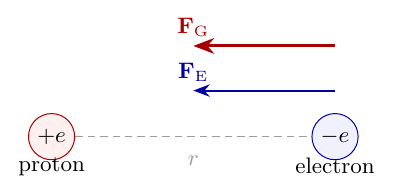
 points from proton to
electron, each force on the electron is directed along
 . With
 ,
 dependence cancels. Each expression describes a pair-force
 and
 have
 . Their ratio is dimensionless.
 and
 , respectively. The ratio
stays
 .