Beats, Interference, and Coherence
Wave phenomena are governed by superposition.
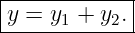
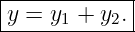
When two or more waves occupy the same region, the resulting field is the sum of the individual
fields.
For two scalar waves,
That simple statement produces several distinct observable effects.
If two waves have the same frequency but different phase, the result is interference.
If two waves have nearby but unequal frequencies, the result is beating.
If the relative phase remains sufficiently stable, interference remains observable. This phase
stability is called coherence.
These ideas apply broadly to:
The mathematics is classical and general.
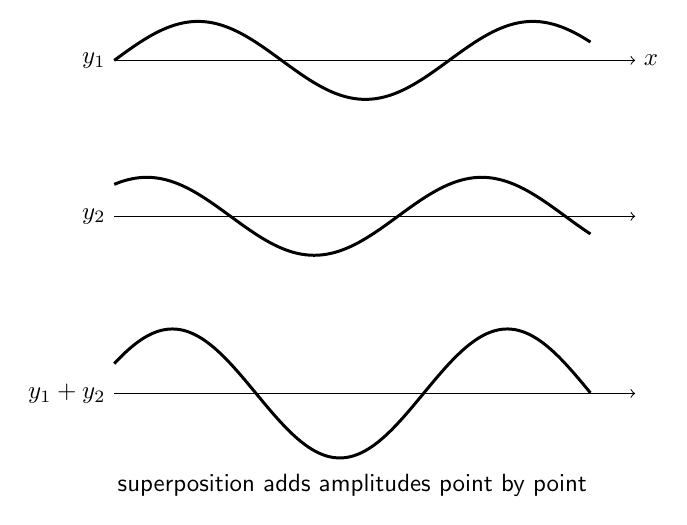
Figure 1. Superposition adds wave amplitudes point by point. Depending on their relative phase,
the same two component waves can reinforce or cancel one another.
1 The superposition principle
For a linear wave equation, if
and
are solutions, then
is also a solution.
This follows because a linear differential operator
satisfies
If
and
then
Superposition is therefore a consequence of linearity.
2 Two sinusoidal waves of the same frequency
Consider
and
Their sum is another sinusoid at the same angular frequency:
The resultant amplitude follows from phasor addition:
Thus the amplitude depends on relative phase.
3 Equal-amplitude interference
If
then
| y | = A cos(ωt) + A cos(ωt + ϕ). | (15) |
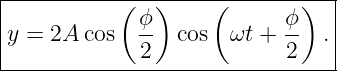
Use
Then
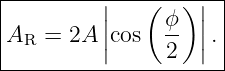
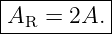
The resultant amplitude is therefore
4 Constructive interference
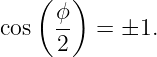
For
Thus
This is complete constructive interference for equal amplitudes.
5 Destructive interference
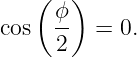
For
Thus
This is complete destructive interference.
Complete cancellation requires equal amplitudes.
If the amplitudes differ, the minimum resultant amplitude is
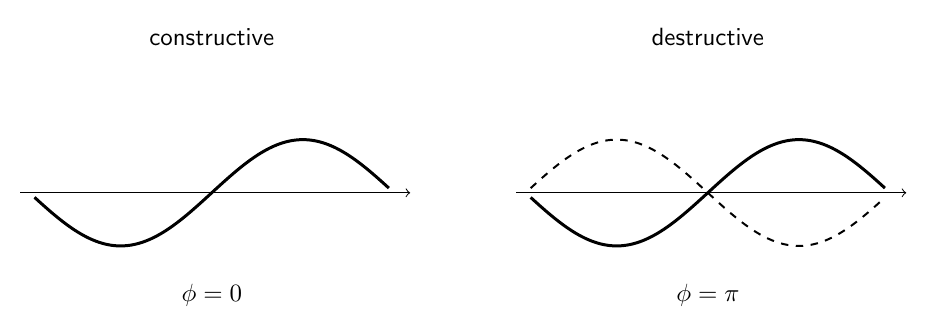
Figure 2. Equal-frequency waves interfere according to their phase difference. Equal amplitudes
give full reinforcement at zero phase difference and complete cancellation at a phase difference of
π.
6 Intensity interference
Measured wave intensity is usually proportional to the time average of the square of a field
amplitude.
For two coherent waves, the total intensity is
This interference term is the intensity counterpart of amplitude superposition.
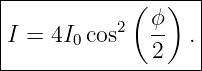
For equal intensities
Using
At constructive interference,
At destructive interference,
7 Why the maximum intensity can be four times one-source intensity
If two equal coherent waves are in phase, the field amplitude doubles.
Since intensity is proportional to amplitude squared,
Therefore the local maximum is four times the intensity due to either source separately.
This does not violate energy conservation.
Interference redistributes energy spatially.
Regions of enhancement are accompanied by regions of reduced intensity.
8 Fringe visibility
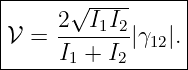
When the two source intensities are unequal,
and
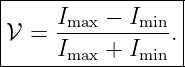
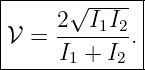
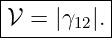
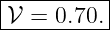
Define the visibility
Then for perfectly coherent waves,
The maximum visibility
occurs when
9 Phase difference from path difference
Suppose two coherent waves have the same frequency and wavelength
but travel different path lengths.
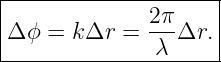
Let
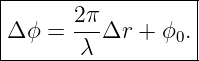
Then the propagation phase difference is
If the sources also begin with an intrinsic phase difference
then
10 Constructive and destructive path conditions
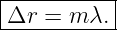
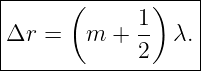
For sources in phase at emission,
Constructive interference occurs when
Destructive interference occurs when
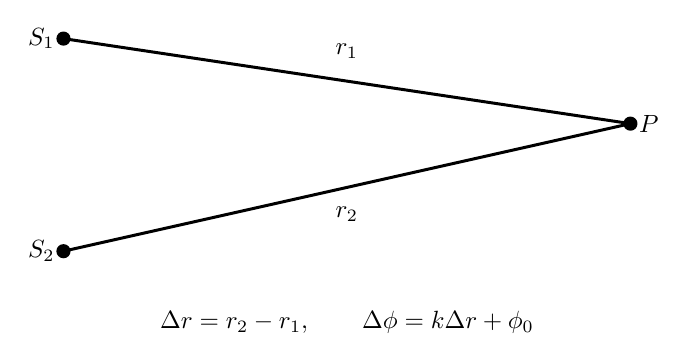
Figure 5. Two coherent sources can reach an observation point along different path lengths. The
resulting phase difference is kΔr plus any phase offset already present at emission.
11 Example 1: two-source sound interference
Two coherent acoustic sources emit the same frequency
in air with
The wavelength is
| λ | =  | (50)
|
| =  | (51)
|
| = 0.686 m. | (52) |
If the path difference is
then
For in-phase sources, the observation point therefore lies at a destructive-interference
condition.
12 Interference intensity as a function of phase
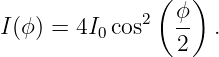
For equal coherent source intensities,
This pattern is periodic in phase with period
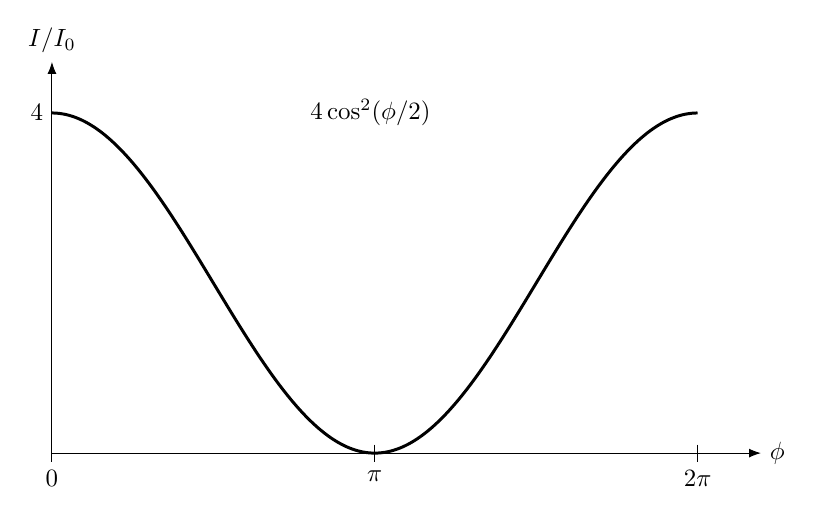
Figure 6. For two equal coherent waves, normalized intensity varies as 4cos2(ϕ∕2) relative to the
one-source intensity.
13 Beats from nearby frequencies
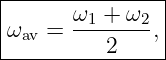
Now consider two equal-amplitude waves with slightly different angular frequencies:
and
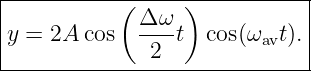
Their sum is
Using the sum identity,
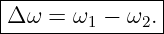
Define
and
Then
The rapidly oscillating factor acts like a carrier.
The slowly varying factor controls the envelope.
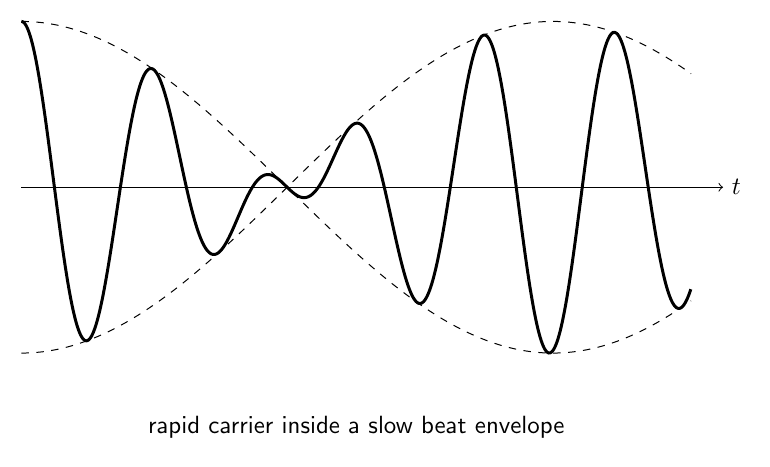
Figure 3. Two nearby frequencies produce a rapid oscillation inside a slowly varying envelope.
The repeated maxima of the envelope are heard or measured as beats.
14 Beat frequency
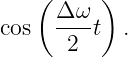
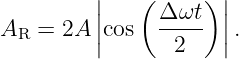
The signed envelope factor is
But a measured amplitude magnitude repeats whenever the cosine changes from
to
and back in magnitude.
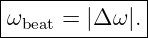
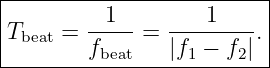
Therefore the beat angular frequency is
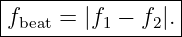
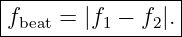
In ordinary frequency,
This factor-of-two distinction between the signed envelope cosine and the observed beat rate is a
common source of confusion.
15 Example 2: acoustic beats
Two tuning forks produce
and
Then
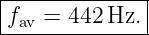
The rapid oscillation occurs near
A listener therefore hears a tone near
whose loudness rises and falls four times per second.
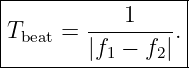
16 Beat period
The time between adjacent beat maxima is
For the previous example,
17 Unequal-amplitude beats
Let
and
The instantaneous squared resultant amplitude contains the phase-dependent combination
Therefore the envelope ranges between
and
Unequal amplitudes therefore produce incomplete beat minima.
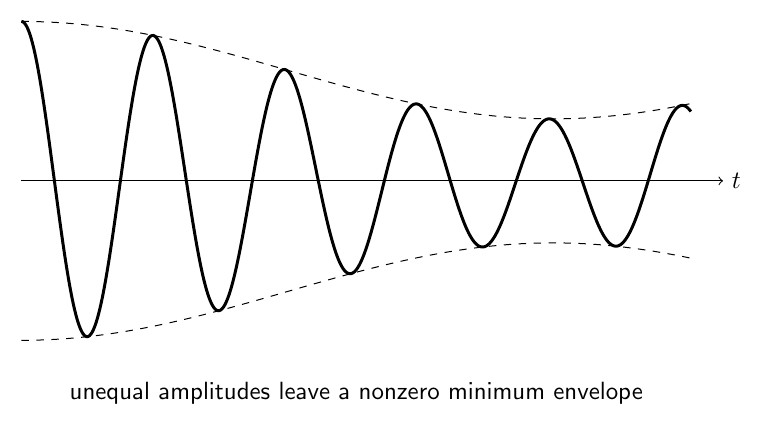
Figure 4. If the two nearby-frequency waves have unequal amplitudes, the beat minima do not
reach zero. The envelope ranges from |A1 − A2| to A1 + A2.
18 Beats in the frequency domain
M06-10 showed that a signal can be represented by its frequency spectrum.
A simple beat signal contains two narrow spectral components at
and
The slow beat modulation does not require a third independent physical frequency
source.
It arises from interference between the two nearby components.
This is an important connection between time-domain envelopes and frequency-domain
structure.
19 Standing waves as spatial interference
A Standing Wave is another form of interference.
Consider equal waves traveling in opposite directions:
and
Their sum is
Thus standing-wave nodes and antinodes are produced by spatially varying interference between
counter-propagating waves.
Beats and standing waves are mathematically related:
- beats arise from a small frequency difference,
- standing waves arise from a propagation-direction difference at the same frequency.
20 What coherence means
Interference requires more than simply overlapping waves.
The relative phase must remain sufficiently predictable during the measurement.
Two waves are coherent if their phase relation is stable enough that the interference term does not
average away.
Perfectly monochromatic waves with a fixed phase difference are ideally coherent.
Real sources have finite bandwidth and finite phase stability.
Coherence therefore has a finite time and length scale.
21 Why random phase destroys interference
For two waves,
Suppose
changes randomly and rapidly during the measurement.
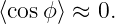
Then the time average approaches
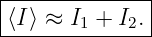
Thus
This is why independent incoherent sources usually contribute intensities rather than stable
interference fringes.
22 Temporal coherence
Temporal coherence describes phase correlation of a wave with itself at different times.
A source with a very narrow frequency spectrum maintains a predictable phase over a relatively
long time.
A source with broad bandwidth loses phase predictability more quickly.
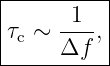
Define a characteristic coherence time
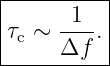
A rough inverse-bandwidth scaling is
The numerical coefficient depends on how bandwidth and coherence time are defined and on the
spectral shape.
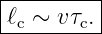
23 Coherence length
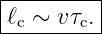
If the wave travels at speed
then the coherence length is of order
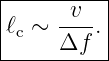
Using the inverse-bandwidth estimate,
Interference between paths with a difference much greater than the coherence length is strongly
reduced.
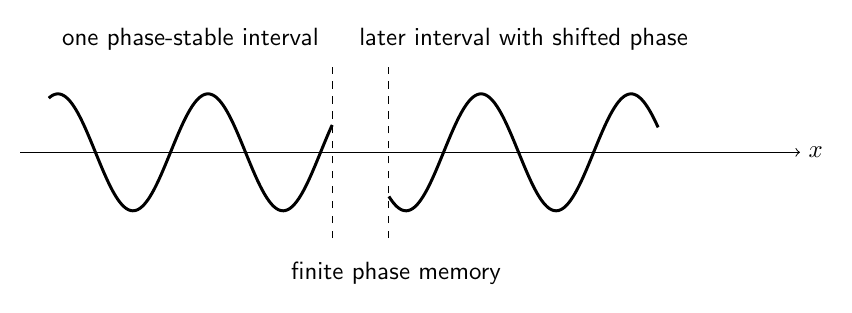
Figure 7. A real finite-bandwidth source can be pictured as maintaining a predictable phase only
over a finite wave-train scale. Path differences much larger than this scale wash out stable
interference.
24 Example 3: coherence estimate
Suppose an acoustic signal has effective bandwidth
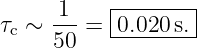
A rough coherence-time estimate is
Using
the corresponding coherence-length scale is
This is an order-of-magnitude estimate rather than an exact universal equality.
25 Spatial coherence
Temporal coherence concerns correlations separated in time.
Spatial coherence concerns phase correlations across different transverse positions in a wave
field.
An extended source generally has lower spatial coherence than a small source because different
source regions contribute with different phases.
Spatial coherence determines whether two separated sampling points can produce high-contrast
interference.
A complete treatment uses correlation functions, but the physical idea is simple:
Coherence measures how reliably phase information is shared between two
measurements of a wave field.
26 Complex degree of coherence
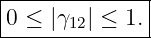
For a more general description, introduce the complex degree of coherence
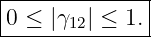
Its magnitude satisfies
For two fields, the interference intensity can be written
If
the fields are fully coherent.
If
the stable interference term vanishes.
27 Visibility and partial coherence
For equal source intensities and suitable phase scanning, the fringe visibility becomes
For unequal intensities,
Thus poor visibility can arise from:
- unequal source intensities,
- imperfect coherence,
- or both.
28 Coherence time, bandwidth, and wave packets
M06-10 showed that a narrow frequency spectrum produces a long spatial packet, while a broad
spectrum produces a short packet.
Coherence follows the same Fourier logic.
A narrow spectral width
corresponds to a long characteristic time scale.
A broad spectral width corresponds to a short characteristic time scale.
Thus temporal coherence is another manifestation of the reciprocal relationship between time
localization and frequency bandwidth.
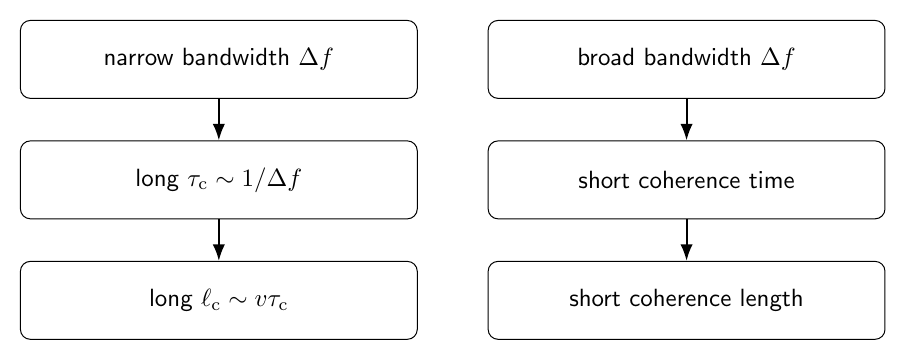
Figure 8. Narrow bandwidth corresponds to long coherence time and long coherence length, while
broad bandwidth corresponds to short phase memory. Exact numerical factors depend on the
spectral shape and chosen width convention.
29 Interference versus beats
It is useful to separate two related cases.
For equal frequencies,
the phase difference is constant in time.
The interference pattern is stationary.
For unequal frequencies,
the relative phase evolves:
The interference therefore cycles between reinforcement and cancellation.
That time-dependent interference is what produces beats.
30 Beats as moving phase difference
For equal amplitudes,
Using the identity
Thus a beat is simply interference whose relative phase continuously drifts.
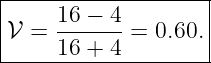
31 Example 4: unequal coherent intensities
Let
For full coherence,
The minimum is
Therefore
Perfect coherence does not guarantee unit visibility when the source intensities differ.
32 Example 5: partial coherence
Let two equal-intensity fields have
Then the maximum possible fringe visibility is
The intensity can be written
Therefore
and
33 Connection to acoustics
For coherent sound sources, pressure amplitudes superpose before intensity is calculated.
This allows:
- interference maxima and minima,
- active noise cancellation,
- beats between nearby tones,
- standing-wave patterns in rooms and ducts.
For independent sound sources whose relative phases fluctuate rapidly, long-time average
intensities approximately add instead.
This distinction is why acoustic phase information matters.
34 Connection to resonance
Beats can appear when two resonance frequencies lie close together.
Coupled oscillators from M06-04 provide a classic example.
If both nearby normal modes are excited, the observable motion may show periodic energy transfer
and an amplitude envelope at the difference frequency.
Thus beating provides a time-domain signature of closely spaced spectral components.
35 Connection to Fourier analysis
Interference and coherence are naturally described in Fourier language.
A perfectly monochromatic component has a sharply defined frequency and indefinitely long phase
memory in the ideal model.
A finite-bandwidth signal combines many nearby frequencies.
As those components acquire different phases, the field loses long-time phase predictability.
Therefore Fourier bandwidth and temporal coherence are reciprocal aspects of the same wave
structure.
36 Common mistakes
- Adding intensities directly when coherent amplitudes should be added first.
- Forgetting that destructive interference requires phase opposition and equal amplitudes
for complete cancellation.
- Using I1 + I2 for coherent fields with a fixed phase relation.
- Confusing phase difference with path difference.
- Forgetting the factor 2π∕λ in converting path difference to phase difference.
- Writing the beat frequency as (f1 − f2)∕2 instead of |f1 − f2|.
- Confusing the average carrier frequency with the beat frequency.
- Forgetting that unequal-amplitude beats do not fall to zero.
- Assuming two overlapping waves are automatically coherent.
- Treating coherence time as exactly 1∕Δf without specifying a bandwidth convention.
- Confusing temporal coherence with spatial coherence.
- Assuming poor fringe visibility always means poor coherence.
- Forgetting that unequal intensities also reduce visibility.
- Treating standing waves and beats as unrelated phenomena.
- Forgetting that beats are interference with a time-varying phase difference.
37 Practice exercises
- Derive the resultant amplitude of two same-frequency waves with amplitudes A1 and
A2 and phase difference ϕ.
- For equal amplitudes, derive the constructive and destructive interference conditions.
- Starting from amplitude addition, derive the coherent intensity formula
- Derive the visibility formula for two perfectly coherent waves of unequal intensities.
- Convert a path difference Δr into a phase difference.
- Determine the constructive and destructive path-difference conditions for two in-phase
sources.
- Derive the beat identity for two equal-amplitude nearby frequencies.
- Explain why the observed beat frequency is |f1 − f2|.
- Determine the beat period for two specified frequencies.
- Derive the maximum and minimum envelopes for unequal-amplitude beats.
- Show how a standing wave results from interference of equal counter-propagating waves.
- Explain why rapidly fluctuating random phase causes the interference term to average
toward zero.
- Estimate coherence time and coherence length from a specified bandwidth.
- For unequal intensities and specified |γ12|, calculate the maximum fringe visibility.
- Explain the Fourier connection between narrow bandwidth and long coherence time.
38 Summary
Linear waves obey superposition:
For two same-frequency waves,
For coherent intensities,
Path difference produces phase difference:
For two nearby frequencies,
The beat period is
For unequal beat amplitudes,
A rough temporal-coherence scaling is
with coherence length
Partial coherence can be represented by
Interference, beats, standing waves, and coherence are therefore not isolated topics. They are
different consequences of superposition, phase evolution, and spectral content.
References
References
[1] PhysicsLibrary, M06-12, Acoustic Resonance in Pipes and Helmholtz Resonators.
[2] PhysicsLibrary, M06-11, Acoustic Waves, Sound Intensity, and Acoustic Impedance.
[3] PhysicsLibrary, M06-10, Fourier Analysis, Wave Packets, and Dispersion.
[4] A. P. French, Vibrations and Waves, W. W. Norton, 1971.
[5] L. E. Kinsler, A. R. Frey, A. B. Coppens, and J. V. Sanders, Fundamentals of
Acoustics, 4th ed., Wiley, 2000.