Newton’s Shell Theorem and Spherical Mass Distributions
M07-02 developed gravitational fields by superposition and introduced continuous mass
distributions.
Spherical symmetry makes those integrals much more powerful.
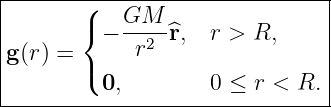
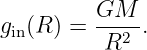
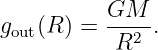
Newton’s shell theorem consists of two results for a thin spherical shell of uniform surface mass
density.
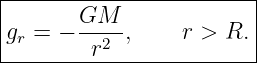
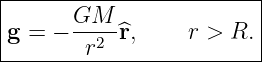
- Outside the shell, The Gravitational Field is exactly the same as if the shell’s entire
mass were concentrated at its center.
- Everywhere inside the shell, the gravitational field is exactly zero.
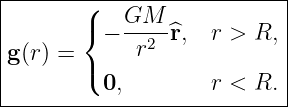
For a shell of radius
and total mass
the result is
These statements are stronger than far-field approximations.
For a perfectly spherical shell, they are exact.
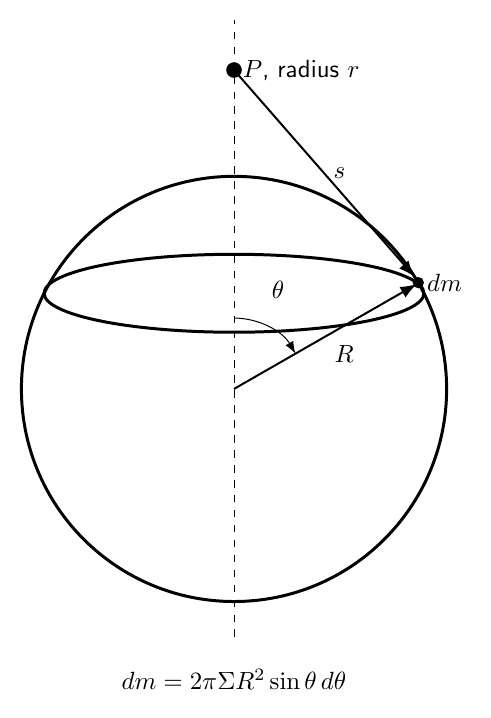
Figure 1. A field point on the symmetry axis of a thin spherical shell. A narrow ring at polar
angle 𝜃 provides the elementary mass used in the direct shell-theorem integration.
1 Why the shell theorem matters
The shell theorem converts many three-dimensional gravitational integrals into one-dimensional
enclosed-mass calculations.
A spherically symmetric body can be viewed as a collection of concentric thin shells.
For a point at radius
all shells lying outside that point contribute zero field.
All shells lying inside that point act as though their masses were concentrated at the
center.
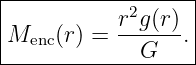
Therefore only the mass enclosed within radius
determines the field.
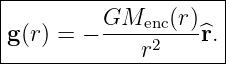
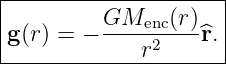
This leads to
2 Geometry of a thin spherical shell
Consider a thin spherical shell:
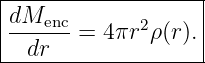
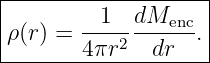
- radius R,
- uniform surface mass density Σ,
- total mass M = 4πR2Σ.
Place the observation point on the positive
axis at distance
from the center.
By spherical symmetry, the total field can only point along the radial direction.
Use a narrow ring on the shell between polar angles
and
The ring circumference is
Its meridional width is
Therefore the ring area is
Its mass is
3 Distance from ring to observation point
Every point on the narrow ring lies the same distance
from the observation point.
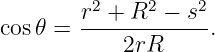
By the law of cosines,
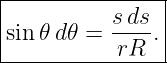
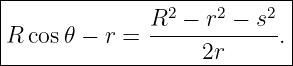
Differentiating,
Thus
This substitution will make the shell integral elementary.
4 Radial component of the ring field
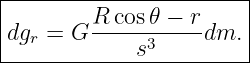
The vector from the observation point to a source element has radial component
Therefore the radial field contribution of the ring is
Substitute the ring mass:
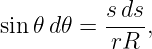
Now use
Then
5 Transforming the shell integral
Using
we obtain
| dgr | = 2πGΣR2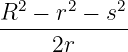   | (25)
|
| = πGΣ 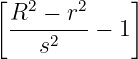 ds. | (26) |
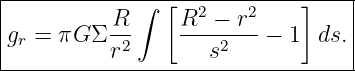
Thus
An antiderivative is
The only remaining issue is the integration limits.
6 Distance limits
At the near pole,
so
At the far pole,
so
Therefore
The absolute value is what distinguishes an exterior point from an interior point.
7 Shell theorem outside the shell
First take
Then
The upper endpoint gives
− − (r + R) | = −2R. | (36) |
The lower endpoint gives
− − (r − R) | = 2R. | (37) |
The difference is
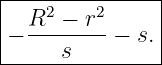
Hence
| gr | = πGΣ (−4R) | (39)
|
| = − . | (40) |
Since
Therefore
The exterior field is exactly the point-mass field.
8 Shell theorem inside the shell
Now take
Then
The upper endpoint again gives
The lower endpoint now gives
Their difference is zero.
Therefore
At the exact center,
symmetry also gives zero field.
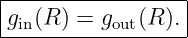
Thus
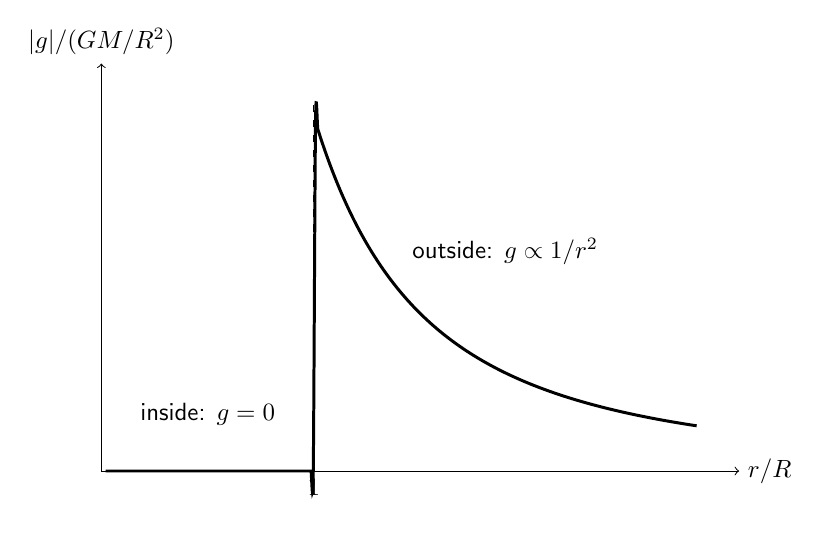
Figure 2. The field of a thin uniform spherical shell is zero throughout the interior and follows the
point-mass inverse-square law outside the shell. The ideal thin-shell field has different one-sided
limits at the surface.
9 What happens at the shell surface
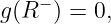
For the ideal infinitely thin shell,
while
Thus the Normal component of the field has a finite jump across the ideal surface mass
layer:
Exactly on an ideal infinitesimally thin shell, the local point-source idealization requires
care.
For real matter with finite thickness, the field varies continuously through the material.
10 Why the inside result is not obvious
A point inside the shell is generally closer to one side than to the other.
Nearby mass elements therefore exert stronger forces individually.
However, the farther side contains a larger area of shell subtending the corresponding
directions.
For a uniform spherical shell, these effects cancel exactly.
The result depends on both:
- inverse-square gravity,
- spherical geometry.
11 Building a spherical body from shells
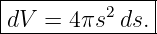
Now consider a spherically symmetric volume density
Divide the body into thin spherical shells of radius
and thickness
A shell has volume
Its mass is
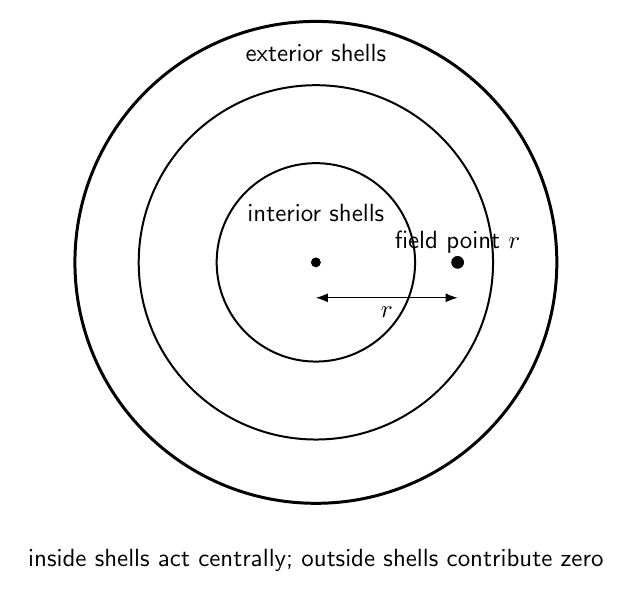
Figure 3. A spherically symmetric body can be decomposed into concentric thin shells. At radius
r, exterior shells contribute zero field while interior shells act collectively like their mass were
concentrated at the center.
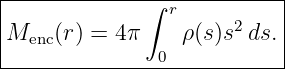
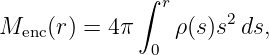
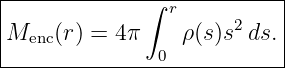
12 Enclosed mass
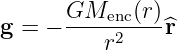
Define the mass enclosed within radius
For a field point inside the body:
- shells with s > r contribute zero,
- shells with s < r act like central point masses.
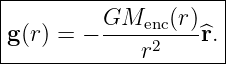
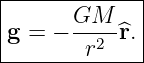
Therefore
This is the fundamental field formula for any spherically symmetric Newtonian mass
distribution.
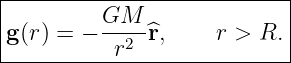
13 Outside a spherical mass distribution
Suppose all matter lies within radius
For
every shell lies inside the field point.
Thus
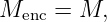
where
is total mass.
Hence
This proves the exact point-mass result for every spherically symmetric body, not merely a thin
shell.
14 Uniform solid sphere
Let a sphere have:
- radius R,
- total mass M,
- constant density ρ.
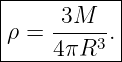
Its density is
For
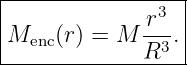
the enclosed mass is
| Menc(r) | = 4πρ∫
0rs2 ds | (69)
|
| =  . | (70) |
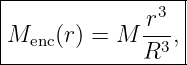
Using the total mass,
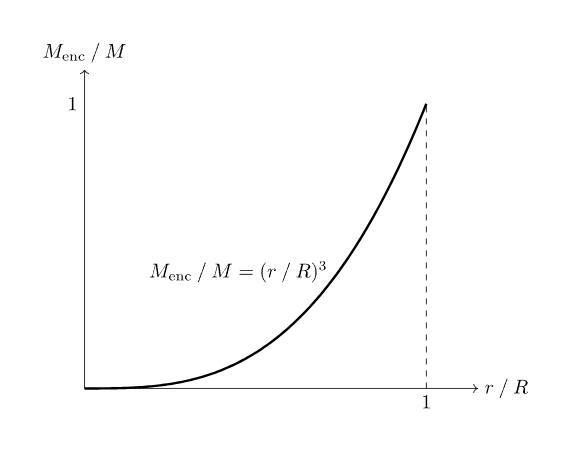
Figure 4. In a uniform solid sphere, enclosed mass grows as r3 because both density and the
spherical volume factor are constant.
15 Field inside a uniform solid sphere
Insert
into the enclosed-mass field formula:
| g(r) | = − M  r | (73)
|
| = − rr. | (74) |
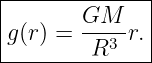
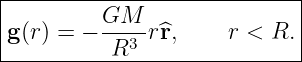
Thus inside a uniform sphere,
The field magnitude increases linearly from zero at the center to
at the surface.
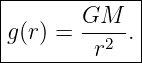
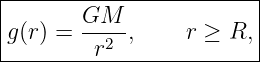
Outside,
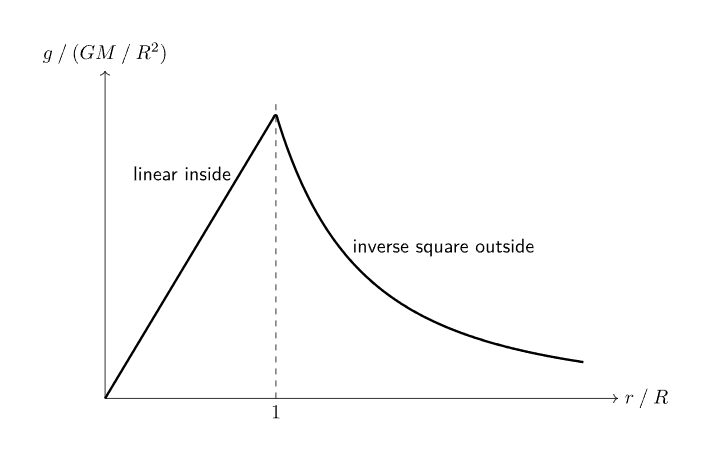
Figure 5. The field magnitude of a uniform solid sphere rises linearly inside the matter, reaches its
maximum at the surface, and then falls with the inverse square of distance outside.
16 Continuity at the surface
The inside value at
is
The outside value at
is
Therefore
Unlike an infinitely thin surface shell, a finite volume density does not create a jump in the
gravitational field itself at the outer boundary.
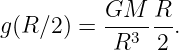
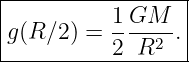
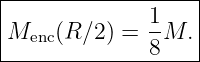
17 Example 1: uniform sphere field halfway to the surface
At
the uniform-sphere interior field is
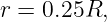
Thus
The enclosed mass there is only
The factor
compensates part of the smaller enclosed mass, giving half the surface field.
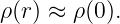
18 Small-radius behavior for a general smooth density
Suppose
remains finite near the center.
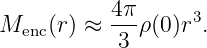
Then for sufficiently small
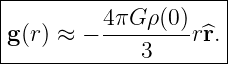
Therefore
Hence
A regular spherical density distribution therefore has approximately linear gravitational field near
its center.
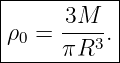
19 Mean density and surface gravity
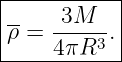
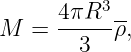
The mean density of a sphere is
Since
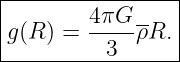
the surface field is
For bodies with the same mean density, surface gravity is proportional to radius.
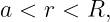
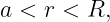
20 Thick hollow spherical shell
Consider a uniform-density spherical body occupying
with density
There is a concentric empty cavity of radius
For
every mass shell lies outside the field point.
Therefore
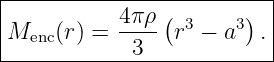
For
the enclosed mass is
Thus
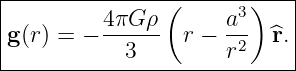
For
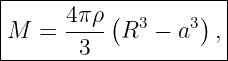
the total shell mass is
and
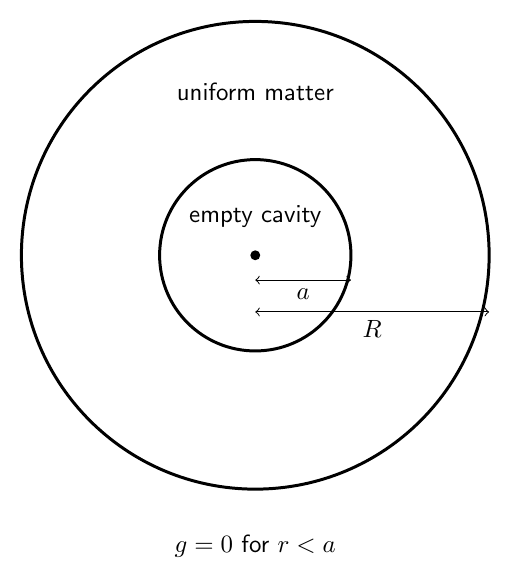
Figure 6. A concentric hollow region contains no gravitational field. Within the material, only
mass between the inner cavity radius and the field-point radius contributes.
21 Nonuniform radial density example
Consider
The density is greatest at the center and falls linearly to zero at the surface.
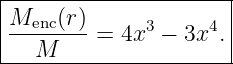
The enclosed mass is
| Menc(r) | = 4πρ0 ∫
0r s2 ds | (108)
|
| = 4πρ0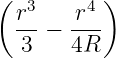 . | (109) |
Therefore
The field points inward.
22 Total mass of the nonuniform example
Set
Then
| M | = 4πρ0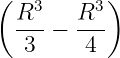 | (112)
|
| =  . | (113) |
Thus
Introduce
Then
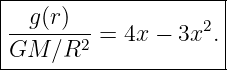
The interior field relative to the surface scale
is
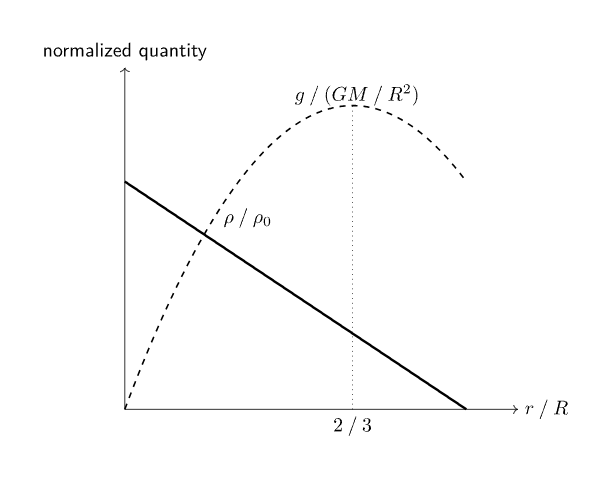
Figure 7. For the example ρ(r) = ρ0(1 − r∕R), mass is more centrally concentrated than in a
uniform sphere. The interior field reaches a maximum before the surface.
23 Maximum field in the nonuniform example
Let
Then
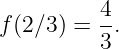
The interior maximum occurs at
At that radius,
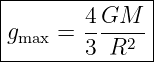
Thus
for this particular density model.
Unlike a uniform sphere, the maximum field need not occur at the surface.
24 Example 2: Earth-like spherical model
For a spherical body with total mass
and radius
the external field is exactly
provided the mass distribution is spherically symmetric.
This justifies the point-mass form used in M07-01 for a spherical Earth model.
The theorem does not require uniform density outside the observation point.
It requires spherical symmetry.
25 Example 3: field inside a uniform spherical planet
Suppose a uniform spherical planet has
and surface gravitational field
At
the uniform-sphere result gives
At the center,
26 The shell theorem is about spherical symmetry
The point-mass exterior result does not hold exactly for an arbitrary nonspherical body at finite
distance.
A nonspherical body can have:
- direction-dependent corrections,
- higher multipole moments,
- local departures from radial symmetry.
Far from any localized body, the leading field approaches the point-mass term.
For a perfectly spherical body, however, all higher nonspherical corrections vanish exactly.
27 Enclosed mass is not total mass inside matter
For
the field is not generally
using the body’s total mass.
The correct quantity is
Outer spherical shells exert zero net field on interior points.
This is one of the most common errors in interior-gravity problems.
28 Field direction
For positive mass distributions,
Therefore
always points inward.
When plotting only the field magnitude,
the inward direction must still be remembered.
29 A useful derivative relation
From
the fundamental theorem of calculus gives
This relation connects local density to the rate at which enclosed mass grows.
It is useful whenever a density profile is specified.
30 Recovering density from enclosed mass
If
is known,
Likewise, if the radial gravitational field magnitude is known and
then
Thus measurements of spherical gravity can constrain the interior mass distribution.
31 Why potential is the next useful tool
The shell theorem makes spherical gravitational fields easy to compute.
However, many orbital and escape problems involve work and energy rather than force
directly.
The natural next quantity is gravitational potential.
M07-04 will introduce:
- gravitational potential energy,
- gravitational potential,
- the relation between field and potential,
- escape energy and escape speed.
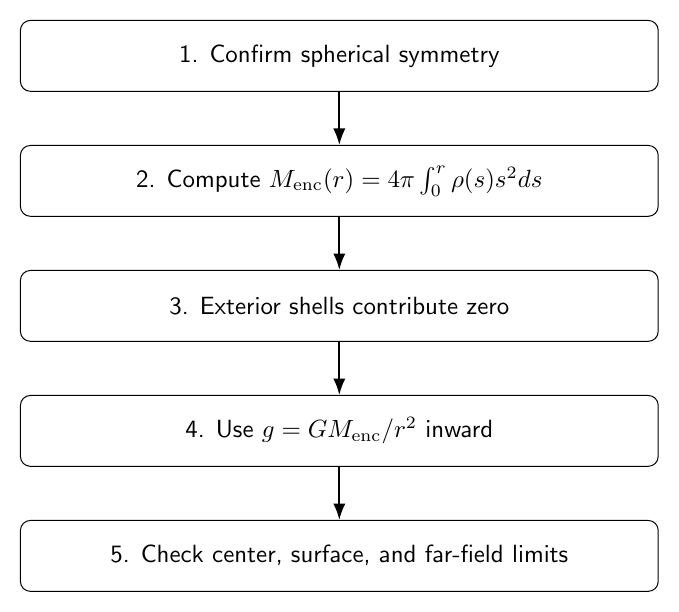
Figure 8. For a spherically symmetric source, determine enclosed mass first. Interior shells
contribute as central mass, exterior shells contribute zero, and the field follows immediately from
GMenc∕r2.
32 Common mistakes
- Treating the exterior shell theorem as only a far-field approximation.
- Assuming the field inside a thin shell follows GM∕r2.
- Forgetting the absolute value in the near-distance limit |r − R| during the direct shell
integration.
- Using total body mass instead of enclosed mass for an interior field point.
- Forgetting that outer concentric shells contribute zero field inside them.
- Assuming the shell theorem holds exactly for nonspherical bodies.
- Confusing the zero field inside a shell with zero gravitational potential.
- Treating the ideal thin-shell field as continuous across the surface.
- Forgetting the factor 4πr2 in a spherical volume element.
- Writing Menc ∝ r2 for a uniform sphere instead of r3.
- Expecting the field of a uniform solid sphere to follow an inverse-square law inside the
matter.
- Forgetting that the field is zero at the center of any regular spherical density
distribution.
- Assuming the maximum gravitational field must always occur at the outer surface.
- Forgetting that dMenc∕dr = 4πr2ρ(r).
- Using the point-mass exterior result before checking spherical symmetry.
33 Practice exercises
- Derive the mass of a narrow ring on a thin spherical shell.
- Starting from the law of cosines, derive the substitution sin 𝜃 d𝜃 = sds∕(rR).
- Complete the shell integral for r > R and recover the point-mass field.
- Complete the shell integral for r < R and show that the field vanishes.
- Evaluate the one-sided field limits at the surface of an ideal thin shell.
- Derive Menc(r) for an arbitrary spherical density ρ(r).
- Prove g = −GMenc(r)r∕r2 using concentric shells.
- Derive the uniform-solid-sphere interior field.
- Show that the uniform-sphere field is continuous at r = R.
- Show that any finite central density gives a field linear in r near the center.
- Derive the field of a uniform thick shell with inner radius a and outer radius R.
- Derive the enclosed mass for ρ(r) = ρ0(1 − r∕R).
- Show that the nonuniform example has maximum interior field at r = 2R∕3.
- Derive the relation dMenc∕dr = 4πr2ρ(r).
- Explain why a nonspherical body need not produce an exact point-mass field outside
itself.
34 Summary
For a thin spherical shell of radius
and mass
Newton’s shell theorem gives
A spherically symmetric body can be assembled from concentric shells.
Its enclosed mass is
The field is
Outside the entire body,
so the exact point-mass field is recovered.
For a uniform solid sphere,
and
The shell theorem is therefore the key bridge from continuous spherical matter to simple radial
gravitational dynamics.
References
References
[1] PhysicsLibrary, M07-02, Gravitational Fields, Superposition, and Continuous Mass
Distributions.
[2] PhysicsLibrary, M07-01, Newton’s Law of Universal Gravitation.
[3] I. Newton, Philosophiae Naturalis Principia Mathematica, 1687.
[4] J. R. Taylor, Classical Mechanics, University Science Books, 2005.
[5] D. Kleppner and R. Kolenkow, An Introduction to Mechanics, 2nd ed., Cambridge
University Press, 2014.