Physics Library
 An open source physics library
Encyclopedia | Forums | Docs | Random  

[parent] GRE Physics Companion: Acoustic Resonance in Pipes and Helmholtz Resonators

(Example)

GRE Physics Companion: Acoustic Resonance in Pipes and Helmholtz Resonators

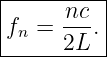
For an ideal open-open pipe,

|-----nc--|
fn =  --. |
------2L---
(1)

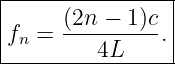
For an ideal closed-open pipe,

|----------------|
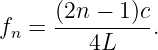
|     (2n-−-1-)c- |
|fn =     4L    .|
-----------------
(2)

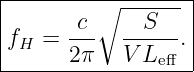
For a Helmholtz resonator,

|------------------|
|         ∘ ------ |
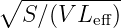
|fH =  -c-  --S---.|
-------2π---V-Leff--
(3)

PIC

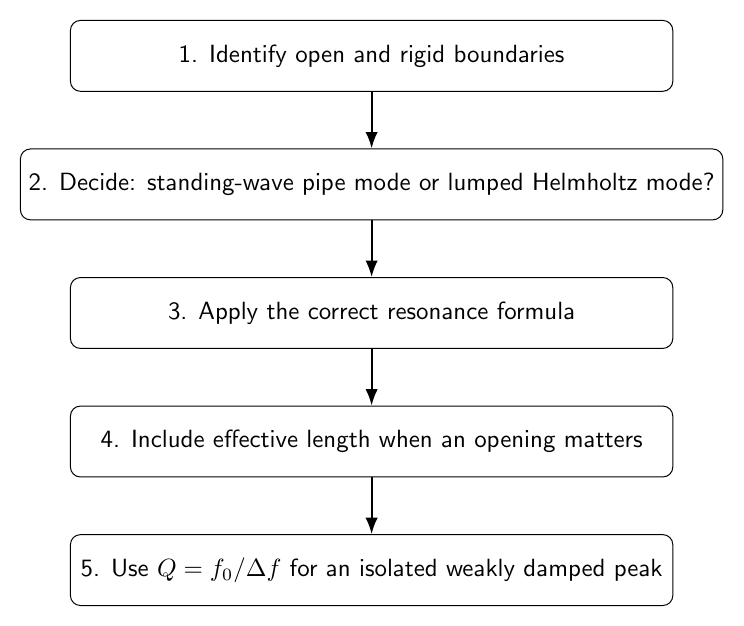
Figure 1. A compact resonance strategy: identify the boundary conditions, determine whether the system is distributed or lumped, choose the correct resonance formula, then include end correction or damping when required.

1 High-value GRE facts

  1. Open end: pressure node, particle-velocity antinode.
  2. Rigid closed end: pressure antinode, particle-velocity node.
  3. Open-open pipe: fn = nc∕(2L).
  4. Closed-open pipe: fn = (2n − 1)c∕(4L).
  5. Closed-open pipes support odd harmonics in the ideal model.
  6. Real open ends make the effective acoustic length longer than the geometric length.
  7. Increasing effective length lowers resonance frequency.
  8. Helmholtz resonance is lumped, not a quarter-wave standing-wave mode.
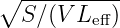
  9. fH ∝∘ ----------
  S∕ (V Leff ).
  10. For an isolated weakly damped resonance, Q = f0∕Δf.

Part I: Original GRE-style problems

Problem 1: open-open fundamental

An ideal pipe of length

L
(4)

is open at both ends. Its fundamental frequency is

  1. c∕(4L)
  2. c∕(2L)
  3. c∕L
  4. 2c∕L
  5. 4c∕L

Problem 2: closed-open fundamental

A pipe of length

L
(5)

is rigidly closed at one end and open at the other. Its fundamental frequency is

  1. c∕(4L)
  2. c∕(2L)
  3. c∕L
  4. 2c∕L
  5. 4c∕L

Problem 3: open-end boundary

At an ideal open pipe end,

  1. pressure has an antinode and particle velocity a node
  2. pressure has a node and particle velocity an antinode
  3. both pressure and particle velocity have nodes
  4. both have antinodes
  5. neither has a standing-wave condition

Problem 4: closed-open harmonic content

The first three ideal resonances of a closed-open pipe are proportional to

  1. 1, 2, 3
  2. 1, 3, 5
  3. 2, 4, 6
  4. 1, 4, 9
  5. 1, 2, 4

Problem 5: end correction

Including a positive open-end correction generally

  1. increases effective length and lowers frequency
  2. increases effective length and raises frequency
  3. decreases effective length and lowers frequency
  4. does not affect resonance frequency
  5. changes sound speed rather than acoustic length

Problem 6: numerical open pipe

For

L = 0.750 m,     c = 343 m ∕s,
(6)

the ideal open-open fundamental is closest to

  1. 57.2 Hz
  2. 114 Hz
  3. 229 Hz
  4. 343 Hz
  5. 457 Hz

Problem 7: Helmholtz scaling with volume

If the cavity volume of a Helmholtz resonator is increased by a factor of

4
(7)

with all other parameters fixed, its resonance frequency becomes

  1. four times as large
  2. twice as large
  3. unchanged
  4. one half as large
  5. one fourth as large

Problem 8: Helmholtz scaling with neck area

If neck area is increased by a factor of

4
(8)

while cavity volume and effective neck length remain fixed, the Helmholtz frequency becomes

  1. one fourth as large
  2. one half as large
  3. unchanged
  4. twice as large
  5. four times as large

Problem 9: effective neck mass

The effective moving mass in the elementary Helmholtz model is

  1. ρ0V
  2. ρ0SLeff
  3. ρ0S∕Leff
  4. V Leff∕ρ0
  5. ρ0cS

Problem 10: acoustic compliance

The acoustic compliance of the cavity is

  1. ρ0c2∕V
  2. V∕(ρ0c2)
  3. ρ0V∕c2
  4. c2∕(ρ 0V )
  5. S∕(ρ0c)

Problem 11: numerical Helmholtz resonance

A resonator has

              −3  3
V =  1.00 × 10   m  ,
(9)

S =  3.142 × 10⁻⁴ m2,
(10)

and

L   = 0.0500 m.
 eff
(11)

Take

c = 343 m ∕s.
(12)

The resonance frequency is closest to

  1. 34 Hz
  2. 69 Hz
  3. 137 Hz
  4. 274 Hz
  5. 686 Hz

Problem 12: quality factor

A resonance has

f0 = 500Hz,
(13)

and half-power frequencies

490 Hz
(14)

and

510 Hz.
(15)

Its quality factor is

  1. 5
  2. 10
  3. 20
  4. 25
  5. 50

Part II: Complete worked solutions

Solution 1

For an open-open pipe,

f1 = -c-.
     2L
(16)

Answer: (B).

Solution 2

For a closed-open quarter-wave resonator,

f  = -c-.
 1   4L
(17)

Answer: (A).

Solution 3

An ideal open end is approximately a pressure node and particle-velocity antinode. Answer: (B).

Solution 4

The closed-open spectrum is

     (2n-−-1-)c-
fn =     4L    .
(18)

Thus the sequence is

1,3,5,...
(19)

times the fundamental. Answer: (B).

Solution 5

A positive end correction increases the effective acoustic length. Since

f ∝  -1-,
     Leff
(20)

the resonance frequency decreases. Answer: (A).

Solution 6

f1 = ---343--
2 (0.750) (21)
≈ 228.7 Hz. (22)

Answer: (C).

Solution 7

For a Helmholtz resonator,

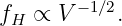
f  ∝ V −1∕2.
 H
(23)

Therefore multiplying

V
(24)

by

4
(25)

divides the frequency by

2.
(26)

Answer: (D).

Solution 8

Since

     √ --
fH ∝   S,
(27)

multiplying

S
(28)

by

4
(29)

doubles the resonance frequency. Answer: (D).

Solution 9

The neck plug has approximate volume

SLe ff.
(30)

Thus

me ff = ρ0SLe ff.
(31)

Answer: (B).

Solution 10

The cavity pressure-volume relation gives

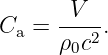
       V
Ca =  ρ-c2.
       0
(32)

Answer: (B).

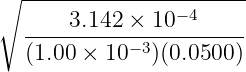
Solution 11

fH = 343
----
2π∘  ----------------------
       3.142 × 10− 4
   ----------−3---------
   (1.00 ×  10  )(0.0500 ) (33)
≈ 136.8 Hz. (34)

Answer: (C).

Solution 12

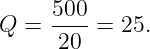
The bandwidth is

Δf  =  510 − 490 = 20 Hz.
(35)

Thus

Q  = 500- = 25.
      20
(36)

Answer: (D).

2 GRE checklist

  1. Translate open and closed ends into pressure and particle-velocity node conditions first.
  2. Use c∕(2L) only for half-wave fundamentals such as open-open pipes.
  3. Use c∕(4L) for an ideal closed-open quarter-wave fundamental.
  4. Remember the odd-harmonic sequence for a closed-open pipe.
  5. End correction increases acoustic length and therefore lowers resonance frequency.
  6. Distinguish a pipe standing-wave resonance from a Helmholtz lumped resonance.
  7. Read Helmholtz scaling directly from fH ∝∘ ----------
  S ∕(V Leff).
  8. For an isolated weakly damped resonance, use Q = f0∕Δf.

References

References

[1]   PhysicsLibrary, M06-11, Acoustic Waves, Sound Intensity, and Acoustic Impedance.

[2]   PhysicsLibrary, M06-03, Driven Harmonic Motion and Resonance.

[3]   A. P. French, Vibrations and Waves, W. W. Norton, 1971.

[4]   L. E. Kinsler, A. R. Frey, A. B. Coppens, and J. V. Sanders, Fundamentals of Acoustics, 4th ed., Wiley, 2000.


"GRE Physics Companion: Acoustic Resonance in Pipes and Helmholtz Resonators" is owned by bloftin.
(view preamble)
View style:
Other names:  M06-12G
Keywords:  GRE physics, acoustic resonance, open pipe, closed pipe, Helmholtz resonator, end correction, standing waves, quality factor

This object's parent.

Cross-references: relation, spectrum, acoustic compliance, mass, effective neck length, parameters, volume, speed, frequency, particle velocity, fundamental frequency, resonance frequency, harmonics, antinode, node, end correction, formula, system, boundary, resonance, Helmholtz resonator

This is version 1 of GRE Physics Companion: Acoustic Resonance in Pipes and Helmholtz Resonators, born on 2026-10-23.
Object id is 1526, canonical name is GREPhysicsCompanionAcousticResonanceInPipesAndHelmholtzResonators.
Accessed 6 times total.

Classification:
Physics Classification: 45.50.-j (Dynamics and kinematics of a particle and a system of particles)
 45.05.+x (General theory of classical mechanics of discrete systems)

Pending Errata and Addenda

None.

Discussion

No messages.

Interact