Physics Library
 An open source physics library
Encyclopedia | Forums | Docs | Random  

[parent] GRE Physics Companion: Acoustic Waves, Sound Intensity, and Acoustic Impedance

(Example)

GRE Physics Companion: Acoustic Waves, Sound Intensity, and Acoustic Impedance

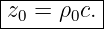
For a plane acoustic wave in a fluid,

|--------|
z0-=-ρ0c.-
(1)

The pressure and particle-velocity amplitudes satisfy

|--------|
-^p-=-z0^u-|
(2)

for positive-direction propagation.

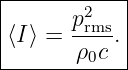
The average intensity is

|-----------|
|      2    |
⟨I⟩ = prms. |
-------ρ0c---
(3)

PIC

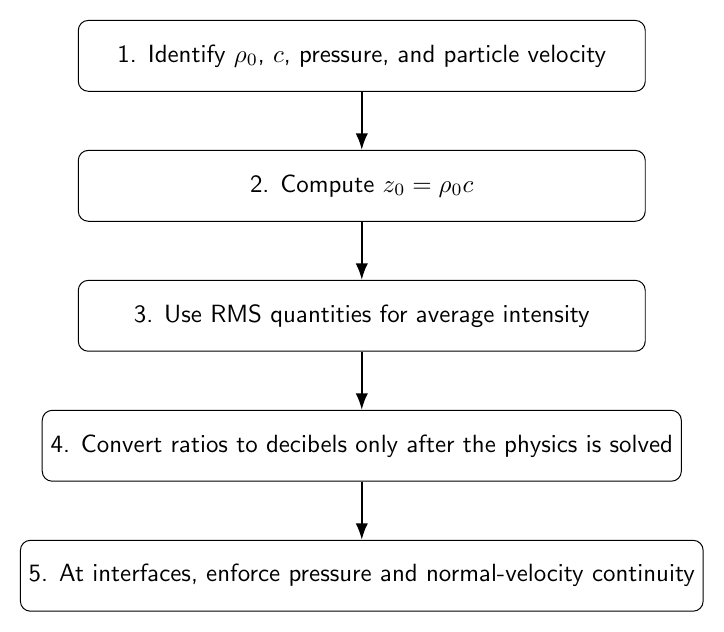
Figure 1. A compact acoustics strategy: identify the medium properties, compute c and ρ0c, connect pressure to particle velocity, use RMS quantities for intensity, and apply pressure and velocity continuity at an interface.

1 High-value GRE facts

  1. c2 = (∂p∕∂ρ) s.
  2. For an ideal gas, c = ∘ γp-∕ρ--
    0   0.
  3. z0 = ρ0c.
  4. For a right-moving plane wave, p′ = z0u.
  5. ⟨I⟩ = prms2∕z 0 = z0urms2.
  6. LI = 10 log 10(I∕Iref).
  7. Lp = 20 log 10(prms∕pref).
  8. Doubling ideal free-field distance lowers level by about 6 dB.
  9. Pressure reflection at a fluid interface is (z2 − z1)∕(z1 + z2).
  10. A rigid wall is a pressure antinode and particle-velocity node.

Part I: Original GRE-style problems

Problem 1: characteristic impedance

For a progressive plane wave in a fluid, the characteristic specific acoustic impedance is

  1. ρ0∕c
  2. ρ0c
  3. c∕ρ0
  4. ρ0c2
  5. 1∕(ρ0c)

Problem 2: intensity

The average intensity of a harmonic plane wave is

  1. prmsρ0c
  2. prms2∕(ρ 0c)
  3. prms∕(ρ0c)
  4. ρ0c∕prms2
  5. independent of pressure

Problem 3: right-moving pressure and velocity

For a right-moving progressive plane wave,

  1. pressure and particle velocity differ by 90∘
  2. pressure and particle velocity are in phase
  3. particle velocity is always zero
  4. pressure is always zero
  5. pressure and particle velocity have unrelated frequencies

Problem 4: intensity level

Increasing intensity by a factor of

100
(4)

changes the sound intensity level by

  1. 2 dB
  2. 10 dB
  3. 20 dB
  4. 40 dB
  5. 100 dB

Problem 5: pressure level

Increasing RMS pressure by a factor of

10
(5)

at fixed impedance changes sound pressure level by

  1. 3 dB
  2. 6 dB
  3. 10 dB
  4. 20 dB
  5. 100 dB

Problem 6: distance doubling

For an ideal isotropic point source in a lossless free field, doubling distance changes the intensity level by approximately

  1. +6 dB
  2. −6 dB
  3. +3 dB
  4. −3 dB
  5. 0 dB

Problem 7: pressure reflection

At Normal incidence from medium 1 to medium 2, the pressure reflection coefficient is

  1. (z1 − z2)∕(z1 + z2)
  2. (z2 − z1)∕(z1 + z2)
  3. 2z1∕(z1 + z2)
  4. 2z2∕(z1 + z2)
  5. z1z2

Problem 8: matched interface

If

z1 = z2,
(6)

then the pressure reflection coefficient is

  1. −1
  2. +1
  3. 0
  4. 1∕2
  5. infinite

Problem 9: rigid wall

At an ideal rigid wall,

  1. pressure is a node and particle velocity an antinode
  2. pressure is an antinode and particle velocity a node
  3. both pressure and particle velocity are nodes
  4. both are antinodes
  5. no reflection occurs

Problem 10: air intensity

Take

               3
ρ0 = 1.204 kg∕m  ,   c = 343 m ∕s,
(7)

and

prms = 0.200 Pa.
(8)

The intensity is closest to

  1. 9.7 × 10⁻⁷ W∕m2
  2. 9.7 × 10⁻⁵ W∕m2
  3. 4.1 × 10⁻² W∕m2
  4. 0.200 W∕m2
  5. 413 W∕m2

Problem 11: pressure level

For

p    = 0.200Pa
 rms
(9)

and

pref = 20 μPa,
(10)

the sound pressure level is

  1. 20 dB
  2. 40 dB
  3. 60 dB
  4. 80 dB
  5. 100 dB

Problem 12: two equal incoherent sources

Two independent incoherent sources each produce intensity

I.
(11)

Together they increase the level by approximately

  1. 1 dB
  2. 3 dB
  3. 6 dB
  4. 10 dB
  5. 20 dB

Part II: Complete worked solutions

Solution 1

For a progressive plane wave,

z0 = ρ0c.
(12)

Answer: (B).

Solution 2

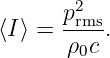
Using RMS pressure,

      p2
⟨I⟩ = -rms.
       ρ0c
(13)

Answer: (B).

Solution 3

For positive-direction propagation,

 ′
p = ρ0cu.
(14)

Thus pressure and particle velocity are in phase. Answer: (B).

Solution 4

10 log10(100) = 20 dB.
(15)

Answer: (C).

Solution 5

20 log10(10) = 20dB.
(16)

Answer: (D).

Solution 6

Ideal spherical spreading gives

I ∝ r−2.
(17)

Doubling distance gives

10 log10(1∕4 ) ≈ − 6.02 dB.
(18)

Answer: (B).

Solution 7

Pressure and normal particle-velocity continuity give

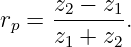
     z  − z
rp = -2----1.
     z1 + z2
(19)

Answer: (B).

Solution 8

If

z =  z ,
 1    2
(20)

then

rp = 0.
(21)

Answer: (C).

Solution 9

A rigid wall requires

u = 0.
(22)

Thus particle velocity is a node and pressure is an antinode. Answer: (B).

Solution 10

First,

z0 = (1.204)(343) ≈ 413 Pa s∕m.
(23)

Then

⟨I⟩ = (0.200 )2
--------
  413 (24)
≈ 9.7 × 10⁻⁵ W∕m2. (25)

Answer: (B).

Solution 11

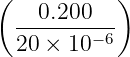
Lp = 20 log 10(          )
  --0.200---
  20 × 10−6 (26)
= 20 log 10(104) (27)
= 80 dB. (28)

Answer: (D).

Solution 12

The total intensity is

2I.
(29)

Thus

10 log  (2) ≈ 3.01 dB.
      10
(30)

Answer: (B).

2 GRE checklist

  1. Distinguish wave speed from particle velocity.
  2. Use ρ0c as the plane-wave specific acoustic impedance.
  3. Use RMS pressure in the standard intensity formula.
  4. Remember the different logarithmic factors: 10 for intensity, 20 for pressure amplitude.
  5. Apply pressure and normal particle-velocity continuity at a fluid interface.
  6. Use the acoustic pressure reflection sign, not the string displacement sign.
  7. A rigid wall is a pressure antinode and velocity node.
  8. Add physical intensities before converting independent-source results back to decibels.

References

References

[1]   PhysicsLibrary, M06-10, Fourier Analysis, Wave Packets, and Dispersion.

[2]   PhysicsLibrary, M06-09, Waves on Strings: Reflection, Transmission, and Mechanical Impedance.

[3]   A. P. French, Vibrations and Waves, W. W. Norton, 1971.

[4]   L. E. Kinsler, A. R. Frey, A. B. Coppens, and J. V. Sanders, Fundamentals of Acoustics, 4th ed., Wiley, 2000.


"GRE Physics Companion: Acoustic Waves, Sound Intensity, and Acoustic Impedance" is owned by bloftin.
(view preamble)
View style:
Other names:  M06-11G
Keywords:  GRE physics, acoustics, sound intensity, sound pressure, acoustic impedance, decibel, plane wave, acoustic reflection, acoustic transmission

This object's parent.

Cross-references: displacement, acoustic pressure, formula, speed, Normal, sound pressure level, impedance, sound intensity level, frequencies, phase, harmonic, specific acoustic impedance, node, antinode, velocity, particle velocity, amplitudes, acoustic wave

This is version 1 of GRE Physics Companion: Acoustic Waves, Sound Intensity, and Acoustic Impedance, born on 2026-10-23.
Object id is 1524, canonical name is GREPhysicsCompanionAcousticWavesSoundIntensityAndAcousticImpedance.
Accessed 11 times total.

Classification:
Physics Classification: 45.50.-j (Dynamics and kinematics of a particle and a system of particles)
 45.05.+x (General theory of classical mechanics of discrete systems)

Pending Errata and Addenda

None.

Discussion

No messages.

Interact