Physics Library
 An open source physics library
Encyclopedia | Forums | Docs | Random  

[parent] GRE Physics Companion: Continuous Strings, Standing Waves, and Normal Modes

(Example)

GRE Physics Companion: Continuous Strings, Standing Waves, and Normal Modes

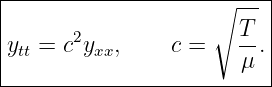
For a uniform stretched string,

|-------------------∘-----|
|      2              T-  |
ytt = c yxx,    c =    μ. |
--------------------------|
(1)

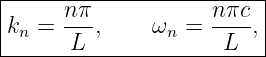
For a string fixed at both ends,

|------------------------|
|k =  nπ-,    ω   = nπc-,|
--n----L--------n----L----
(2)

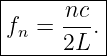
and

|---------|
|     nc- |
fn =  2L. |
-----------
(3)

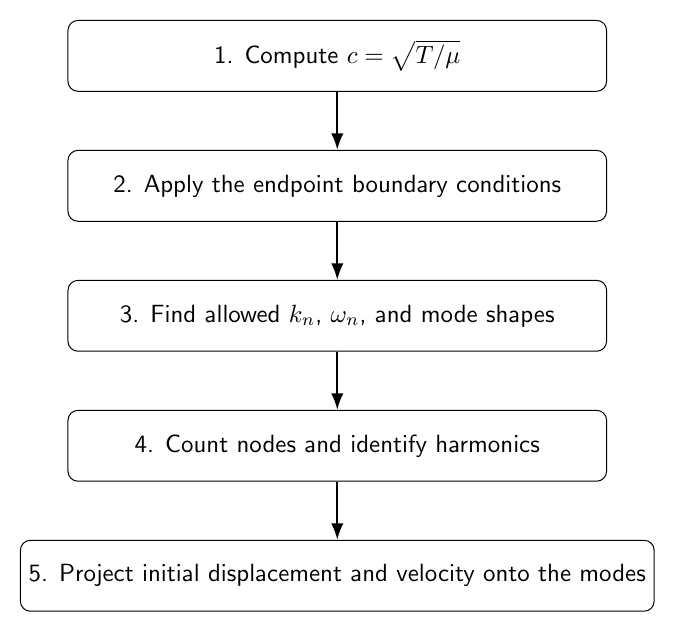
PIC

Figure 1. A compact string-mode strategy: determine the wave speed, apply the correct endpoint conditions, solve the spatial eigenvalue problem, then project any initial displacement and velocity onto the allowed normal modes.

1 High-value GRE facts

  1. c = ∘ -----
  T ∕μ.
  2. An ideal string satisfies ytt = c2y xx.
  3. Fixed-fixed modes have kn = nπ∕L.
  4. Fixed-fixed frequencies are fn = nc∕(2L).
  5. The allowed wavelength is λn = 2L∕n.
  6. Mode n has n − 1 internal nodes.
  7. Distinct sine modes are orthogonal on 0 ≤ x ≤ L.
  8. Arbitrary initial shapes are Fourier sine series.
  9. A midpoint triangular pluck excites only odd harmonics.
  10. A fixed-free string has only odd harmonic multiples of its fundamental.

Part I: Original GRE-style problems

Problem 1: string wave speed

For tension

T
(4)

and linear density

μ,
(5)

the wave speed is

  1. T∕μ
  2. ∘ -----
  T ∕μ
  3. ∘ -----
  μ∕T
  4. Tμ
  5. 1∕√T--μ

Problem 2: fixed-fixed fundamental

The fundamental frequency of a fixed-fixed string is

  1. c∕L
  2. c∕(2L)
  3. 2c∕L
  4. πc∕L
  5. c∕(4L)

Problem 3: third-mode wavelength

For a fixed-fixed string, the wavelength of the third normal mode is

  1. L∕3
  2. 2L∕3
  3. L
  4. 3L∕2
  5. 6L

Problem 4: internal nodes

The fourth fixed-fixed normal mode has how many internal nodes?

  1. 1
  2. 2
  3. 3
  4. 4
  5. 5

Problem 5: dispersion

For an ideal uniform string,

  1. ω ∝ k2
  2. ω = ck
  3. ω is independent of k
  4. vg = 0
  5. only discrete traveling waves exist on an infinite string

Problem 6: orthogonality

For

n ⁄= m,
(6)

∫
  L
    sin(nπx ∕L )sin(m πx∕L )dx
 0
(7)

equals

  1. 0
  2. L
  3. L∕2
  4. 1
  5. nm

Problem 7: midpoint pluck

A perfectly symmetric triangular midpoint pluck excites

  1. only even harmonics
  2. only odd harmonics
  3. only the fundamental
  4. no harmonics
  5. equal amplitude in every harmonic

Problem 8: fixed-free fundamental

A string fixed at one end and free at the other has fundamental frequency

  1. c∕(2L)
  2. c∕L
  3. c∕(4L)
  4. 2c∕L
  5. zero

Problem 9: free-end boundary condition

The ideal transverse free-end condition is

  1. X(L) = 0
  2. X′(L) = 0
  3. X′′(L) = 0
  4. Ẋ(L) = 0
  5. X(L) = 1

Problem 10: numerical fundamental

For

L  = 0.650m,    T = 120 N,   μ = 5.00 × 10− 3kg∕m,
(8)

the fundamental frequency is closest to

  1. 59.6 Hz
  2. 119 Hz
  3. 155 Hz
  4. 238 Hz
  5. 357 Hz

Problem 11: modal coefficient

For initial displacement

f (x)
(9)

and zero initial velocity, the fixed-fixed coefficient is

  1. ∫ 0Lf(x) dx
  2. 2-
L∫ 0Lf(x) sin(nπx∕L) dx
  3.  1
---
ωn ∫ 0Lf(x) dx
  4. 2-
L∫ 0Lf(x) cos(nπx∕L) dx
  5. always zero

Problem 12: modal dynamics

Each fixed-string modal coordinate obeys

  1. Qn = 0
  2. Qn + ωn2Q n = 0
  3. Qn + ωnQn = 0
  4. Qn − ωn2Q n = 0
  5. a nonlinear equation necessarily

Part II: Complete worked solutions

Solution 1

The string equation gives

c2 = T-.
     μ
(10)

Therefore

    ∘ ---

c =    T.
       μ
(11)

Answer: (B).

Solution 2

For

n = 1,
(12)

f  = -c-.
 1   2L
(13)

Answer: (B).

Solution 3

λn =  2L-.
      n
(14)

Thus

      2L-
λ3 =  3 .
(15)

Answer: (B).

Solution 4

Mode

n
(16)

has

n − 1
(17)

internal nodes. Therefore mode 4 has 3. Answer: (C).

Solution 5

For the ideal string,

ω = ck.
(18)

Both phase and group velocity equal

c.
(19)

Answer: (B).

Solution 6

Distinct sine modes are orthogonal:

∫
   L
    sin(nπx ∕L) sin(m πx ∕L) dx = 0.
  0
(20)

Answer: (A).

Solution 7

For a midpoint triangular pluck,

An ∝ sin(nπ ∕2).
(21)

This vanishes for every even

n.
(22)

Answer: (B).

Solution 8

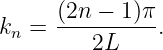
The fixed-free allowed wave numbers are

     (2n − 1)π
kn = ----------.
         2L
(23)

For

n = 1,
(24)

     -c-
f1 = 4L .
(25)

Answer: (C).

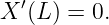
Solution 9

Zero transverse force at an ideal free end requires zero slope:

  ′
X  (L) = 0.
(26)

Answer: (B).

Solution 10

c = ∘ ------
  -120--
  0.005 (27)
≈ 154.9 m∕s. (28)

Then

f1 =   154.9
--------
2 (0.650) (29)
≈ 119.2 Hz. (30)

Answer: (B).

Solution 11

Orthogonality gives

        ∫ L
A  =  2-    f(x) sin(n πx∕L )dx.
  n   L  0
(31)

Answer: (B).

Solution 12

Each normal coordinate is an independent harmonic oscillator:

¨      2
Qn + ω nQn =  0.
(32)

Answer: (B).

2 GRE checklist

  1. Identify whether the problem gives linear density μ or total string mass.
  2. Compute c = ∘ -----
  T∕μ before applying endpoint conditions.
  3. For fixed-fixed strings, use L = nλn∕2.
  4. Count internal nodes as n − 1.
  5. Distinguish traveling-wave speed from material-point transverse speed.
  6. Use sine-series projection for fixed-fixed endpoint data.
  7. For a fixed-free string, use zero displacement at the fixed end and zero slope at the free end.
  8. Remember that each normal coordinate obeys its own SHO equation.

References

References

[1]   PhysicsLibrary, M06-07, Diatomic Oscillator Chains and Acoustic and Optical Branches.

[2]   PhysicsLibrary, M06-06, Discrete Oscillator Chains and Dispersion.

[3]   A. P. French, Vibrations and Waves, W. W. Norton, 1971.

[4]   J. R. Taylor, Classical Mechanics, University Science Books, 2005.


"GRE Physics Companion: Continuous Strings, Standing Waves, and Normal Modes" is owned by bloftin.
(view preamble)
View style:
Other names:  M06-08G
Keywords:  GRE physics, vibrating string, wave equation, standing waves, normal modes, nodes, antinodes, harmonics, Fourier coefficients, boundary conditions

This object's parent.

Cross-references: mass, oscillator, normal coordinate, force, group velocity, phase, nonlinear equation, modal coordinate, amplitude, tension, nodes, frequencies, normal modes, velocity, displacement, speed

This is version 1 of GRE Physics Companion: Continuous Strings, Standing Waves, and Normal Modes, born on 2026-10-18.
Object id is 1503, canonical name is GREPhysicsCompanionContinuousStringsStandingWavesAndNormalModes.
Accessed 14 times total.

Classification:
Physics Classification: 45.50.-j (Dynamics and kinematics of a particle and a system of particles)
 45.05.+x (General theory of classical mechanics of discrete systems)

Pending Errata and Addenda

None.

Discussion

No messages.

Interact