Diatomic Oscillator Chains and Acoustic and Optical Branches
M06-06 considered a monatomic chain with one displacement degree of freedom in each primitive
cell.
The next step is to place two inequivalent masses in each cell.
This small change produces one of the most important new features of lattice dynamics: more than
one frequency branch.
Consider a one-dimensional chain with
- alternating masses m1 and m2,
- identical nearest-neighbor springs of constant κ,
- primitive-cell length a,
- displacement un(t) for mass m1 in cell n,
- displacement vn(t) for mass m2 in cell n.
The two masses in one cell provide two mechanical degrees of freedom.
For every allowed wave number
the normal-mode problem therefore has two eigenfrequencies.
These form:
- a lower acoustic branch,
- an upper optical branch.
The dispersion relation is
The lower sign is the acoustic branch.
The upper sign is the optical branch.
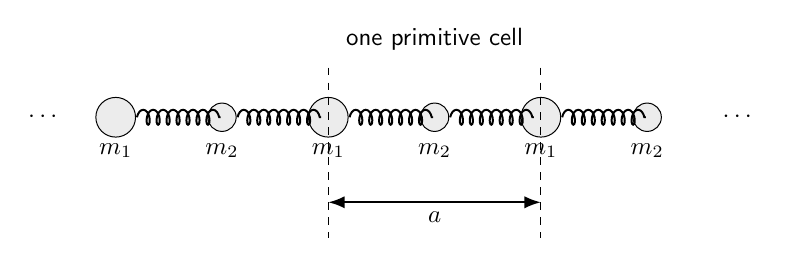
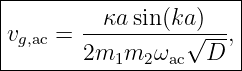
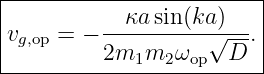
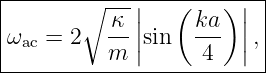
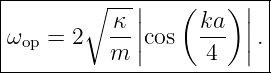
Figure 1. A diatomic chain has two inequivalent masses per primitive cell. The primitive-cell
length is a, while neighboring masses are separated by a∕2 in this symmetric geometry.
1 Choice of primitive cell
Let cell
contain:
- mass m1 with displacement un,
- mass m2 with displacement vn.
Mass
is connected to:
- vn on its right,
- vn−1 on its left.
Mass
is connected to:
- un on its left,
- un+1 on its right.
This indexing makes translation by one primitive cell correspond to
2 Equation of motion for mass m1
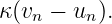
The right spring contributes
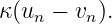
The left spring contributes
Thus
3 Equation of motion for mass m2
The left spring contributes
The right spring contributes
Thus
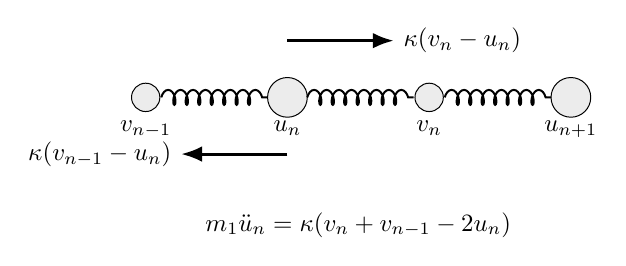
Figure 2. Each mass is coupled to the two nearest neighbors of the other species. The resulting
lattice equations are coupled both within a cell and between adjacent cells.
4 Bloch-form normal modes
Use the traveling normal-mode form
and
Then
and
After canceling the common phase factor,
and
5 The two-by-two eigenvalue problem
The amplitudes satisfy
For a nonzero polarization vector,
the determinant must vanish.
6 Characteristic equation
The determinant condition is
Now
 2 2 | = (1 + eika)(1 + e−ika) | (22)
|
| = 2 + 2 cos ka | (23)
|
| = 4 cos 2 . . | (24) |
Therefore
| 0 | = m1m2ω4 − 2κ(m
1 + m2)ω2 | (25)
|
| + 4κ2 sin 2 . . | (26) |
Thus the squared frequencies are roots of a quadratic equation.
7 Acoustic and optical dispersion relations
Solving for
gives
| ω±2 | = κ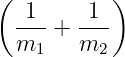 | (28)
|
| ± κ . . | (29) |
Define
and
The names acoustic and optical refer to the different long-wavelength motions of the two
masses.
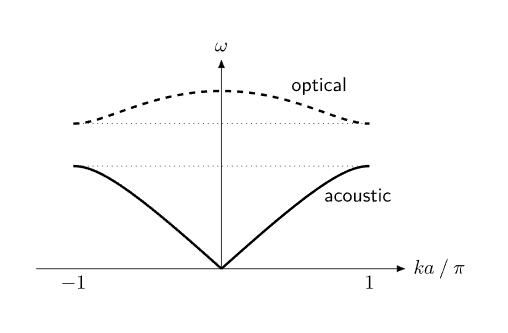
Figure 3. A diatomic chain has two dispersion branches. The acoustic branch begins at zero
frequency. The optical branch begins at a finite frequency. Unequal masses produce a frequency
gap between the branches at the Brillouin-zone edge.
8 Why there are two branches
A primitive cell has two independent displacement amplitudes:
and
For each fixed
the dynamical problem is therefore two-dimensional.
Its two eigenvalues are
and
This is the lattice version of the rule developed in M06-04 and M06-05:
The number of normal-mode branches equals the number of independent
displacement degrees of freedom in each primitive cell.
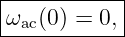
9 The acoustic branch at k = 0
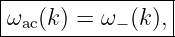
At
The lower branch becomes
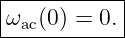
The amplitude equations reduce to
Hence
Both masses move together.
No spring changes length in the exact
mode.
This is uniform translation of the entire chain.
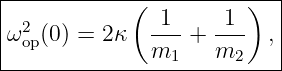
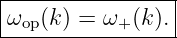
10 The optical branch at k = 0
At
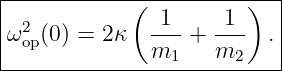
the upper branch has
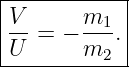
The amplitude equation gives
Therefore
The two masses move in opposite directions.
The center of mass of each cell remains fixed:
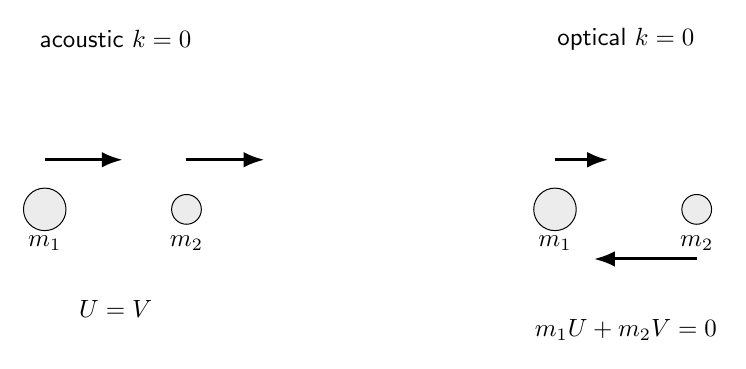
Figure 4. At k = 0, the acoustic mode translates both masses together. In the optical mode the
masses move oppositely with amplitudes inversely proportional to their masses, leaving the cell
center of mass fixed.
11 Why the names acoustic and optical are different
The acoustic branch has
as
Long-wavelength disturbances on this branch behave like sound waves.
The optical branch remains at finite frequency as
In ionic crystals, opposite motion of differently charged ions can create an oscillating electric dipole
that couples to electromagnetic radiation.
That historical physical context motivates the name optical branch.
In the purely mechanical model developed here, the important distinction is the relative motion
inside the primitive cell.
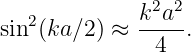
12 Long-wavelength acoustic limit
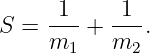
Define
For
The square root in the dispersion relation becomes
| 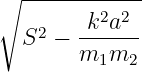 | (54)
|
| ≈ S −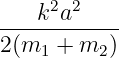 . . | (55) |
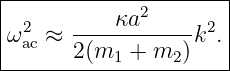
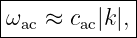
Thus the acoustic branch satisfies
Therefore
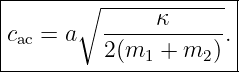
where
This is the long-wavelength sound speed of the diatomic chain.
13 Long-wavelength optical limit
At small
the optical branch remains near
To leading order,
Thus the optical branch bends downward away from
Its group velocity vanishes at
14 Brillouin-zone boundary
At
Suppose
so
is the heavier mass.
Then
and
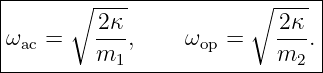
15 Zone-edge polarization
At
The off-diagonal coupling terms in the two-by-two amplitude matrix vanish.
The equations become
and
For
the lower-frequency zone-edge mode has
Only the heavier sublattice moves.
The upper-frequency zone-edge mode has
Only the lighter sublattice moves.
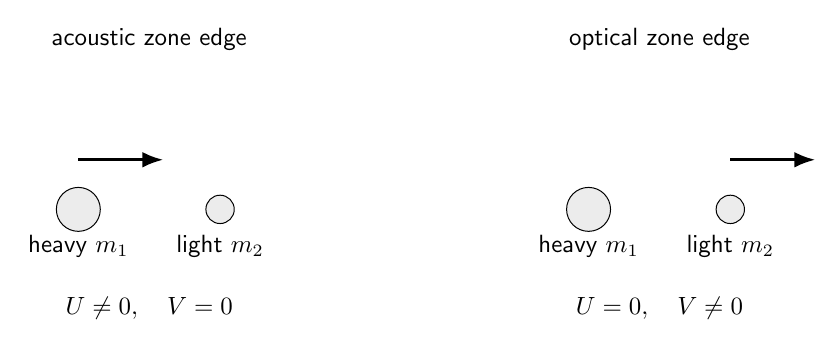
Figure 5. At the zone boundary and for unequal masses, the two sublattices decouple in the
normal-mode equations. The lower branch is carried by the heavier mass, while the upper branch
is carried by the lighter mass.
16 Frequency gap
Again assume
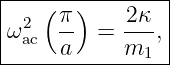
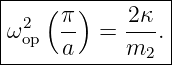
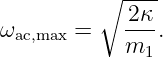
The top of the acoustic branch is
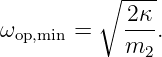
The bottom of the optical branch is at the same zone edge:
Since
Thus there is a frequency interval with no propagating normal mode in this ideal infinite
lattice.
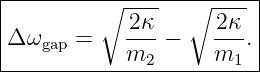
The gap width in angular frequency is
The gap vanishes when
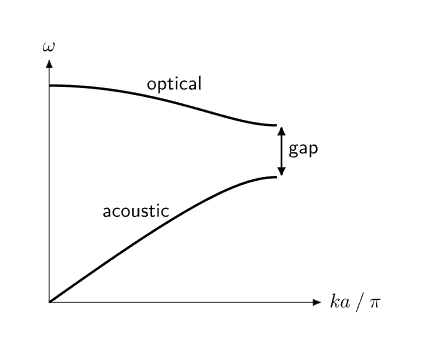
Figure 6. Increasing mass contrast separates the acoustic and optical branches at the
Brillouin-zone edge. Equal masses close the gap; unequal masses create a finite forbidden
frequency interval between the two branches.
17 Example 1: branch frequencies for unequal masses
Let
At
while
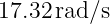
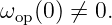
| ωop(0) | = 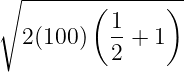 | (87)
|
| =  | (88)
|
| ≈ 17.32 rad∕s. | (89) |
At
and
The zone-edge frequency gap is therefore
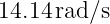
Notice that the optical branch decreases from
at
to
at the zone edge.
18 Example 2: sound speed
For the same masses, let
Then
| cac | = 0.40 | (98)
|
| ≈ 1.63 m∕s. | (99) |
This is the limiting slope of the acoustic branch near
19 General polarization ratio
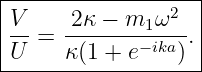
The first amplitude equation gives
Therefore
This complex ratio contains:
- the relative amplitude of the two sublattices,
- their relative phase.
Different points along a dispersion branch therefore have different mode polarizations.
The eigenfrequency alone does not fully specify the normal mode.
20 A phase convention that makes the dynamical matrix real
The two masses are physically offset within each cell.
It is often convenient to absorb half the cell phase into the
amplitude by writing
Then the mode equation can be written with a real symmetric coupling term:
This form makes the Hermitian nature of the lattice normal-mode problem especially
transparent.
21 Group velocity of the two branches
Define
Then
Differentiation gives
and
Within
the acoustic branch rises with
while the optical branch falls.
Both group velocities vanish at the zone boundary.
The optical group velocity also vanishes at
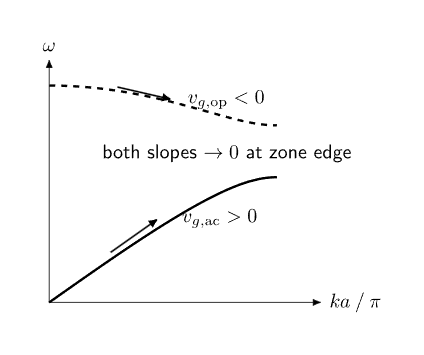
Figure 8. In the reduced-zone picture, the acoustic branch rises from the origin while the optical
branch bends downward. Their slopes determine group velocity, and both branches become
horizontal at the zone boundary.
22 Equal-mass limit
Set
Then
Inside the first Brillouin zone,
so
Therefore
and
The gap closes at
23 Zone folding
When
the physical chain is actually monatomic with nearest-neighbor spacing
Its natural primitive cell could therefore be half as long as the two-mass cell.
Using the artificially doubled cell halves the Brillouin-zone width.
The original monatomic dispersion curve is then folded back into the smaller zone.
The two apparent branches are simply two pieces of the same monatomic branch.
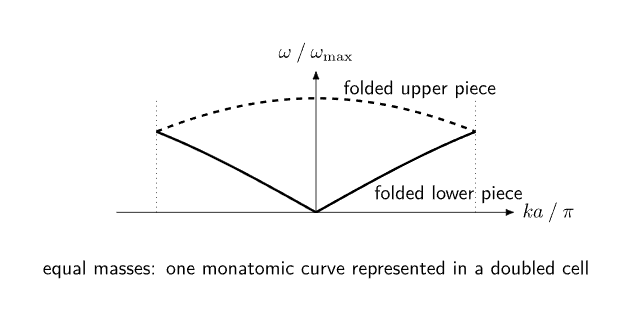
Figure 7. In the equal-mass limit the two-mass cell is not primitive. The acoustic and optical
curves are obtained by folding one monatomic dispersion curve into the smaller Brillouin zone
associated with the doubled cell.
24 Why mass contrast opens the gap
With equal masses, the folded branches meet at the reduced-zone boundary.
When the masses become unequal, the translational symmetry of the smaller
cell is lost.
The true primitive cell has length
The degeneracy at the crossing is lifted.
The two modes separate into:
- a lower heavy-sublattice zone-edge mode,
- an upper light-sublattice zone-edge mode.
This creates the frequency gap.
This simple mechanical model is an important prototype for band-gap formation in periodic
media.
25 Mode counting
Suppose there are
primitive cells with periodic boundary conditions.
There are
independent scalar displacements:
values of
and
values of
There are
distinct allowed wave numbers in one Brillouin zone.
At each
there are two branches.
Therefore
normal modes, exactly matching the number of degrees of freedom.
26 Acoustic branch as collective translation
For very small
neighboring cells move almost together.
The two masses inside each cell are approximately in phase.
The cell behaves approximately as a composite mass
That is why the acoustic branch approaches a continuum sound wave.
Its frequency tends continuously to zero as wavelength tends to infinity.
27 Optical branch as internal cell vibration
For the optical branch near
the two masses within each cell move against one another.
This is an internal vibration of the primitive cell.
Even at infinite wavelength, the internal relative coordinate continues to oscillate.
Therefore
This distinction between collective translation and internal vibration generalizes to much more
complicated lattices.
28 Relation to the small-oscillation eigenvalue problem
For every fixed
the diatomic chain reduces to a two-coordinate generalized normal-mode problem.
The Bloch phase handles translation from one primitive cell to the next.
The remaining vector
describes the internal mode shape within the cell.
Thus lattice dynamics separates naturally into:
- spatial phase between primitive cells,
- polarization inside each primitive cell.
This is the periodic-system extension of the eigenvector ideas developed in M06-05.
29 Common mistakes
- Using the nearest-neighbor spacing a∕2 as the primitive-cell length after defining a as
the cell length.
- Forgetting that there are two displacement amplitudes for every wave number.
- Using the monatomic dispersion relation for a diatomic lattice.
- Losing the complex phase factors e±ika in the neighboring-cell terms.
- Forgetting to take the determinant of the full two-by-two amplitude matrix.
- Confusing the acoustic and optical signs in the quadratic solution.
- Assuming the optical branch goes to zero frequency as k → 0.
- Assuming the acoustic k = 0 mode stretches the springs.
- Forgetting the mass-weighted amplitude relation m1U +m2V = 0 for the optical k = 0
mode.
- Assuming both sublattices move at the unequal-mass zone boundary.
- Reversing which zone-edge frequency belongs to the heavier and lighter masses.
- Assuming a frequency gap exists when the masses are equal.
- Confusing a frequency gap with the Brillouin-zone interval in wave number.
- Forgetting that equal masses make the two-mass cell nonprimitive.
- Describing an eigenfrequency without also considering the polarization eigenvector.
30 Practice exercises
- Derive the two lattice equations for un and vn.
- Insert the Bloch-form normal modes and derive the two-by-two amplitude matrix.
- Evaluate its determinant and derive the quadratic equation for ω2.
- Solve for the acoustic and optical dispersion relations.
- Show that the acoustic k = 0 mode has U = V .
- Show that the optical k = 0 mode satisfies m1U + m2V = 0.
- Derive the long-wavelength acoustic speed.
- Derive the small-k optical frequency correction.
- For m1 > m2, derive both zone-edge frequencies and polarizations.
- Derive the frequency-gap width.
- Reproduce the numerical frequencies in Example 1.
- Derive the general polarization ratio V∕U.
- Derive the group-velocity formulas for the two branches.
- Take the equal-mass limit and derive the two reduced-zone branch equations.
- Explain mathematically and physically why the equal-mass branches are a zone-folded
version of a monatomic dispersion curve.
31 Summary
The diatomic chain obeys
and
Bloch-form normal modes lead to two branches:
| ω±2 | = κ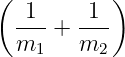 | (141)
|
| ± κ . . | (142) |
The acoustic branch has
and
at
The optical branch has
and
For
the zone-edge frequencies are
The mass contrast opens a frequency gap between the branches.
In the equal-mass limit the gap closes, and the two branches become a zone-folded representation
of the monatomic chain.
References
References
[1] PhysicsLibrary, M06-06, Discrete Oscillator Chains and Dispersion.
[2] PhysicsLibrary, M06-05, Small Oscillations and the Normal-Mode Eigenvalue
Problem.
[3] PhysicsLibrary, M06-04, Coupled Oscillators and Normal Modes.
[4] A. P. French, Vibrations and Waves, W. W. Norton, 1971.
[5] C. Kittel, Introduction to Solid State Physics, 8th ed., Wiley, 2005.
















![|[----------------------------][--]------|
| 2κ − m1 ω2 − κ(1 + e−ika) U |
| − κ(1 + eika) 2κ − m ω2 V = 0. |
-------------------------2---------------](https://images.physicslibrary.org/cache/objects/1500/make4ht/DiatomicOscillatorChainsAndAcousticAndOpticalBranches18x.png)
![[ ]
U ,
V](https://images.physicslibrary.org/cache/objects/1500/make4ht/DiatomicOscillatorChainsAndAcousticAndOpticalBranches19x.png)












































![|------------------------------------------|
|[ 2κ − m ω2 − 2κcos(ka ∕2)][U ] |
| 1 2 ^ = 0.|
--−-2κ-cos(ka-∕2)----2κ-−-m2-ω------V-------|](https://images.physicslibrary.org/cache/objects/1500/make4ht/DiatomicOscillatorChainsAndAcousticAndOpticalBranches100x.png)






![[ | ( )|]
ω2 = 2κ- 1 ± ||cos ka- || .
± m | 2 |](https://images.physicslibrary.org/cache/objects/1500/make4ht/DiatomicOscillatorChainsAndAcousticAndOpticalBranches109x.png)







![[ ]
U
V](https://images.physicslibrary.org/cache/objects/1500/make4ht/DiatomicOscillatorChainsAndAcousticAndOpticalBranches133x.png)