|
|
|
|||||||
The normal modes satisfy
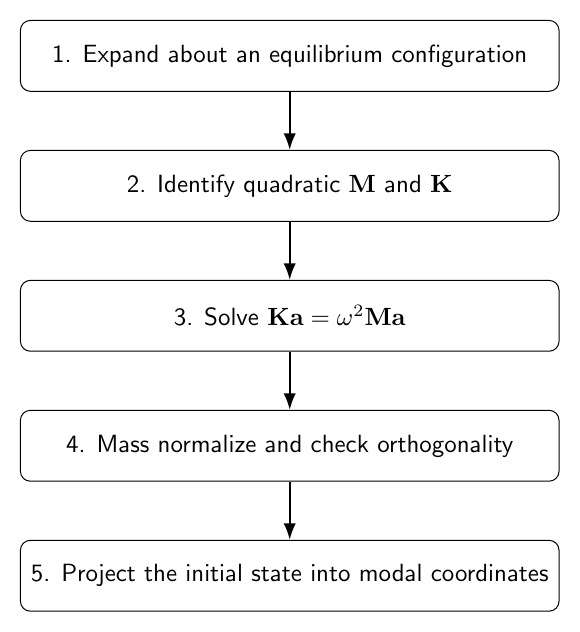
Figure 1. A compact small-oscillation strategy: expand about equilibrium, identify M and K, solve for ω2 and mode shapes, mass normalize the modes, then project initial conditions into modal coordinates.
1 High-value GRE facts
Part I: Original GRE-style problems
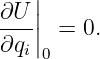
Problem 1: equilibrium expansionAt a mechanical equilibrium,
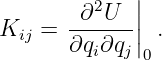
Problem 2: stiffness matrixThe small-oscillation stiffness matrix is
Problem 3: generalized eigenproblemThe mode equation is
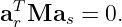
Problem 4: mass orthogonalityFor two distinct-frequency modes of a conservative symmetric system,
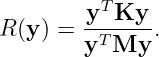
Problem 5: Rayleigh quotientThe Rayleigh quotient is
Problem 6: zero modeIf
the modal equation of motion is
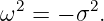
Problem 7: unstable eigenvalueIf a generalized eigenvalue is negative,
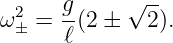
Problem 8: double-pendulum frequenciesFor the equal-mass equal-length small-angle double pendulum,
are
Problem 9: lower double-pendulum mode shapeA mode vector for the lower-frequency equal-mass double-pendulum mode is proportional to
Problem 10: numerical low frequencyFor
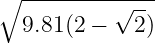
the lower double-pendulum normal frequency is closest to
Problem 11: mass normalizationIf the columns of Φ are mass-normalized modes, then
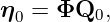
Problem 12: modal projectionFor mass-normalized modes, the initial modal displacement is
Part II: Complete worked solutions
Solution 1At equilibrium,
This eliminates the linear term in the potential expansion. Answer: (B).
Solution 2The local quadratic potential is determined by the Hessian:
Answer: (B).
Solution 3Substituting
into the small-oscillation equations gives
Answer: (B).
Solution 4For distinct eigenfrequencies and symmetric
the modes satisfy
Answer: (B).
Solution 5The Rayleigh quotient is
For an exact mode it equals
Answer: (B).
Solution 6With
the modal equation becomes
Answer: (B).
Solution 7Write
Then
whose solutions contain
and
Answer: (C).
Solution 8The equal-mass equal-length double pendulum gives
Answer: (B).
Solution 9The lower-frequency eigenvector has same-sign angular components:
Answer: (C).
Solution 10
Answer: (B).
Solution 11Mass normalization gives
Thus
Answer: (A).
Solution 12From
multiply by
Therefore
Answer: (B).
2 GRE checklist
References
References
[1] PhysicsLibrary, M06-04, Coupled Oscillators and Normal Modes. [2] PhysicsLibrary, M06-03, Driven Harmonic Motion and Resonance. [3] PhysicsLibrary, M06-01, Simple Harmonic Motion. [4] A. P. French, Vibrations and Waves, W. W. Norton, 1971. [5] J. R. Taylor, Classical Mechanics, University Science Books, 2005. [6] H. Goldstein, C. Poole, and J. Safko, Classical Mechanics, 3rd ed., Addison-Wesley, 2002. "GRE Physics Companion: Small Oscillations and the Normal-Mode Eigenvalue Problem" is owned by bloftin.
This object's parent. Cross-references: formulas, inner product, displacement, vector, zero mode, system, Normal, identity, kinetic energy, mechanical equilibrium, frequencies, Rayleigh quotient, mass-normalized modes, small oscillations, generalized coordinates, mass matrix, stiffness matrix, modal coordinates, mass, mode shapes, equilibrium, normal modes, oscillations This is version 1 of GRE Physics Companion: Small Oscillations and the Normal-Mode Eigenvalue Problem, born on 2026-10-18. Object id is 1497, canonical name is GREPhysicsCompanionSmallOscillationsAndTheNormalModeEigenvalueProblem. Accessed 16 times total. Classification:
|
|
|
|
Pending Errata and AddendaNone.
|
DiscussionNo messages.
|
Interact |
![[parent]](https://images.physicslibrary.org/images/uparrow.png)




 )
)
 )
)
![[1 ]
0](https://images.physicslibrary.org/cache/objects/1497/make4ht/GREPhysicsCompanionSmallOscillationsAndTheNormalModeEigenvalueProblem6x.png)
![[ ]
1
1](https://images.physicslibrary.org/cache/objects/1497/make4ht/GREPhysicsCompanionSmallOscillationsAndTheNormalModeEigenvalueProblem7x.png)
![[ ]
√1--
2](https://images.physicslibrary.org/cache/objects/1497/make4ht/GREPhysicsCompanionSmallOscillationsAndTheNormalModeEigenvalueProblem8x.png)
![[ ]
1
− √2--](https://images.physicslibrary.org/cache/objects/1497/make4ht/GREPhysicsCompanionSmallOscillationsAndTheNormalModeEigenvalueProblem9x.png)
![[ ]
0
1](https://images.physicslibrary.org/cache/objects/1497/make4ht/GREPhysicsCompanionSmallOscillationsAndTheNormalModeEigenvalueProblem10x.png)









![[ ]
a− ∝ √1-- .
2](https://images.physicslibrary.org/cache/objects/1497/make4ht/GREPhysicsCompanionSmallOscillationsAndTheNormalModeEigenvalueProblem27x.png)