|
|
|
|||||||
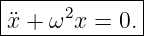
Equivalently,
The displacement
is measured from equilibrium. The constant
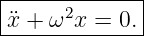
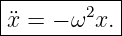
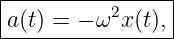
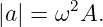
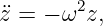
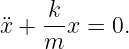
is the angular frequency. The defining physical feature is that acceleration is:
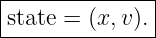
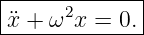
The solution is sinusoidal, but the deeper structure is broader than a sine wave. Because the equation of motion is second order, the complete instantaneous state requires both position and velocity:
Once
and
are specified, the equation of motion determines the complete future and past motion.
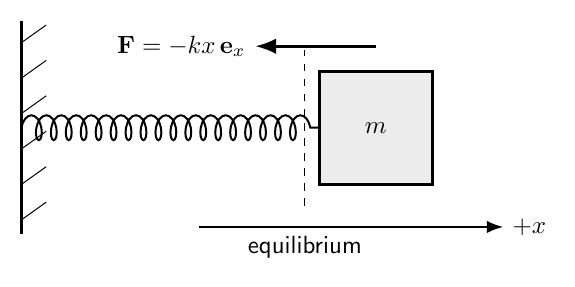
Figure 1. A mass attached to an ideal spring provides the standard model of simple harmonic motion. Displacement from equilibrium produces a restoring force directed back toward equilibrium.
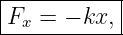
1 Spring-mass derivationFor an ideal spring,
where
is the spring constant. Newton’s second law gives
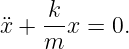
Therefore
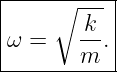
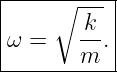
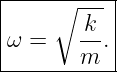
Define
Then
The angular frequency has dimensions
2 Why the force is called restoringIf
then
If
then
In either case, the force points toward
The equilibrium is therefore stable.
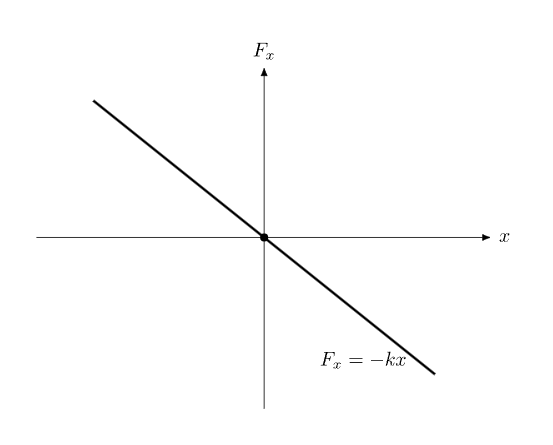
Figure 3. The Hooke-law force is a straight line through the origin with negative slope. Positive displacement produces negative force, and negative displacement produces positive force.
3 Solving the differential equationConsider
A general real solution is
Differentiate:
Differentiate again:
Thus
as required.
4 Position, velocity, and acceleration phase relationsFor the special form
the velocity is
and the acceleration is
Therefore:
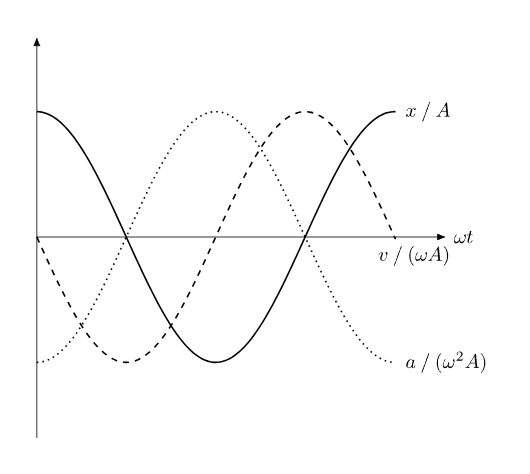
Figure 2. Position, velocity divided by ω, and acceleration divided by ω2 are sinusoidal functions with fixed phase offsets.
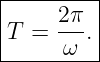
5 Period and frequencyThe motion repeats when the phase increases by
Thus
Therefore
The ordinary frequency is
so
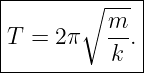
For the spring-mass oscillator,
The ideal linear oscillator period is independent of amplitude.
6 Initial conditions determine the motionLet
Start with
At
From
we obtain
Therefore
The initial-value solution is
The corresponding velocity is
The factor
is required both by the initial condition and by dimensional consistency.
7 Amplitude from initial position and velocityWrite the solution in the form
Use the angle-addition identity:
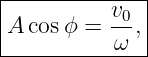
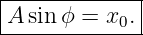
Compare with
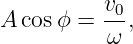
Therefore
and
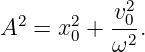
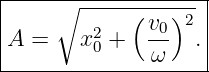
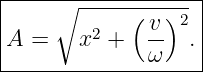
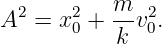
Square and add:
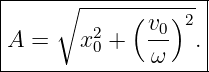
Hence
Thus the amplitude is determined by the complete initial state, not by initial position alone.
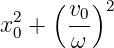
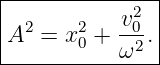
8 Dimensional checkThe two terms under the square root must have the same dimensions. Because
and
Therefore
has dimensions
as required for
Dimensional analysis provides a fast check on initial-condition formulas.
9 Phase from the initial stateFrom
and
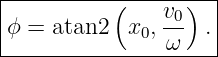
the phase can be obtained with the quadrant-aware function
Using a one-argument inverse tangent can lose quadrant information. Different sine or cosine phase conventions produce equivalent formulas with correspondingly shifted phase constants.
10 Example 1: amplitude and phase from an initial stateLet
with
Then
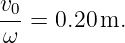
The amplitude is
For the sine convention,
Thus
11 The state of the oscillatorThe equation
is second order. Define
Then it becomes two first-order equations:
The pair
is therefore a complete state description. At a given position, velocity distinguishes whether the oscillator is:
Position alone is not enough to specify the state.
12 State-space matrix formDefine the state vector
Then
The exact state evolution is
Thus the initial state uniquely determines the state at every later time.
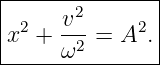
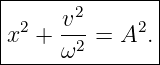
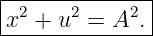
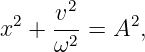
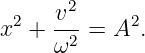
13 The phase planeEliminate time using the amplitude relation. For any time,
and
Therefore
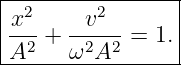
Equivalently,
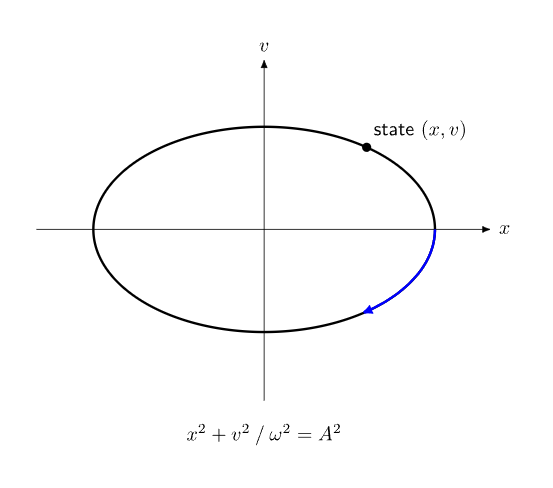
The trajectory in the
phase plane is an ellipse.
Figure 4. The SHO state moves around an ellipse in the position-velocity phase plane. Each point (x,v) specifies the complete instantaneous state.
14 Scaled phase planeDefine a scaled velocity coordinate
Then
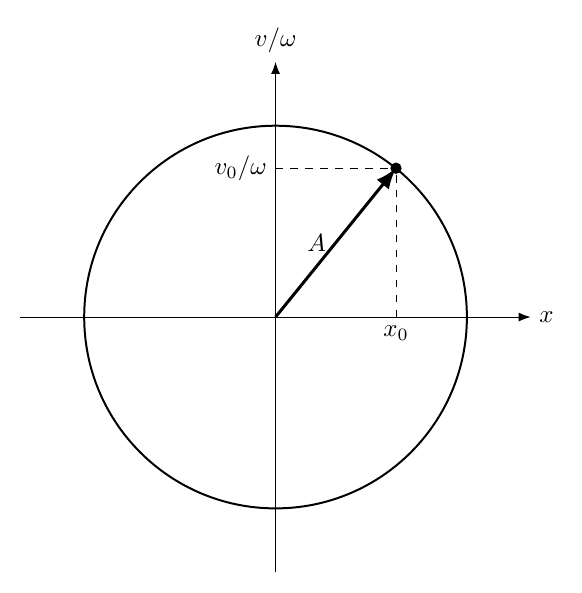
The phase-space ellipse becomes a circle. The amplitude is simply the radius:
In particular, at
Figure 5. In the scaled phase plane (x,v∕ω), the state moves on a circle. The amplitude is the distance from the origin to the state point, and the phase specifies its angular position on that circle.
15 Direction of motion in phase spaceAt
the acceleration is
Therefore the state begins moving toward negative velocity. In an
horizontal,
vertical phase plane, the standard SHO trajectory is traversed clockwise. The direction matters: the same position coordinate can occur twice per cycle with opposite velocities.
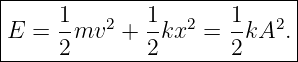
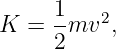
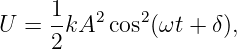
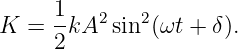
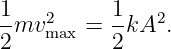
16 Mechanical energyFor a spring-mass oscillator,
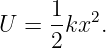
and
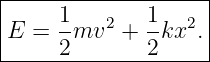
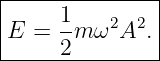
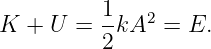
The total mechanical energy is
Use
Then
Since
Since
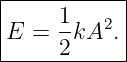
Therefore
Amplitude is therefore a direct measure of the conserved energy.
17 Energy from initial conditionsAt
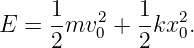
Set this equal to
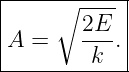
Then
Since
This gives an independent energy derivation of the amplitude formula.
18 Exchange of kinetic and potential energyUsing
and
Therefore
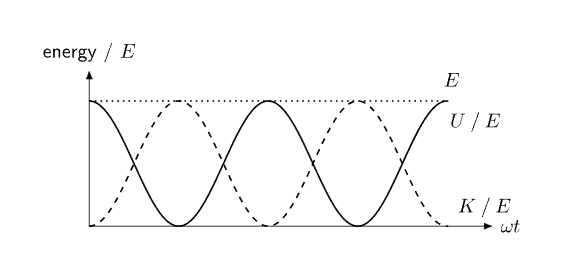
Energy continually transfers between kinetic and potential forms while the total remains constant.
Figure 6. Kinetic and potential energy exchange during an SHO cycle. Their sum remains constant for the ideal undamped oscillator.
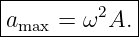
19 Maximum speed and accelerationAt equilibrium,
so all the energy is kinetic:
Thus
At a turning point,
so
Therefore
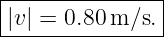
20 Example 2: speed from displacementA spring-mass oscillator has
Find the speed when
From the phase-plane equation,
Thus
Therefore
The sign of
depends on which half of the phase-plane ellipse the oscillator occupies.
21 Superposition and linearityThe SHO equation
is linear. If
and
are solutions, then
is also a solution for constants
That is why
and
can serve as a basis for all real SHO solutions. Linearity is also the foundation for normal modes, Fourier methods, and wave mechanics.
22 Complex exponential representationEuler’s identity gives
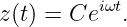
Therefore a convenient complex trial solution is
Then
so
The physical displacement can be taken as the real part:
Complex notation becomes especially valuable for driven oscillators and waves.
23 Simple harmonic motion near a stable equilibriumThe harmonic oscillator is much more general than an ideal spring. Suppose a one-dimensional system has potential energy
with a stable equilibrium at
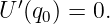
At equilibrium,
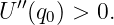
For stability,
Let
Expand the potential near equilibrium:
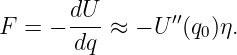
Then
For mass
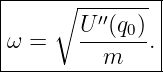
Therefore small motion near any smooth stable equilibrium is approximately simple harmonic, with
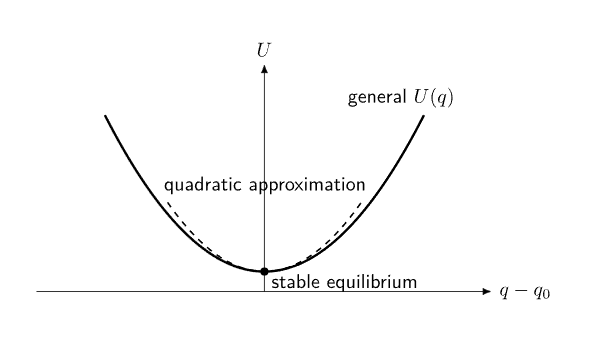
Figure 8. Near a smooth stable equilibrium, a general potential is approximately quadratic. The resulting restoring force is approximately linear, producing simple harmonic motion for sufficiently small displacement.
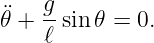
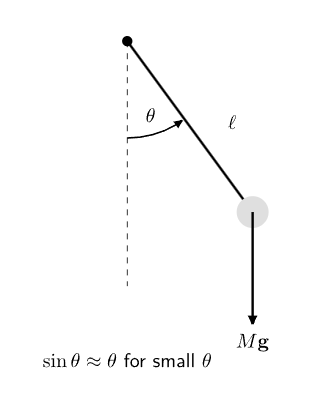
24 Small-angle pendulumA pendulum of length
obeys
For small angles measured in radians,
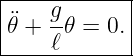
Then
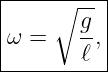
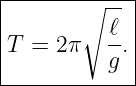
Therefore
and
The pendulum is therefore approximately a simple harmonic oscillator only in the small-angle regime.
Figure 7. For sufficiently small angular displacement, the tangential gravitational restoring term is linear in 𝜃, and the pendulum approaches simple harmonic motion.
25 Vertical spring and shifted equilibriumFor a vertical spring, gravity changes the equilibrium position but not the angular frequency of small ideal oscillations about that equilibrium. Let downward displacement from the spring’s natural length be
Newton’s law is
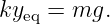
The equilibrium extension satisfies
Define displacement from equilibrium:
Then
so
Gravity shifts the equilibrium but does not change the ideal linear frequency.
26 Canonical phase spaceThe state
is a useful mechanical state-space description. In Hamiltonian mechanics the canonical momentum is
The canonical phase-space state is
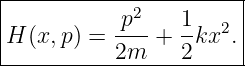
The Hamiltonian is
Hamilton’s equations are
Combining them gives
Thus the elementary SHO is also one of the simplest examples of Hamiltonian phase-space dynamics.
27 What amplitude and phase really representThe constants
and
are another way to encode the same two pieces of state information carried by
and
In the scaled phase plane:
For the ideal conservative oscillator:
This geometric interpretation becomes useful when damping, forcing, coupled oscillators, and nonlinear oscillations are introduced.
28 Common mistakes
29 Practice exercises
30 SummarySimple harmonic motion is defined by
For a spring-mass system,
The initial state
determines the entire motion:
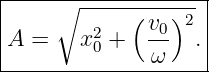
The amplitude is
The phase-plane orbit is
The total mechanical energy is
The same mathematics appears approximately near any smooth stable equilibrium. This makes the harmonic oscillator one of the central local models of classical physics and the starting point for the broader study of oscillations.
References
References
[1] PhysicsLibrary, simple harmonic oscillator, canonical object SimpleHarmonicOscillator. [2] A. P. French, Vibrations and Waves, W. W. Norton, 1971. [3] J. R. Taylor, Classical Mechanics, University Science Books, 2005. [4] D. Kleppner and R. Kolenkow, An Introduction to Mechanics, 2nd ed., Cambridge University Press, 2014. "M06-01 Simple Harmonic Motion" is owned by bloftin.
This object's parent.
Cross-references: matrix, Hooke's law, periodic motion, coupled oscillators, angular position, momentum, Hamiltonian, Newton's law, simple harmonic oscillator, mass, potential energy, system, mechanics, normal modes, speed, energy, total mechanical energy, relation, state vector, phase constants, function, formulas, square, identity, period, oscillator, frequency, turning points, magnitude, force, dimensions, velocity, position, equilibrium, displacement, acceleration There are 9 references to this object. This is version 1 of M06-01 Simple Harmonic Motion, born on 2026-10-17. Object id is 1488, canonical name is M0601SimpleHarmonicMotion. Accessed 6 times total. Classification:
|
|
|
|
Pending Errata and AddendaNone.
|
DiscussionNo messages.
|
Interact |
![[parent]](https://images.physicslibrary.org/images/uparrow.png)






![[ω ] = T −1.](https://images.physicslibrary.org/cache/objects/1488/make4ht/M0601SimpleHarmonicMotion13x.png)




























![[x0] = L,](https://images.physicslibrary.org/cache/objects/1488/make4ht/M0601SimpleHarmonicMotion49x.png)
![[v0] = LT − 1, [ω] = T− 1,](https://images.physicslibrary.org/cache/objects/1488/make4ht/M0601SimpleHarmonicMotion50x.png)
![[ ]
v0
ω = L.](https://images.physicslibrary.org/cache/objects/1488/make4ht/M0601SimpleHarmonicMotion51x.png)












![[ ]
z = x .
v](https://images.physicslibrary.org/cache/objects/1488/make4ht/M0601SimpleHarmonicMotion68x.png)
![|----[-------]---|
| 0 1 |
|˙z = − ω2 0 z.|
------------------](https://images.physicslibrary.org/cache/objects/1488/make4ht/M0601SimpleHarmonicMotion69x.png)
![|---------[-----------------]-------|
[ ] sinωt- [ ] |
|x (t) = cosωt ω x0 . |
| v(t) − ωsin ωt cosωt v0 |
-------------------------------------](https://images.physicslibrary.org/cache/objects/1488/make4ht/M0601SimpleHarmonicMotion70x.png)











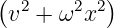

![[ ]
2 v2-
x + ω2](https://images.physicslibrary.org/cache/objects/1488/make4ht/M0601SimpleHarmonicMotion92x.png)










![[ 2 2]
(0.20 ) − (0.12)](https://images.physicslibrary.org/cache/objects/1488/make4ht/M0601SimpleHarmonicMotion117x.png)










![|----------[-----]-|
|x(t) = Re Cei ωt .|
--------------------](https://images.physicslibrary.org/cache/objects/1488/make4ht/M0601SimpleHarmonicMotion131x.png)














 =
= 
 =
= 


 by comparing sine and cosine coefficients.