|
|
|
|||||||
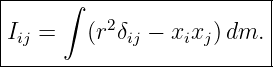
with
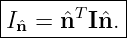
For an arbitrary unit axis,
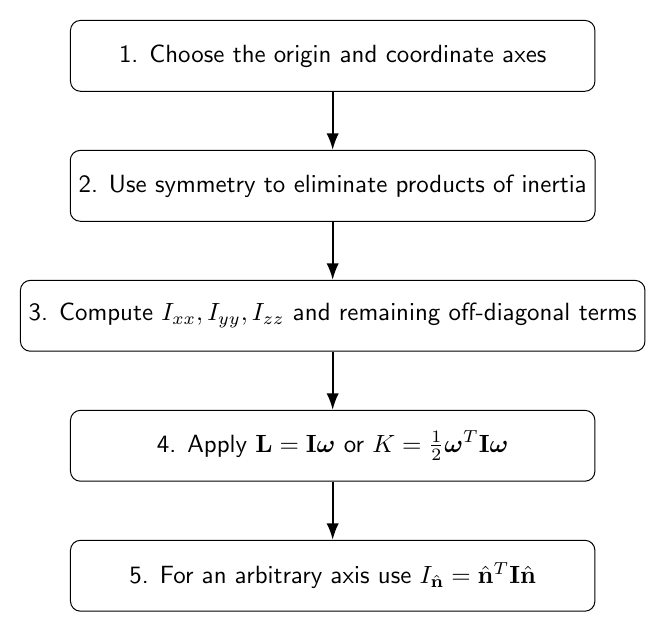
Figure 1. A compact inertia-tensor strategy: define the origin and axes, exploit symmetry first, compute diagonal moments and products of inertia, then use the tensor to obtain angular momentum, energy, or an arbitrary-axis moment.
1 High-value GRE facts
Part I: Original GRE-style problems
Problem 1: tensor symmetryFor a mass inertia tensor in Cartesian coordinates,
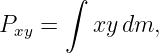
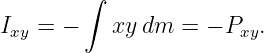
Problem 2: product signUsing the convention Pxy = ∫ xy dm, the tensor component is
Problem 3: reflection symmetryA body is symmetric under x →−x. Which products must vanish?
Problem 4: planar laminaFor a lamina in the xy plane,
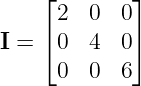
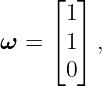
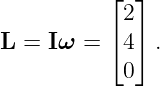
Problem 5: angular momentumIf
and
then
is
Problem 6: parallelismFor the tensor and angular velocity in Problem 5,
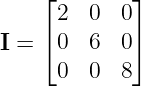
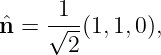
Problem 7: arbitrary-axis momentFor
and unit axis
the scalar moment is
Problem 8: rotational energyFor the tensor in Problem 5 and
the rotational kinetic energy is
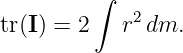
Problem 9: traceThe trace of the inertia tensor equals
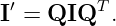
Problem 10: coordinate rotationIf vector components transform as r′ = Qr with orthogonal Q, then the inertia tensor transforms as
Problem 11: shift along an axisA center of mass inertia tensor is diagonal. The origin is shifted distance d along the x axis. Which center of mass moment is unchanged by the tensor parallel-axis shift?
Problem 12: principal axisIf e is an eigenvector of I with eigenvalue Ip, and
then
Part II: Complete worked solutions
Solution 1The inertia tensor is symmetric because
Thus
Answer: (B).
Solution 2With
the off-diagonal tensor component is
Answer: (B).
Solution 3Under x →−x, both xy and xz change sign. Their paired contributions cancel:
Answer: (A).
Solution 4For z = 0,
Therefore
Answer: (B).
Solution 5Multiply:
Answer: (C).
Solution 6The vectors
and
are not scalar multiples of each other. Answer: (C).
Solution 7
Answer: (C).
Solution 8
Answer: (C).
Solution 9Adding the diagonal entries gives
Answer: (B).
Solution 10For an orthogonal coordinate transformation,
Answer: (A).
Solution 11A shift along the x axis leaves all perpendicular distances to the x axis unchanged. Thus Ixx is unchanged. Answer: (A).
Solution 12The eigenvector equation is
Therefore
Answer: (B).
2 GRE checklist
References
References
"GRE Physics Companion: The Inertia Tensor and Products of Inertia" is owned by bloftin.
This object's parent. Cross-references: center of mass, vector, trace, angular velocity, Cartesian coordinates, mass, rotational kinetic energy, scalar, inertia tensor, energy, angular momentum, tensor, products of inertia, unit, relation This is version 1 of GRE Physics Companion: The Inertia Tensor and Products of Inertia, born on 2026-10-17. Object id is 1481, canonical name is GREPhysicsCompanionTheInertiaTensorAndProductsOfInertia. Accessed 5 times total. Classification:
|
|
|
|
Pending Errata and AddendaNone.
|
DiscussionNo messages.
|
Interact |
![[parent]](https://images.physicslibrary.org/images/uparrow.png)











 (2) +
(2) +  (6)
(6)
 (1
(1