Physics Library
 An open source physics library
Encyclopedia | Forums | Docs | Random  

[parent] GRE Physics Companion: Parallel-Axis and Perpendicular-Axis Theorems

(Example)

GRE Physics Companion: Parallel-Axis and Perpendicular-Axis Theorems

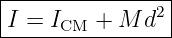
The two central relations are

|--------------2-|
-I-=-ICM-+--M-d--|
(1)

for a shifted parallel axis, and

|------------|
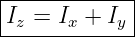
-Iz =-Ix +-Iy|
(2)

for a planar lamina with mutually perpendicular axes through the same point.

PIC

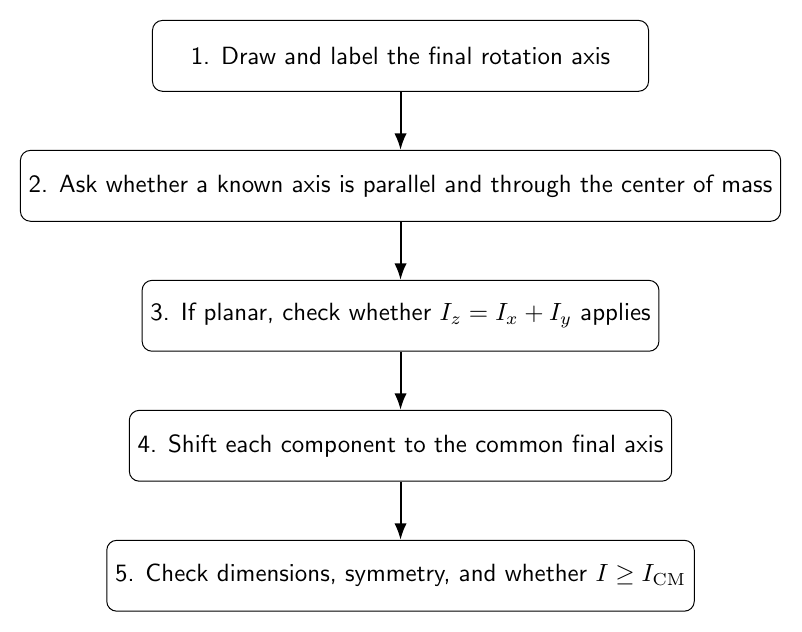
Figure 1. A compact strategy for axis-theorem problems. Identify the body geometry and the final axis before deciding whether the parallel-axis theorem, perpendicular-axis theorem, both, or direct integration applies.

1 High-value GRE facts

  1. The parallel-axis theorem requires parallel axes.
  2. The known reference axis must pass through the center of mass.
  3. d is the perpendicular distance between the two axes.
  4. Shifting away from the center of mass always increases I by Md2.
  5. The perpendicular-axis theorem applies only to planar laminas.
  6. The three perpendicular-axis theorem axes must intersect at the same point.
  7. For a thin disk, Iz = 12MR2 and I diameter = 14MR2.
  8. For a thin ring, Iz = MR2 and I diameter = 1
2MR2.
  9. A disk tangent axis perpendicular to the plane has I = 3
2MR2.
  10. A disk tangent axis in the plane has I = 5
4MR2.

Part I: Original GRE-style problems

Problem 1: shifted axis

A body has ICM = 2I0 about an axis through its center of mass. A parallel axis is displaced by d, and Md2 = 3I 0. The shifted-axis moment is

  1. I0
  2. 2I0
  3. 3I0
  4. 5I0
  5. 6I0

Problem 2: minimum parallel-axis inertia

Among all axes parallel to a chosen direction, the smallest moment of inertia occurs for the axis

  1. farthest from the body
  2. through the center of mass
  3. tangent to the body
  4. through the largest mass element
  5. with maximum angular speed

Problem 3: rod about an end

A uniform thin rod of mass M and length L has moment of inertia about a perpendicular axis through one end equal to

  1. 1-
12ML2
  2. 1
6ML2
  3. 1
4ML2
  4. 13ML2
  5. ML2

Problem 4: disk tangent normal axis

A uniform disk of mass M and radius R rotates about an axis perpendicular to the disk and tangent to its rim. Its moment of inertia is

  1. 1
4MR2
  2. 1
2MR2
  3. MR2
  4. 5
4MR2
  5. 3
2MR2

Problem 5: disk diameter

A uniform thin disk has moment of inertia about any diameter equal to

  1. 1
8MR2
  2. 1
4MR2
  3. 12MR2
  4. 3
4MR2
  5. MR2

Problem 6: ring diameter

A thin ring has moment of inertia about any diameter equal to

  1. 1
4MR2
  2. 1
2MR2
  3. 34MR2
  4. MR2
  5. 2MR2

Problem 7: applicability

Which body permits direct use of the perpendicular-axis theorem?

  1. a uniform solid sphere
  2. a thick solid cylinder about arbitrary axes
  3. a thin rectangular plate
  4. a three-dimensional irregular rock
  5. a solid cone

Problem 8: rectangular plate

A thin rectangular plate has central in-plane moments Ix = 2I0 and Iy = 5I0. Its perpendicular central moment is

  1. 3I0
  2. 5I0
  3. 7I0
  4. 10I0
  5. 25I0

Problem 9: disk tangent in-plane axis

A thin disk rotates about a tangent line lying in its plane. Its moment of inertia is

  1. 14MR2
  2. 1
2MR2
  3. MR2
  4. 5
4MR2
  5. 3
2MR2

Problem 10: inverse shift

A body has I = 10 kg m2 about a shifted axis. Its mass is M = 8 kg and the parallel-axis separation is d = 0.50 m. The center of mass moment is

  1. 2 kg m2
  2. 4 kg m2
  3. 6 kg m2
  4. 8 kg m2
  5. 12 kg m2

Problem 11: radius of gyration

If kg,CM = 0.30 m and a parallel axis is displaced by d = 0.40 m, the new radius of gyration is

  1. 0.10 m
  2. 0.35 m
  3. 0.50 m
  4. 0.70 m
  5. 1.00 m

Problem 12: wrong theorem

A student tries to use Iz = Ix + Iy for a solid sphere. The main error is that

  1. a sphere has no center of mass
  2. the sphere is not a planar lamina
  3. the axes are not perpendicular
  4. the sphere has no moment of inertia
  5. the theorem requires zero mass

Part II: Complete worked solutions

Solution 1

The parallel-axis theorem gives

              2
I = ICM + M  d  = 2I0 + 3I0 = 5I0.
(3)

Answer: (D).

Solution 2

Since

I = ICM +  M d2
(4)

and Md2 ≥ 0, the minimum occurs at d = 0, which is the center of mass axis. Answer: (B).

Solution 3

Iend = 1--
12ML2 + M(  )
  L-
  22 (5)
= 1-
3ML2. (6)

Answer: (D).

Solution 4

For the central perpendicular axis,

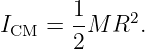
       1    2
ICM =  -M R  .
       2
(7)

Shift by R:

     1                3
I =  -M R2 +  M R2 =  -M  R2.
     2                2
(8)

Answer: (E).

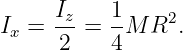
Solution 5

For a thin disk,

Iz = Ix + Iy.
(9)

Symmetry gives Ix = Iy, so

     Iz   1
Ix = -- = --M R2.
     2    4
(10)

Answer: (B).

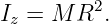
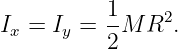
Solution 6

For a thin ring,

         2
Iz = M  R .
(11)

By symmetry,

          1     2
Ix = Iy = --M R  .
          2
(12)

Answer: (B).

Solution 7

The perpendicular-axis theorem requires a planar lamina. A thin rectangular plate satisfies that condition. Answer: (C).

Solution 8

Iz = Ix + Iy = 2I0 + 5I0 = 7I0.
(13)

Answer: (C).

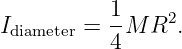
Solution 9

First use the perpendicular-axis theorem to obtain the central diameter moment:

I       = 1-M R2.
 diameter   4
(14)

Then shift by R:

         1-    2       2   5-   2
Itangent = 4 M R  + M  R  =  4M R  .
(15)

Answer: (D).

Solution 10

ICM = I − Md2 (16)
= 10 − 8(0.50)2 (17)
= 10 − 2 (18)
= 8 kg m2. (19)

Answer: (D).

Solution 11

Use

k2g = k2g,CM  + d2.
(20)

Then

kg = ∘ -----------------
  (0.30 )2 + (0.40)2 (21)
= 0.50 m. (22)

Answer: (C).

Solution 12

The perpendicular-axis theorem relies on all mass lying in one plane. A solid sphere is three-dimensional. Answer: (B).

2 GRE checklist

  1. Parallel-axis theorem: axes parallel, known axis through the center of mass.
  2. Use the perpendicular distance between axes for d.
  3. Shift away from the center of mass by adding Md2.
  4. Perpendicular-axis theorem: planar lamina only.
  5. All three perpendicular-axis theorem axes must meet at the same point.
  6. Use symmetry only when the geometry actually supports it.
  7. A tangent axis perpendicular to a disk and a tangent axis in its plane are different problems.
  8. For composite bodies, shift every component to the final common axis before adding or subtracting.

References

References

[1]   J. R. Taylor, Classical Mechanics, University Science Books, 2005.

[2]   D. Kleppner and R. Kolenkow, An Introduction to Mechanics, 2nd ed., Cambridge University Press, 2014.

[3]   OpenStax, University Physics, Volume 1, Rice University, 2016.


"GRE Physics Companion: Parallel-Axis and Perpendicular-Axis Theorems" is owned by bloftin.
(view preamble)
View style:
Other names:  M05-05G
Keywords:  GRE physics, parallel-axis theorem, perpendicular-axis theorem, moment of inertia, rigid body, center of mass, thin disk, thin ring, rod, planar lamina

This object's parent.

Cross-references: theorem, radius of gyration, shifted axis, solid, speed, mass, moment of inertia, center of mass, perpendicular-axis theorem, parallel-axis theorem, relations

This is version 1 of GRE Physics Companion: Parallel-Axis and Perpendicular-Axis Theorems, born on 2026-10-17.
Object id is 1473, canonical name is GREPhysicsCompanionParallelAxisAndPerpendicularAxisTheorems.
Accessed 10 times total.

Classification:
Physics Classification: 45.40.-f (Dynamics and kinematics of rigid bodies)
 45.20.Dd (Newtonian mechanics)

Pending Errata and Addenda

None.

Discussion

No messages.

Interact