|
|
|
|||||||
and
The corresponding magnitudes are
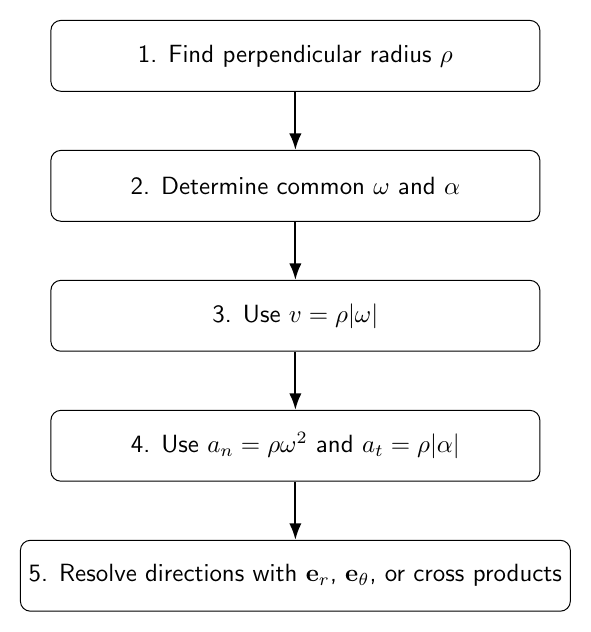
Figure 1. A compact strategy for fixed-axis particle kinematics: identify perpendicular radius, solve the common angular motion, and then compute the point’s tangential and Normal motion.
1 High-value GRE facts
Part I: Original GRE-style problems
Problem 1: speed at a known radiusA point lies 0.30 m from a fixed axis and the body rotates at 10 rad∕s. The point’s speed is
Problem 2: normal accelerationFor the point in Problem 1, the normal acceleration magnitude is
Problem 3: tangential accelerationIf the same body has α = 4 rad∕s2, the tangential acceleration magnitude at ρ = 0.30 m is
Problem 4: two radiiTwo points on the same rigid body lie at radii r and 4r. Their speed ratio is
Problem 5: same two radiiFor the points in Problem 4, their normal-acceleration ratio at the same instant is
Problem 6: axial offsetTwo material points have equal perpendicular radius ρ but different positions along the fixed axis. Their speed magnitudes are
Problem 7: direction of velocityThe instantaneous velocity of a point in fixed-axis rotation is
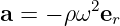
Problem 8: constant angular speedIf ω is constant and nonzero, the particle acceleration is
Problem 9: vector velocityIf ω = 5ez rad∕s and r = 2ex m, then
Problem 10: relative velocity rigidity checkFor two points A and B on the same rigid body,
is
Problem 11: inverse relationA point at radius 0.25 m has tangential speed 5 m∕s. The angular speed magnitude is
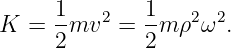
Problem 12: kinetic-energy bridgeFor one particle in fixed-axis rotation, its kinetic energy can be written
Part II: Complete worked solutions
Solution 1
Answer: (C).
Solution 2
Answer: (C).
Solution 3
Answer: (C).
Solution 4Since v = ρ|ω| and both points share the same ω,
Answer: (D).
Solution 5Since an = ρω2 at the same instant,
Answer: (D).
Solution 6Fixed-axis kinematics depends on perpendicular radius, not axial position. Equal ρ and common ω give equal speeds. Answer: (A).
Solution 7The velocity is in the e𝜃 direction, tangent to the circular path. Answer: (C).
Solution 8Constant angular speed implies α = 0, so only
remains. Answer: (C).
Solution 9
Answer: (C).
Solution 10Rigid body relative velocity is perpendicular to separation:
Answer: (C).
Solution 11
Answer: (D).
Solution 12Since v = ρ|ω|,
Answer: (C).
2 GRE checklist
References
References
"GRE Physics Companion: Fixed-Axis Rotation and Particle Kinematics" is owned by bloftin.
This object's parent. Cross-references: cross products, kinetic energy, fixed-axis rotation, positions, rigid body, vector, acceleration, vectors, speed, tangential acceleration, normal acceleration, velocity, Normal, motion, kinematics, magnitudes, material point This is version 1 of GRE Physics Companion: Fixed-Axis Rotation and Particle Kinematics, born on 2026-10-05. Object id is 1423, canonical name is GREPhysicsCompanionFixedAxisRotationAndParticleKinematics. Accessed 3 times total. Classification:
|
|
|
|
Pending Errata and AddendaNone.
|
DiscussionNo messages.
|
Interact |
![[parent]](https://images.physicslibrary.org/images/uparrow.png)