Rotational Kinematics of Rigid Bodies
A rigid body is an idealized collection of particles whose pairwise distances remain constant:
for every pair of material points i and j.
This constraint allows the motion of a large collection of particles to be described using a small
number of translational and rotational variables.
The simplest rotational motion is fixed-axis rotation. Every material point moves in a circle
centered on the same fixed axis, and all points share the same angular position, angular velocity,
and angular acceleration.
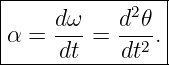
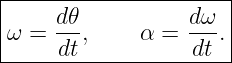
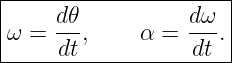
For planar fixed-axis rotation, define an angular coordinate 𝜃(t). Then
and
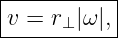
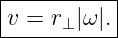
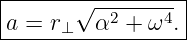
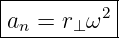
For a point a perpendicular distance r⊥ from the axis,
and
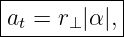
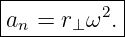
These equations connect the angular motion of the rigid body to the linear motion of each material
point.
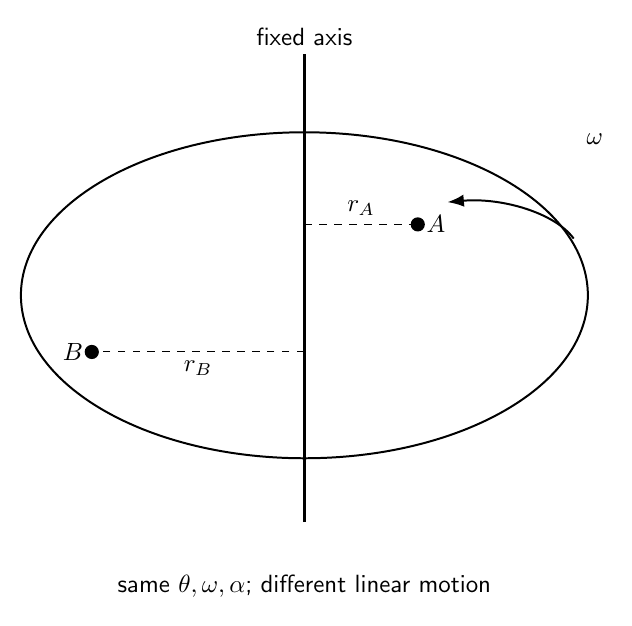
Figure 1. In fixed-axis rotation, every material point moves on a circle centered on the same axis.
All points share the same angular motion even though their linear speeds depend on distance
from the axis.
1 What makes a body rigid?
Consider two material points A and B inside a body.
The rigid body assumption requires
The body may translate through space and it may rotate, but it does not deform.
Real materials are never perfectly rigid. Disturbances propagate through matter at finite wave
speeds, and sufficiently large forces produce deformation.
Rigid body mechanics is therefore an approximation.
It is extremely useful when:
- elastic deformation is negligible for the problem,
- dimensions of the body can be treated as constant,
- rotational motion is important.
2 Translation and rotation
A rigid body can undergo several basic types of motion.
2.1 Pure translation
In pure translation, every point has the same instantaneous velocity:
The body’s orientation does not change.
2.2 Pure rotation about a fixed axis
In pure rotation, one axis is stationary in an inertial frame and every other point moves in a circle
around it.
2.3 General rigid body motion
In general, a rigid body can translate and rotate simultaneously.
The present article focuses on fixed-axis rotational kinematics. General plane motion is developed
later in the M05 sequence.
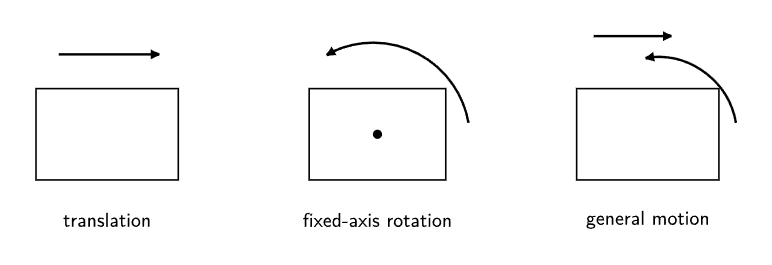
Figure 7. Rigid body motion can be separated conceptually into translation, rotation, or a
combination of the two. This article develops the fixed-axis rotational part.
3 Angular position
For planar rotation about a fixed axis, choose a reference line attached to the body.
Its orientation can be described by an angle
A common sign convention is:
- counterclockwise angles are positive,
- clockwise angles are negative.
The zero-angle direction is arbitrary but must be stated or implied consistently.
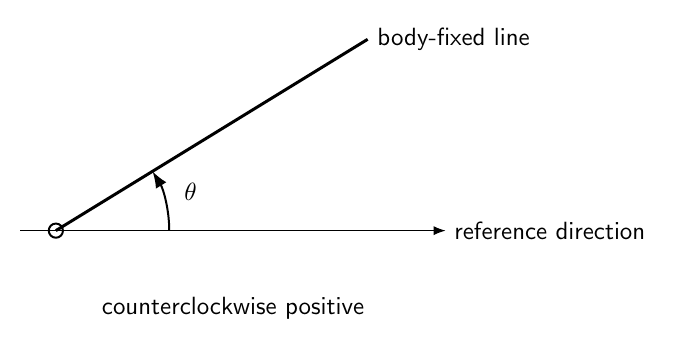
Figure 2. A body-fixed reference line defines the planar angular position 𝜃 relative to a chosen
inertial reference direction.
4 Radians
Angular motion equations are simplest when angles are measured in radians.
A radian is defined geometrically by
where s is arc length and r is radius.
Therefore
when 𝜃 is measured in radians.
One full revolution corresponds to
Thus
Although the radian is dimensionless in SI, it is often retained explicitly in angular units to make
the physical meaning clear.
5 Angular displacement
Suppose the angular position changes from
to
The angular displacement is
Angular displacement is signed.
A positive angular displacement corresponds to the chosen positive rotational direction.
A negative angular displacement corresponds to the opposite direction.
For multiple revolutions, Δ𝜃 need not lie between 0 and 2π.
For example, three complete counterclockwise revolutions give
6 Arc length and angular displacement
A material point at perpendicular distance r⊥ from the rotation axis travels an arc
length
For a finite rotation, the distance traveled along the circular path is
The same angular displacement produces a larger linear path for points farther from the
axis.
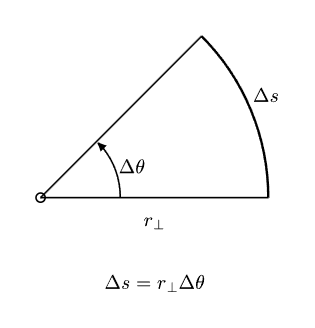
Figure 3. A common angular displacement Δ𝜃 produces arc length Δs = r⊥Δ𝜃. Points farther
from the rotation axis travel farther.
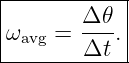
7 Average angular velocity
Average angular velocity is defined by
Its SI unit is commonly written
The sign of ωavg indicates rotational direction.
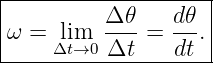
8 Instantaneous angular velocity
Take the time interval to zero:
For fixed-axis motion in a plane:
- ω > 0 means rotation in the positive angular direction,
- ω < 0 means rotation in the negative angular direction.
The magnitude
is the angular speed.
9 Period and frequency
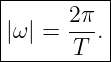
If a body rotates steadily with period T, one revolution occurs in time T:
Therefore
Frequency is
Thus
If rotational speed is given in revolutions per minute,
it should normally be converted to radians per second before substitution into mechanics
equations.
10 Example 1: rpm to angular speed
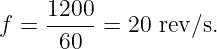
A wheel rotates at
Convert to revolutions per second:
Then
Thus
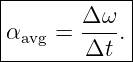
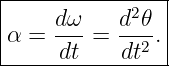
11 Angular acceleration
Average angular acceleration is
Instantaneous angular acceleration is
The SI unit is
The sign of α describes how the signed angular velocity changes.
A positive α does not necessarily mean the body is speeding up.
For example:
- ω > 0, α > 0: angular speed increases,
- ω > 0, α < 0: angular speed decreases,
- ω < 0, α < 0: angular speed increases,
- ω < 0, α > 0: angular speed decreases.
12 Constant angular acceleration
If
then the angular-motion equations have exactly the same mathematical form as one-dimensional
constant-acceleration translation.
Integrating
gives
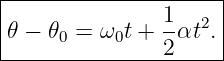
Integrating
gives
Eliminating time gives
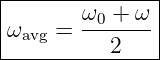
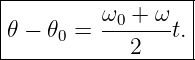
The average angular velocity under constant angular acceleration is
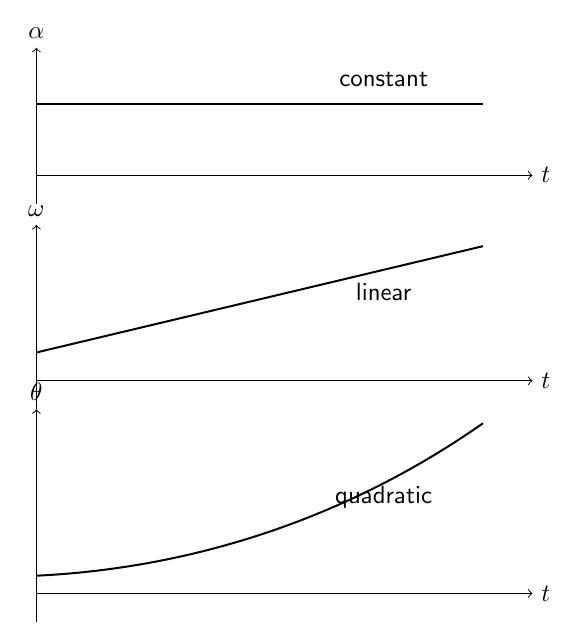
Figure 6. Under constant angular acceleration, α(t) is constant, ω(t) varies linearly, and 𝜃(t)
varies quadratically.
13 Example 2: spin-up from rest
A rotor starts from rest and has constant angular acceleration
for
The final angular velocity is
| ω | = ω0 + αt | (47)
|
| = 0 + (4.0)(5.0) | (48)
|
| = 20 rad∕s. | (49) |
The angular displacement is
| Δ𝜃 | = ω0t +  αt2 αt2 | (50)
|
| =  (4.0)(25) (4.0)(25) | (51)
|
| = 50 rad. | (52) |
Thus
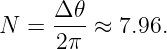
The number of revolutions is
14 All points share the same angular motion
In a rigid body rotating about a fixed axis, every material point sweeps through the same angular
displacement during the same time interval.
Therefore all points share the same:
They do not share the same linear speed.
For a point at perpendicular distance r⊥ from the axis,
Thus a point farther from the axis moves faster.
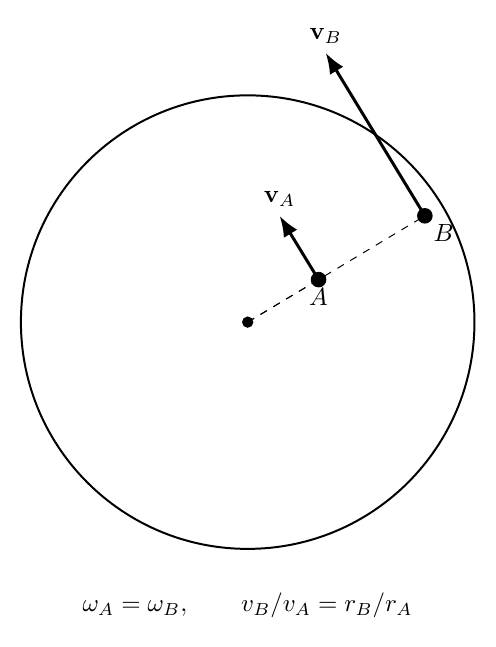
Figure 4. Points A and B on the same rigid body share the same ω, but the point farther from
the axis has the larger tangential speed because v = r⊥|ω|.
15 Derivation of tangential speed
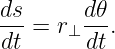
A point at radius r⊥ travels
Divide by dt:
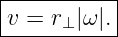
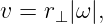
Thus the tangential speed is
The velocity direction is tangent to the circular path.
16 Tangential acceleration
Differentiate the tangential speed relation for a fixed material point:
using signed tangential components.
Then
Therefore the tangential-acceleration magnitude is
Tangential acceleration changes the magnitude of the point’s velocity.
17 Normal acceleration
Even if
a rotating point is accelerated because the direction of its velocity changes.
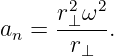
For circular motion,
Since
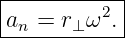
Thus
This component points inward toward the rotation axis.
18 Total acceleration of a point
The tangential and Normal components are perpendicular:
Therefore the magnitude is
Equivalently,
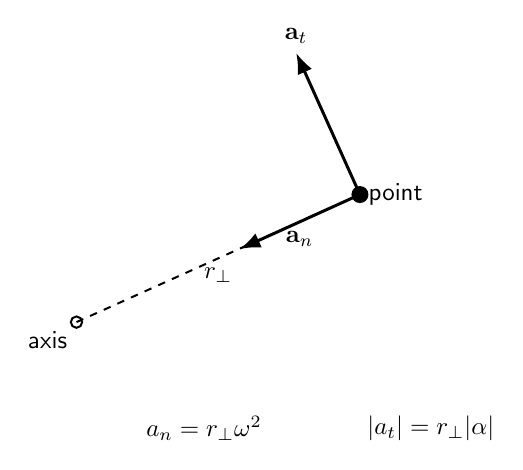
Figure 5. A point on a rotating rigid body generally has tangential acceleration at = r⊥α and
inward normal acceleration an = r⊥ω2.
19 Example 3: two points on a rotating disk
A disk rotates with
and
Point A is at
and point B is at
Their speeds are
| vA | = rAω = 1.0 m∕s, | (75)
|
| vB | = rBω = 3.0 m∕s. | (76) |
Their tangential accelerations are
| at,A | = rAα = 0.30 m∕s2, | (77)
|
| at,B | = rBα = 0.90 m∕s2. | (78) |
Their normal accelerations are
| an,A | = rAω2 = 10 m∕s2, | (79)
|
| an,B | = rBω2 = 30 m∕s2. | (80) |
Both points share the same ω and α, but point B has three times the linear speed and three times
each linear acceleration component.
20 Points on the rotation axis
For a point exactly on the fixed axis,
Therefore
| v | = 0, | (82)
|
| at | = 0, | (83)
|
| an | = 0. | (84) |
The axis is stationary in fixed-axis rotation.
This fact distinguishes fixed-axis rotation from more general rotational motion in which the axis
itself can translate or change direction.
21 Angular graphs
The angular variables have the same derivative hierarchy as translational kinematics:
Therefore:
- the slope of a 𝜃-versus-t graph is ω,
- the slope of an ω-versus-t graph is α,
- the area under an ω-versus-t graph is angular displacement,
- the area under an α-versus-t graph is change in angular velocity.
These interpretations remain valid when ω and α vary with time.
22 Example 4: variable angular acceleration from a graph
Suppose
in rad∕s2, with
Then
| ω(t) − ω(0) | = ∫
0t2τ dτ | (88)
|
| = t2. | (89) |
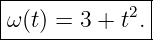
Therefore
Angular position follows by integrating again:
| 𝜃(t) − 𝜃(0) | = ∫
0t(3 + τ2) dτ | (91)
|
| = 3t +  t3. t3. | (92) |
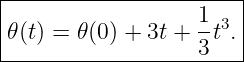
Thus
23 Angular velocity is common, tangential velocity is not
A frequent mistake is to say every point of a rigid body has the same velocity during
rotation.
That is false.
All material points share the same angular velocity for fixed-axis rotation:
But
Thus linear velocities depend on position.
Their directions also differ because each velocity is tangent to its own circular path.
24 Angular acceleration is common, linear acceleration is not
Similarly,
for the shared rigid body rotation, but
and
Linear acceleration therefore varies across the body.
25 Relation to uniform circular motion
Uniform circular motion is recovered when
Then
but
remains nonzero.
A point can therefore move at constant speed while continuously accelerating.
26 Finite rotations and orientation
In planar motion, a single angle 𝜃 completely specifies orientation.
In three dimensions, a general rigid body orientation requires more information than one scalar
angle.
This becomes important because finite rotations about different axes do not generally
commute.
The present article avoids that complication by concentrating on fixed-axis motion.
M05-02 develops angular velocity and angular acceleration as vectors and begins the transition to
three-dimensional rotational kinematics.
27 Vector bridge
For fixed-axis rotation, introduce the angular-velocity vector
along the rotation axis according to the right-hand rule.
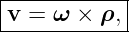
If ρ is the position of a material point measured from a point on the fixed axis, then
Its magnitude is
Similarly, the point acceleration can be written
The first term is tangential acceleration.
The second term is inward normal acceleration.
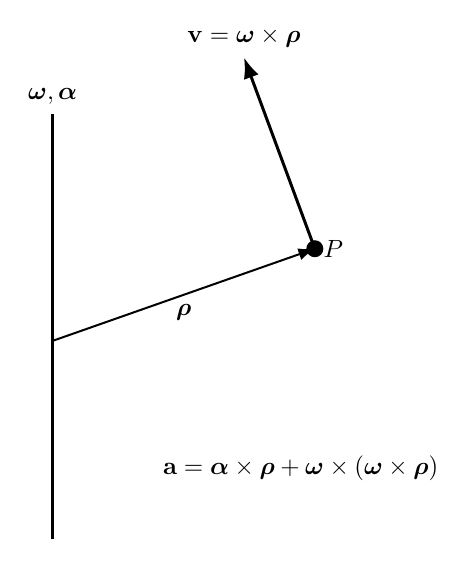
Figure 8. Fixed-axis point kinematics can be written compactly with cross products. M05-02
develops the vector meaning of ω and α in detail.
28 Example 5: vector velocity check
Let
and let a point have position
Then
| v | = ω ×ρ | (108)
|
| = 4ez × (3ex + 2ey) | (109)
|
| = 12ey − 8ex. | (110) |
Thus
The perpendicular radius is
The speed predicted by the scalar relation is
The vector magnitude is
so the two forms agree.
29 Common mistakes
- Treating a rigid body as a single particle and ignoring the different linear motions of
its material points.
- Using degrees directly in s = r𝜃 instead of converting to radians.
- Confusing angular displacement with distance traveled along an arc.
- Confusing angular velocity with tangential speed.
- Saying every point of a rotating rigid body has the same linear velocity.
- Forgetting that r⊥ is the perpendicular distance to the rotation axis, not necessarily
the distance to an arbitrary origin.
- Forgetting that normal acceleration remains nonzero when α = 0.
- Assuming positive angular acceleration always means increasing angular speed.
- Applying constant-angular-acceleration formulas when α varies with time.
- Forgetting the factor 2π when converting between frequency and angular speed.
- Confusing rpm with rad/s.
- Treating a point on the fixed rotation axis as though it had nonzero tangential speed.
- Using a = r⊥α as the complete acceleration and omitting the normal term.
- Treating planar angular position 𝜃 as a complete description of arbitrary
three-dimensional rigid body orientation.
30 Practice exercises
- Explain the rigid body constraint in terms of the distance between any two material
points.
- Convert 900 rpm to rad/s.
- A wheel turns through 18 revolutions. Find its angular displacement in radians.
- A disk starts at 𝜃0 = 0.5 rad and rotates with constant ω = 6 rad∕s for 4 s. Find 𝜃f.
- A rotor starts from rest with constant α = 5 rad∕s2 for 3 s. Find its final angular
velocity and angular displacement.
- A wheel slows from 20 rad∕s to 5 rad∕s in 3 s with constant angular acceleration.
Find α.
- A point lies 0.25 m from a fixed rotation axis. If ω = 12 rad∕s, find its speed.
- For the point in the previous problem, find the normal acceleration.
- If α = 4 rad∕s2 in the same motion, find the tangential acceleration and total
acceleration magnitude.
- Two points lie at radii 0.10 m and 0.40 m on the same rotating disk. Compare their
angular velocities, tangential speeds, and normal accelerations.
- Show by differentiation that v = r⊥ω implies at = r⊥α for a fixed material point.
- Use v = r⊥ω and an = v2∕r
⊥ to derive an = r⊥ω2.
- If α(t) = 3t2 and ω(0) = 2 rad∕s, find ω(t).
- If ω(t) = 4 + 2t and 𝜃(0) = 1 rad, find 𝜃(t).
- Verify the magnitude of v = ω ×ρ is |ω|r⊥.
31 Summary
A rigid body preserves all internal distances:
For fixed-axis planar rotation,
When α is constant,
| ω = ω0 + αt, | | (117)
|
𝜃 − 𝜃0 = ω0t +  αt2, αt2, | | (118)
|
| ω2 = ω
02 + 2α(𝜃 − 𝜃
0). | | (119) |
For a material point at perpendicular distance r⊥ from the axis,
| s = r⊥𝜃, | | (120)
|
| v = r⊥|ω|, | | (121)
|
| at = r⊥|α|, | | (122)
|
| an = r⊥ω2. | | (123) |
In vector form,
and
M05-02 develops the vector character of angular velocity and angular acceleration and extends
these ideas toward three-dimensional rigid body kinematics.
References
References
[1] J. R. Taylor, Classical Mechanics, University Science Books, 2005.
[2] D. Kleppner and R. Kolenkow, An Introduction to Mechanics, 2nd ed., Cambridge
University Press, 2014.
[3] K. R. Symon, Mechanics, 3rd ed., Addison-Wesley, 1971.
[4] OpenStax, University Physics, Volume 1, Rice University, 2016.