Conservative Forces and Potential Energy
A force can transfer energy to or from a particle by doing work. For a special and very important
class of forces, the work between two positions depends only on the endpoints and not on the path
followed between them. Such a force is called conservative.
For a conservative force, the work done from point A to point B can be represented by a scalar
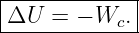
function of position called the potential energy U:
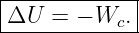
Equivalently,
This relation is the central idea of the article. It turns certain force calculations into energy
bookkeeping and prepares the way for conservation of mechanical energy.
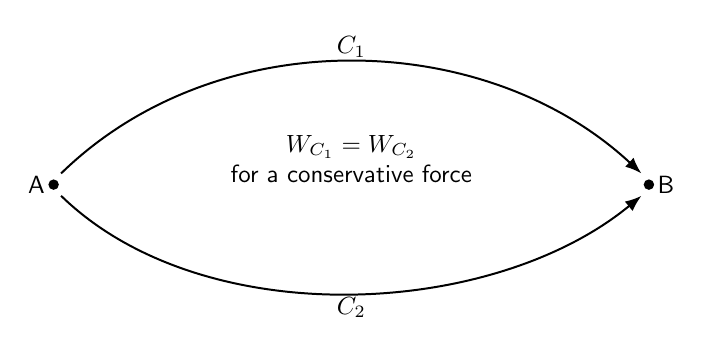
Figure 1. For a conservative force, all paths joining the same two endpoints give the same work.
Path independence allows the work to be represented by a scalar potential-energy difference.
1 What makes a force conservative?
A force is conservative if the work it does between two fixed positions is independent of the
path.
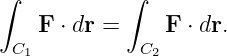
If a particle moves from point A to point B along two different paths C1 and C2, then a
conservative force satisfies
Therefore the work can depend only on the endpoints A and B.
This is a strong restriction. Many familiar forces are conservative in idealized mechanics,
including
- uniform gravity near Earth’s surface,
- Newtonian inverse-square gravity,
- the force of an ideal spring,
- the electrostatic Coulomb force.
Common examples of nonconservative forces include kinetic friction and many forms of
drag.
2 Closed-path test
Suppose a conservative force carries a particle from A to B along one path and the particle returns
from B to A along another path.
Because the work between fixed endpoints is path independent,
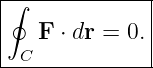
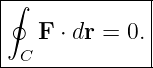
Therefore the total work around the closed path is zero:
For the class of force fields considered in elementary mechanics, the following statements are
equivalent:
- the work between two points is path independent,
- the work around every closed path is zero,
- a potential-energy function can be defined,
- the force can be obtained from the spatial derivative of that potential energy.
The last statement will be developed carefully below.
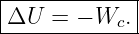
3 Defining potential-energy difference
Let a conservative force do work
Define the change in potential energy by
Thus
The minus sign is essential.
If the conservative force does positive work,
then
The potential energy decreases.
If the conservative force does negative work,
then
The potential energy increases.
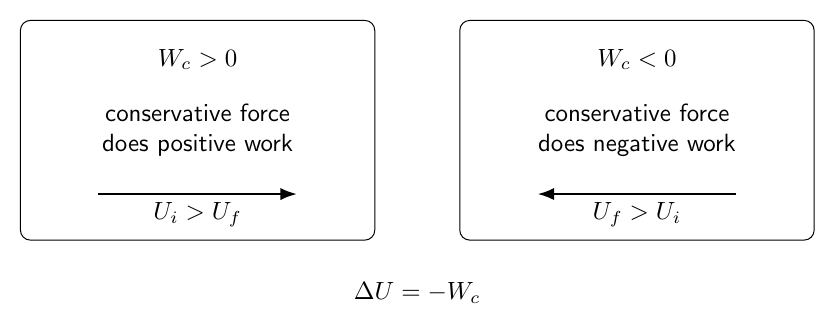
Figure 2. Positive work by a conservative force corresponds to decreasing potential energy.
Negative work by the force corresponds to increasing potential energy.
4 Potential energy is defined up to a constant
Only differences in potential energy are determined by force.
If U(r) is a valid potential-energy function, then
is equally valid for any constant C.
This is because
| U′B − U′A | = (UB + C) − (UA + C) | (14)
|
| = UB − UA. | (15) |
Therefore the physics is unchanged.
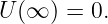
One is free to choose a convenient reference level at which
For uniform gravity near Earth’s surface, the reference height can be chosen arbitrarily. For
Newtonian gravity, a common and useful convention is
5 One-dimensional force from potential energy
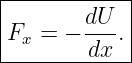
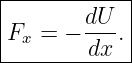
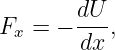
In one-dimensional motion,
Divide by dx:
This equation contains a powerful geometric idea.
The force points in the direction in which potential energy decreases most rapidly.
If
then
If
then
If
then
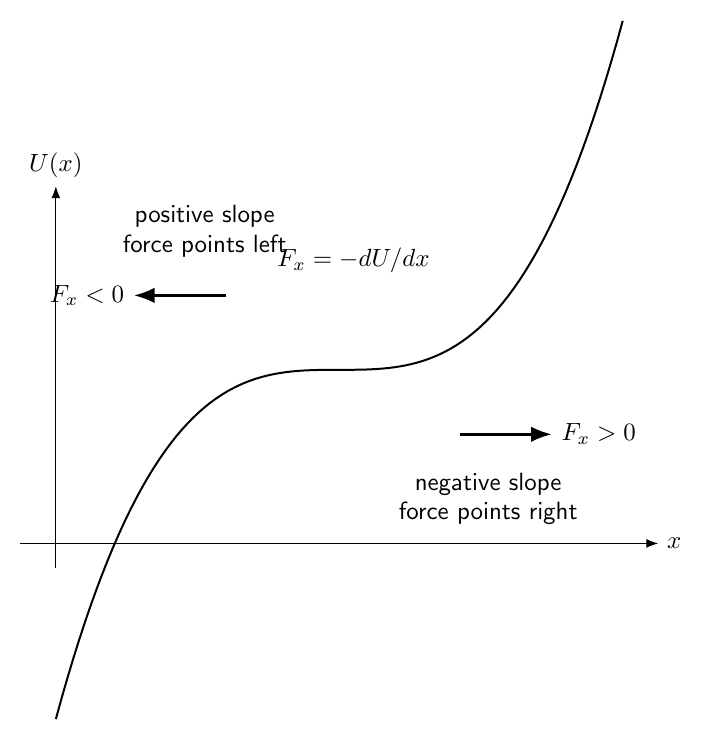
Figure 3. In one dimension, force is minus the slope of the potential-energy curve. A positive slope
produces force toward negative x, while a negative slope produces force toward positive x.
6 Recovering potential energy from force
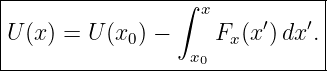
If the force is known, potential energy can be found by integration.
From
integrate from a reference point x0 to x:
Therefore
The variable x′ is a dummy integration variable. It prevents confusion between the integration
variable and the endpoint x.
7 Example 1: constant force
Suppose
is constant.
Then
| U(x) − U(x0) | = −∫
x0xF
0 dx′ | (30)
|
| = −F0(x − x0). | (31) |
Thus
where
A constant force therefore corresponds to a linear potential-energy function.
8 Uniform gravity near Earth’s surface
Near Earth’s surface, take the y axis positive upward.
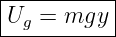
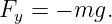
The gravitational force on a mass m is
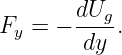
In one dimension,
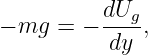
The potential-energy derivative satisfies
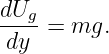
Therefore
so
Integrating,
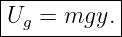
If the zero of potential energy is chosen at y = 0, then
The difference between two heights is
The work done by gravity is
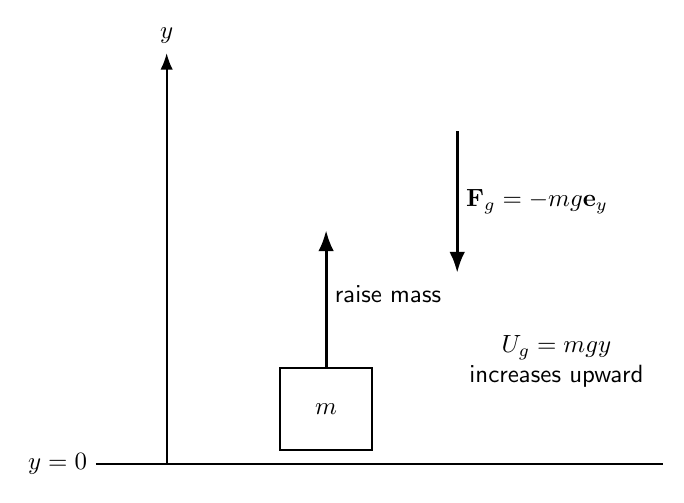
Figure 4. Near Earth’s surface, gravitational potential energy increases linearly with height.
Gravity points downward, toward decreasing potential energy.
9 Example 2: lifting a mass
A 3.0 kg mass is raised vertically from yi = 1.0 m to yf = 6.0 m.
The change in gravitational potential energy is
| ΔUg | = mg(yf − yi) | (43)
|
| = (3.0)(9.81)(5.0) | (44)
|
| = 147 J. | (45) |
Therefore gravity does
The result depends only on the change in height. It does not depend on whether the mass moved
vertically, along a ramp, or along some other path, provided gravity is the same uniform
conservative field.
10 Elastic potential energy of an ideal spring
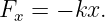
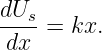
For an ideal spring,
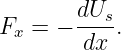
Use
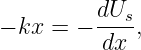
Then
so
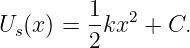
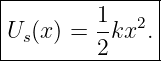
Integrating,
Choosing
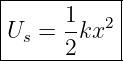
gives
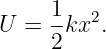
This is the elastic potential energy stored by an ideal spring.
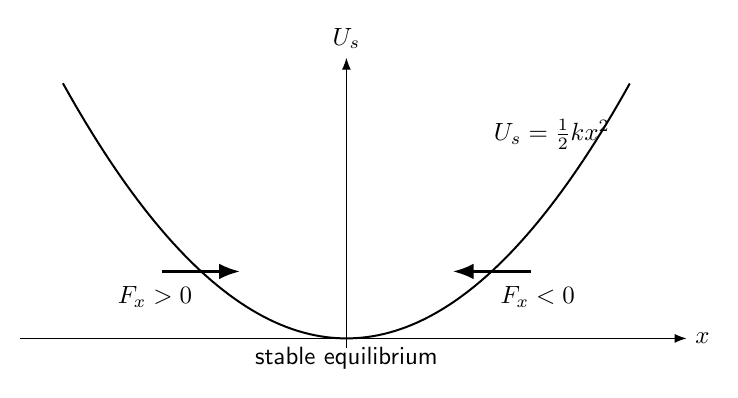
Figure 5. The ideal-spring potential Us =  kx2 has a minimum at equilibrium. The force
Fx = −dU∕dx = −kx always points back toward x = 0.
kx2 has a minimum at equilibrium. The force
Fx = −dU∕dx = −kx always points back toward x = 0.
11 Work and spring potential energy
The spring work from xi to xf is
Therefore
| Ws | = −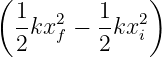 | (55)
|
| =  kxi2 − kxi2 − kxf2 . kxf2 . | (56) |
This reproduces the result derived directly from the work integral in M03-03.
The energy viewpoint and the force-integral viewpoint are not separate physical laws. They are two
descriptions of the same conservative interaction.
12 Newtonian gravitational potential energy
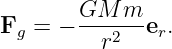
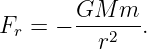
Consider two masses M and m separated by distance r.
The gravitational force on m is radial and inward:
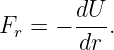
For radial motion,
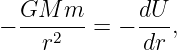
The potential satisfies
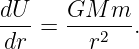
Thus
so
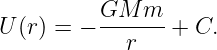
Integrating,
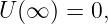
With the standard reference
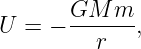
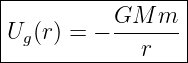
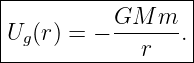
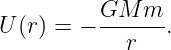
we obtain
The negative sign reflects the chosen zero at infinite separation. At any finite separation, the
gravitational potential energy is lower than at infinity.
13 Why near-Earth gravity gives mgy
The inverse-square potential is
Near Earth’s surface, write
where
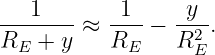
A first-order expansion gives
Therefore
| U(RE + y) | ≈− + +  y. y. | (69) |
Since
this becomes
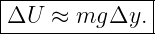
The first term is a constant reference offset, so locally
Thus the familiar near-Earth formula is the local approximation to the inverse-square gravitational
potential.
14 Potential energy in several dimensions
In three-dimensional Cartesian coordinates,
For a conservative force,
Since
we have
But the total differential of U(x,y,z) is
Comparing coefficients,
| Fx | = − , , | (78)
|
| Fy | = − , , | (79)
|
| Fz | = − . . | (80) |
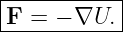
Therefore
The gradient is
The force points toward decreasing potential energy.
15 Equipotential surfaces
A surface on which
is called an equipotential surface.
For a displacement tangent to an equipotential surface,
Since
we obtain
Thus the conservative force is perpendicular to an equipotential surface.
For Newtonian gravity around a spherical mass, the equipotential surfaces are spheres centered on
the mass.
16 Potential-energy curves
In one-dimensional problems, a graph of U(x) reveals important dynamical information.
Because
the slope tells us the force direction.
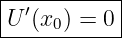
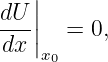
A local minimum of U satisfies
and typically corresponds to stable equilibrium.
A local maximum also satisfies
but it typically corresponds to unstable equilibrium.
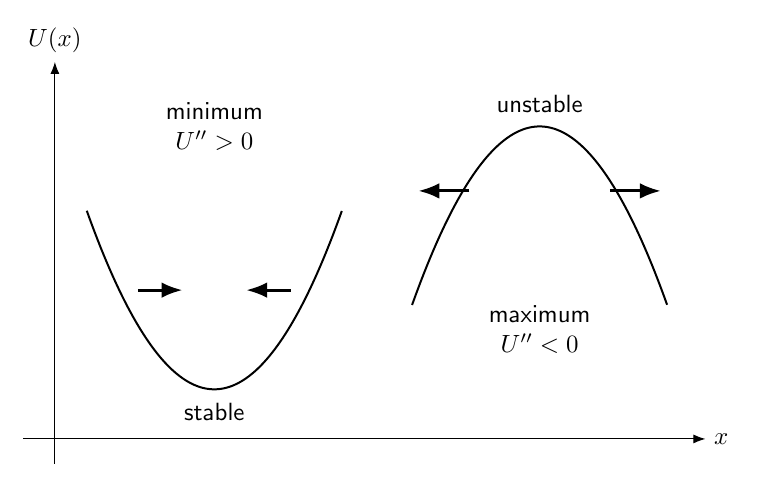
Figure 6. Equilibrium occurs where dU∕dx = 0. A local minimum corresponds to stable
equilibrium, while a local maximum corresponds to unstable equilibrium.
17 Stable equilibrium
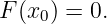
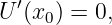
Suppose x = x0 is a local minimum of the potential energy.
Then
so
For a small displacement to the right of x0, the potential rises:
Therefore
which points back toward equilibrium.
For a small displacement to the left,
so
again pointing back toward equilibrium.
This is why a potential-energy minimum is stable.
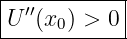
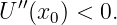
A mathematical test is
18 Unstable equilibrium
At a local maximum,
but
A small displacement produces a force that pushes the particle farther away from the equilibrium
point.
Thus a local maximum corresponds to unstable equilibrium.
19 Example 3: equilibrium from a potential
Let
where
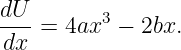
Equilibrium occurs where
Differentiate:
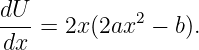
Factor:
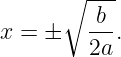
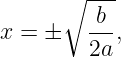
Thus the equilibria are
and
The second derivative is
At
we have
so the origin is unstable.
At
we obtain
| U′′ | = 12a − 2b − 2b | (110)
|
| = 4b > 0. | (111) |
These two equilibria are stable.
20 Conservative and nonconservative forces
A conservative force stores and releases mechanical energy through a potential-energy
function.
A nonconservative force generally cannot be represented globally by a single-valued position-only
potential energy.
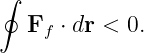
For example, kinetic friction usually does
over a path of nonzero length.
If the particle returns to its starting position after traveling around a loop, friction has generally
done net negative work:
Therefore friction fails the closed-path test for a conservative force.
The energy removed from mechanical motion is not destroyed. It is transferred into thermal energy,
deformation, sound, and microscopic degrees of freedom.
21 Path independence versus path length
A common source of confusion is to think that conservative work depends on path length.
It does not.
Consider uniform gravity. A particle may descend from height yi to height yf by
- falling vertically,
- sliding along a straight incline,
- moving along a curved track.
If only the gravitational work is being calculated, all three paths give
The actual distances traveled can be different, but the gravitational work depends only on the
endpoint heights.
22 Dimensional checks
Potential energy has the same dimensions as work:
For uniform gravity,
so
For a spring,
Since
we obtain
For inverse-square gravity,
which also has units of joules.
23 Common mistakes
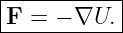
- Forgetting the minus sign in ΔU = −Wc.
- Assuming every force has a potential-energy function.
- Treating the absolute value of potential energy as physically unique.
- Forgetting that only potential-energy differences affect mechanics.
- Writing F = dU∕dx instead of F = −dU∕dx.
- Confusing stable equilibrium with any point where U′(x) = 0.
- Assuming a local maximum of U is stable.
- Using mgy over altitude ranges where constant g is no longer a good approximation.
- Forgetting that U = −GMm∕r uses the reference U(∞) = 0.
- Assuming path-independent gravitational work means the particle travels the same
distance along every path.
- Treating frictional work as if it could be represented by a position-only potential energy.
24 Practice exercises
- A conservative force does +25 J of work on a particle. Find the change in potential
energy.
- A conservative force does −18 J of work. Does the potential energy increase or decrease,
and by how much?
- A force has potential energy U(x) = 4x2 in SI units. Find F
x(x).
- A force is Fx = −6x2. Find a corresponding potential-energy function U(x).
- A 2.0 kg mass moves upward by 3.0 m near Earth’s surface. Find ΔUg.
- A spring with k = 250 N∕m is compressed by 0.12 m. Find its elastic potential energy
relative to equilibrium.
- Starting from Fx = −kx, derive Us =
 kx2 + C.
- Starting from Fr = −GMm∕r2, derive U
g = −GMm∕r + C.
- Show that adding a constant C to a potential-energy function does not change the
force.
- For U(x) = ax4 − bx2 with a,b > 0, classify all equilibrium points.
- Explain why the gravitational work between two fixed heights is the same on a straight
ramp and a curved track.
- A particle moves around a closed loop under a force field. The measured net work is
12 J. Can the force be conservative? Explain.
- A potential-energy curve has negative slope at some point. What is the sign of the
force there?
- For U(x) = U0 cos(kx), derive Fx(x) and identify equilibrium positions.
- Explain physically why a local minimum of potential energy corresponds to stable
equilibrium.
25 Summary
A conservative force does path-independent work:
Equivalently,
For a conservative force around a closed path,
In one dimension,
In three dimensions,
Important examples are
near Earth’s surface,
for an ideal spring, and
for Newtonian gravity with U(∞) = 0.
Potential-energy curves also reveal force direction and equilibrium:
at equilibrium, with
for stable equilibrium.
The next article, M03-06, combines kinetic and potential energy into the conservation of
mechanical energy.
References
References
[1] J. R. Taylor, Classical Mechanics, University Science Books, 2005.
[2] D. Kleppner and R. Kolenkow, An Introduction to Mechanics, 2nd ed., Cambridge
University Press, 2014.
[3] H. Goldstein, C. Poole, and J. Safko, Classical Mechanics, 3rd ed., Addison-Wesley,
2002.
[4] H. D. Young and R. A. Freedman, University Physics with Modern Physics, 15th ed.,
Pearson, 2020.
[5] OpenStax, University Physics, Volume 1, Rice University, 2016.

![|--------------------------------|
W (A → B ) = − [U (B) − U (A)].|
---c------------------------------](https://images.physicslibrary.org/cache/objects/1379/make4ht/ConservativeForcesAndPotentialEnergy0x.png)


















































![[U] = M L2T − 2.](https://images.physicslibrary.org/cache/objects/1379/make4ht/ConservativeForcesAndPotentialEnergy109x.png)

![( L )
[U] = M -2- L = M L2T − 2.
T](https://images.physicslibrary.org/cache/objects/1379/make4ht/ConservativeForcesAndPotentialEnergy111x.png)
![[k ] = F-= M T −2,
x](https://images.physicslibrary.org/cache/objects/1379/make4ht/ConservativeForcesAndPotentialEnergy113x.png)
![[kx2] = M L2T − 2.](https://images.physicslibrary.org/cache/objects/1379/make4ht/ConservativeForcesAndPotentialEnergy114x.png)