Work Done by a Force
Newton’s second law describes how forces change motion locally in time. A second, complementary
viewpoint asks how a force acts through a displacement. The scalar quantity that measures this
force-displacement transfer is called mechanical work.
For a constant force F acting while a particle undergoes a displacement Δr, the work done by that
force is
Using the geometric definition of the dot product,
where 𝜃 is the angle between the force and the displacement.
Work is therefore a scalar. Its sign tells whether the force has a component along the displacement
or opposite the displacement. A force perpendicular to the displacement does zero work at that
instant.
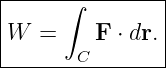
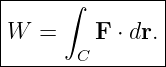
The general definition for a force that may vary in magnitude or direction along a path C
is
This article develops the geometry, sign conventions, units, component form, and basic applications
of work. It also distinguishes displacement from path length, which prevents a common mistake:
work is not generally force magnitude times distance traveled. The work-energy theorem
is derived in M03-02, while variable-force integration is developed in greater detail in
M03-03.
1 Force and displacement are both vectors
Suppose a particle moves from position ri to rf. Its displacement is
A force need not point along the displacement. Only the component of the force parallel to the
displacement contributes to the work.
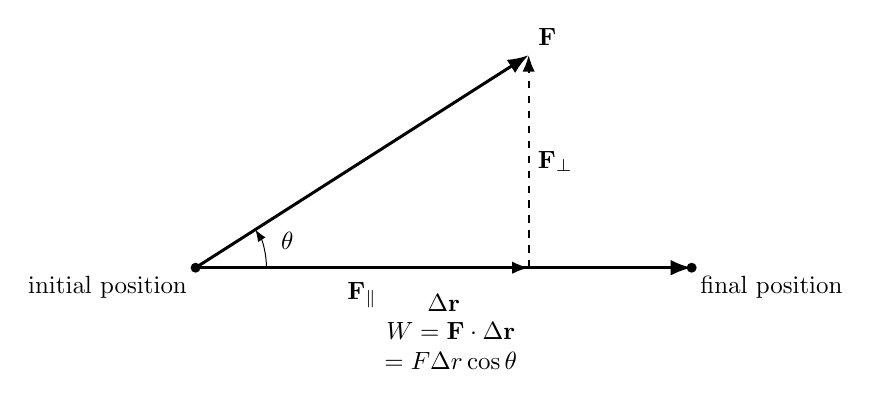
Figure 1. A constant force acts while the particle undergoes a displacement. Only the component
of the force parallel to the displacement contributes to the mechanical work.
Resolve the force into components parallel and perpendicular to the displacement:
The parallel magnitude is
Therefore
The perpendicular component contributes nothing because
This is the first important geometric lesson: a large force can do little or no work if it is nearly
perpendicular to the displacement.
2 Positive, zero, and negative work
The sign of work is set by the angle between the force and displacement:
Three cases are especially important.
- If 0 ≤ 𝜃 < 90∘, then cos 𝜃 > 0 and the force does positive work.
- If 𝜃 = 90∘, then cos 𝜃 = 0 and the force does zero work.
- If 90∘ < 𝜃 ≤ 180∘, then cos 𝜃 < 0 and the force does negative work.
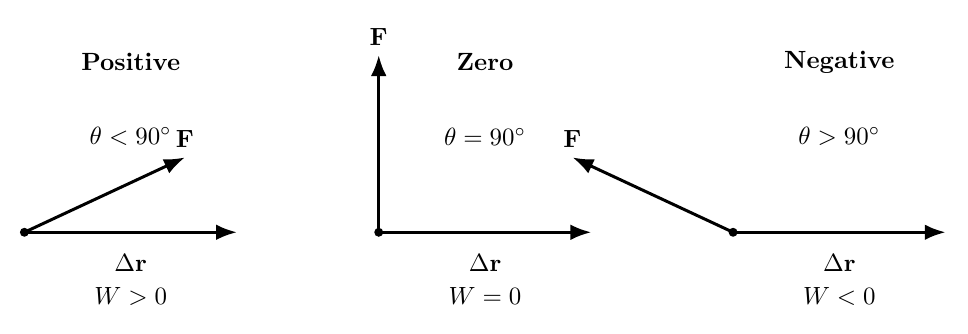
Figure 2. Positive, zero, and negative work follow directly from the angle between the force and
the displacement. The sign belongs to the work done by a particular force, not to the force itself.
A useful interpretation is that positive work corresponds to a force component in the direction of
motion, while negative work corresponds to a force component opposite the motion.
This interpretation will become precise in M03-02 when work is connected to kinetic
energy.
A nonzero force can also do zero work when there is no displacement at all. For example, a person
holding a stationary object exerts a force on it, but the mechanical work done on the stationary
object is zero because Δr = 0.
3 Component form in Cartesian coordinates
If
and
then the dot product gives
This form is often easier than finding the angle explicitly.
For example, if
and
then
4 Units and dimensions
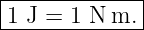
The SI unit of work is the joule:
Since
we have
Thus the dimensions of work are
Torque can also be expressed dimensionally as force times distance, but torque and work are
different physical quantities. Work is a scalar produced by a dot product, while torque is an axial
vector produced by a cross product. For this reason torque is conventionally reported in
newton-meters rather than joules.
5 Work by several forces
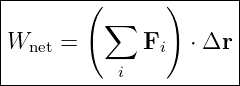
If several forces act on a particle, each force can do its own work. If the forces are constant over the
displacement,
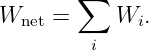
The total work by all forces is
Because the dot product is distributive,
for constant forces acting through the same displacement.
The distinction between work done by one force and net work is essential. Gravity may do positive
work while a tension force does negative work, or one force may do zero work while another does
nonzero work.
6 Work done by common forces
Weight near Earth’s surface
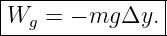
For a vertical displacement Δy measured positive upward,
Therefore
Gravity does positive work when the particle moves downward and negative work when it
moves upward. The potential energy interpretation is developed later in M03-05 and
M03-06.
Normal force
For motion along a fixed smooth surface, the Normal force is perpendicular to the instantaneous
displacement tangent to the surface. Thus
and the normal force does zero work.
This statement has conditions. A normal force can do work when the constraining surface itself
moves. The correct test is always the dot product between the force and the displacement of the
point on which that force acts.
Kinetic friction
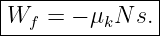
If an object slides across a stationary surface and kinetic friction points opposite the displacement,
then
For a simple horizontal slide with constant fk = μkN,
The minus sign is a consequence of the force-displacement angle, not a special rule attached to
friction. In more complicated systems, including moving surfaces, the work of friction must be
evaluated from the actual force and displacement.
Tension
Tension can do positive, negative, or zero work depending on the geometry and which body is
being analyzed. For example, tension on a mass being lifted upward can do positive
work. The same tension on another connected body moving downward can do negative
work.
7 Worked example 1: constant force at an angle
A worker pulls a crate through a horizontal displacement of 12.0 m using a constant force of
magnitude 85.0 N directed 30.0∘ above the horizontal. Find the work done by the applied
force.
The displacement is horizontal, so the angle between force and displacement is 30.0∘:
Thus
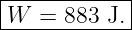
Therefore
The vertical component of the applied force does no work because the crate has no vertical
displacement.
8 Worked example 2: work by individual forces on a sliding block
A 6.00 kg block slides 5.00 m to the right across a horizontal floor. A horizontal applied force of
32.0 N acts to the right. The kinetic friction coefficient is μk = 0.250. Find the work done by the
applied force, friction, gravity, and the normal force.
The normal force is
The kinetic friction magnitude is
Applied-force work:
Friction work:
Gravity and the normal force are perpendicular to the horizontal displacement, so
Hence
The net work is therefore 86.4 J. M03-02 will show what this net work implies about the change in
speed.
9 Worked example 3: a force perpendicular to circular motion
A particle moves at constant radius R around a circle while a purely radial force always points
toward the center. Find the work done by the radial force over any finite arc of the circular
path.
For an infinitesimal displacement along the circle, dr is tangent to the path, while the radial force
is perpendicular to the tangent. Therefore
Integrating around any arc,
A force can continuously change the direction of velocity while doing zero work. This is the force
counterpart of uniform circular motion developed in M01-08 and M02-11.
10 Displacement, distance, and path
For a constant force, the work can be written as F ⋅ Δr, so the endpoint displacement is the
relevant vector. It is generally incorrect to replace Δr by the total distance traveled unless the
force remains tangent to the motion with the appropriate sign.
For example, if a particle moves out and then returns to its starting point while a single constant
force acts throughout, the total displacement is zero. The total work by that constant force over
the complete round trip is therefore zero, even though the particle traveled a nonzero
distance.
For a force that changes with position or direction, the actual path can matter. This is why the
general definition uses a line integral along the path C.
11 The force versus position graph
For one-dimensional motion along x, the differential work is
For a constant force from x1 to x2,
Geometrically, this is the signed area under the Fx versus x graph.
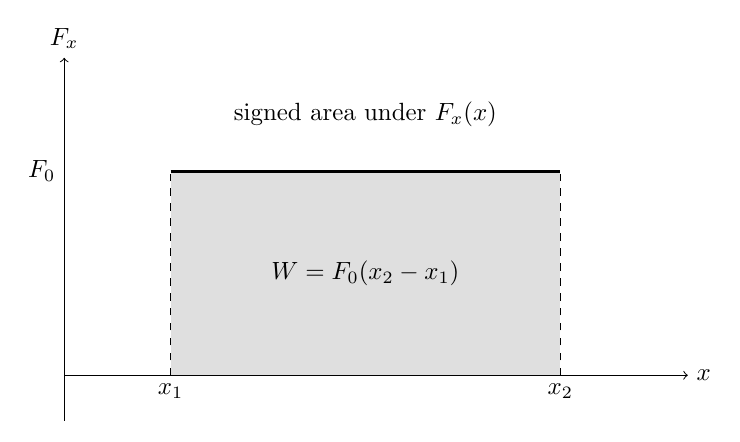
Figure 3. For one-dimensional motion, mechanical work is represented by signed area under the
force versus position graph. A positive force over a positive displacement gives positive area and
positive work.
If Fx varies with position, the rectangle is replaced by the limiting sum of many narrow strips.
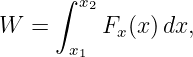
This leads to
which is developed systematically in M03-03.
12 Worked example 4: reading work from a force versus position graph
A force along the x direction has constant value Fx = 18.0 N from x = 2.00 m to x = 7.50 m.
Find the work done by the force.
The displacement is
The work is the rectangular area under the graph:
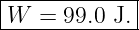
Thus
If the same force had been −18.0 N over the same positive displacement, the work would have
been −99.0 J.
13 Work along a curved path
For a general path, the displacement changes direction continuously. Divide the path into many
small displacement vectors Δri. Over a sufficiently small segment, the force can be treated as
approximately constant, so
Summing and taking the limit gives the line integral
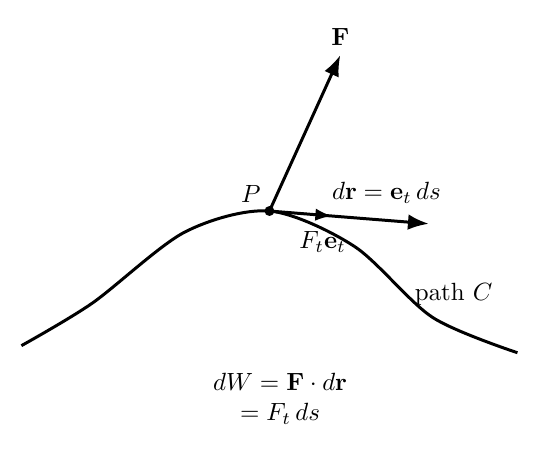
Figure 4. Along a curved path, the infinitesimal displacement is tangent to the trajectory. The
differential work is determined by the component of the force along that tangent.
If et is the unit tangent and ds is an infinitesimal path length, then
Therefore
where Ft is the tangential component of the force. Thus even on a curved path, only the
component of force tangent to the path contributes to work.
14 Work depends on the reference frame
Displacement and velocity depend on the reference frame, so mechanical work generally does also.
A force can do different amounts of work when the same physical process is described from
different inertial frames.
This does not create a contradiction. Kinetic energy is also frame dependent, and the work-energy
theorem remains consistent within each frame. The force, displacement, and energy quantities must
all be evaluated in the same frame.
15 Common mistakes
- Using W = Fd without checking the angle between force and displacement.
- Treating work as a vector because force and displacement are vectors.
- Assuming every force acting on a moving object does nonzero work.
- Calling FΔr the work when the force is perpendicular to the displacement.
- Forgetting that negative work is physically meaningful.
- Adding a separate “work force” or “centripetal work” to the force diagram.
- Confusing work done by one force with net work by all forces.
- Assuming the normal force always does zero work without checking whether the
constraint is moving.
- Assuming friction always does negative work without examining the actual force and
displacement.
- Confusing the joule with the newton. Work has units of force times distance.
16 Practice exercises
- A 25 N horizontal force moves a box 6.0 m horizontally in the same direction. Find
the work done by the force.
- A 40 N force acts through a displacement of 3.0 m at an angle of 60∘ to the
displacement. Find the work.
- A force of magnitude 50 N acts perpendicular to a displacement of 8.0 m. Find the
work done by that force.
- A 12 N force acts opposite a 5.0 m displacement. Find the work and state its sign.
- Evaluate the work for
- A 10 kg crate is raised vertically by 2.5 m. Find the work done by gravity using
g = 9.81 m∕s2.
- A block slides 4.0 m across a level floor with kinetic friction magnitude 18 N. Find
the work done by friction.
- A particle moves through a quarter circle while a force always points radially toward
the circle center. What work does that radial force do? Explain geometrically.
- A constant force Fx = −7.0 N acts while a particle moves from x = −2.0 m to
x = 5.0 m. Find the work.
- A force versus position graph is a rectangle of height 14 N from x = 1 m to x = 9 m.
Find the work from the signed area. Then state what changes if the rectangle lies below
the x axis instead.
17 Answers to practice exercises
- 150 J.
- 60 J.
- 0 J.
- −60 J.
- 2 J.
- −245 J to three significant figures.
- −72 J.
- Zero; the radial force is perpendicular to every infinitesimal tangential displacement.
- −49 J.
- 112 J; below the axis the signed area and work are −112 J.
18 What comes next
This article defines work geometrically and operationally. M03-02 uses Newton’s second law to
derive the work-energy theorem,
which explains how net work changes a particle’s speed. M03-03 then develops variable-force work
and force-position integration in greater detail.
References
[1] OpenStax, University Physics, Volume 1, sections on work and kinetic energy,
OpenStax, Rice University, CC BY 4.0.
[2] Daniel Kleppner and Robert J. Kolenkow, An Introduction to Mechanics, 2nd ed.,
Cambridge University Press, 2014.
[3] John R. Taylor, Classical Mechanics, University Science Books, 2005.

















![|----------2--−2-|
-[W--] =-M-L-T---.-](https://images.physicslibrary.org/cache/objects/1373/make4ht/WorkDoneByAForce18x.png)