Units and Dimensional Analysis in Mechanics
Physics connects mathematical symbols to measurable properties of the physical world. A
numerical value by itself is therefore usually incomplete. The statement that a length is “5”
becomes physically meaningful only after a unit is supplied, such as 5 m or 5 cm. At a deeper level,
both measurements have the same physical dimension: length.
This distinction between unit and dimension is one of the most useful pieces of error checking in
introductory mechanics. It also leads to powerful scaling arguments and, at a more advanced level,
to the construction of dimensionless groups such as those used in similarity theory and the
Buckingham Pi theorem.
The main ideas of this article are:
- physical quantities have dimensions independent of the units chosen to measure them;
- equations representing physical laws must be dimensionally homogeneous;
- units may be converted by multiplying by ratios equal to one;
- scaling laws often follow from powers of length, area, volume, time, or mass;
- dimensional analysis can constrain the possible form of a physical relation, although it
generally cannot determine dimensionless numerical constants;
- when several dimensional variables appear, the physics can often be reorganized into
a smaller number of dimensionless combinations.
1 Physical quantities, dimensions, and units
A physical quantity is a measurable property such as length, time, mass, speed, force, or energy. A
dimension describes the physical kind of a quantity, while a unit is an agreed standard used to
assign it a numerical value.
For example, a distance may be written as
or as
The numerical values and units differ, but the physical dimension is the same:
Here square brackets mean “the dimensions of.”
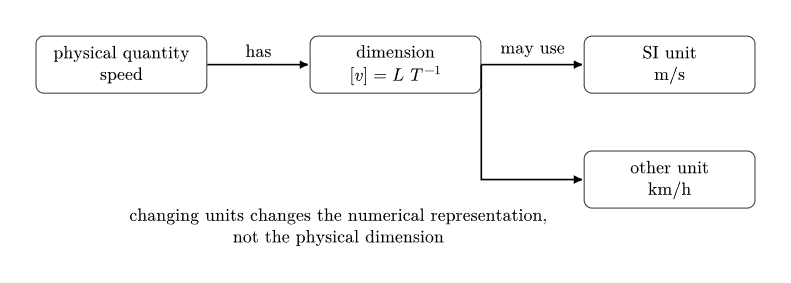
Figure 1. A physical quantity has a dimension independent of the particular unit used to
represent it.
1.1 Base dimensions in mechanics
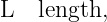
Most elementary mechanics can be expressed using three base dimensions:
Other branches of physics require additional base quantities, such as electric current and
Thermodynamic temperature. The complete SI system contains seven base quantities, but the
M-L-T set is sufficient for most of the mechanics developed in the early part of this learning
path.
A general mechanical dimension can be written as
where the exponents may be positive, negative, zero, or fractional.
1.2 Dimensions of common mechanical quantities
|
|
|
|
| Quantity | Symbol | Dimension | SI unit |
|
|
|
|
| position | x | L | m |
| velocity | v | LT−1 | m/s |
| acceleration | a | LT−2 | m/s2 |
| momentum | p | MLT−1 | kg m/s |
| Force | F | MLT−2 | N |
| Energy | E | ML2T−2 | J |
| Power | P | ML2T−3 | W |
| Pressure | ppr | ML−1T−2 | Pa |
|
|
|
|
Derived SI units are abbreviations for combinations of base units. For example,
and
2 Dimensions obey algebraic rules
Dimensions multiply, divide, and carry powers just like algebraic quantities. If
then
If
then
For velocity,
so
Differentiation by time contributes a factor of T−1. Thus
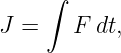
Integration by time contributes a factor of T. For example, since impulse is
its dimensions are
which are the dimensions of momentum.
3 Dimensional homogeneity
An equation intended to represent a physical law must be dimensionally homogeneous: terms that
are added or subtracted must have the same dimensions, and the two sides of an equality must
have the same dimensions.
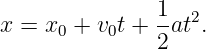
Consider
The four terms have dimensions
and
The equation passes the dimensional test.
Dimensional consistency is a necessary condition for correctness, but not a sufficient one. The
incorrect equation
is dimensionally homogeneous even though its numerical coefficients are not those of
constant-acceleration motion.
3.1 Functions require dimensionless arguments
The argument of a sine, cosine, exponential, or logarithm must be dimensionless. For
example,
requires
so
Angles measured in radians are dimensionless ratios, although the symbol rad is often retained as a
useful label.
Similarly, an exponential such as
requires t∕τ to be dimensionless, so τ must have the dimension of time.
4 Worked example 1: use dimensions to detect an error
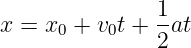
A student proposes the equation
for constant-acceleration motion. Determine whether it can be correct.
The first two contributions have dimension length:
But the final term has dimensions
That is a velocity, not a length. Therefore the proposed equation cannot be correct.
Replacing at by at2 restores dimensional homogeneity:
This example illustrates the fastest use of dimensional analysis: finding algebraic or transcription
errors before inserting numbers.
5 Units and conversion factors
A unit conversion changes the numerical representation of a physical quantity without changing
the quantity itself. The method is to multiply by one in a useful form.
Because
the ratio
is equal to one.
For example,
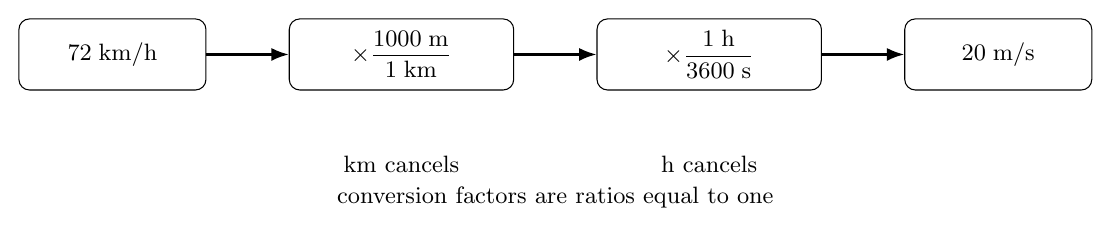
Figure 2. Unit conversion is multiplication by ratios equal to one. Units cancel algebraically and
provide a built-in check on the calculation.
5.1 Powers of units matter
Area and volume conversions require powers of the conversion factor. Since
we have
and
A common error is to convert the numerical factor only once when the unit is squared or
cubed.
6 Scaling and similarity
Dimensional reasoning becomes especially useful when a system is enlarged or reduced while
keeping the same geometric shape. Let every linear dimension be multiplied by a scale factor
s.
Then
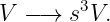
area scales as
and volume scales as
For objects of the same material and density, mass also scales as
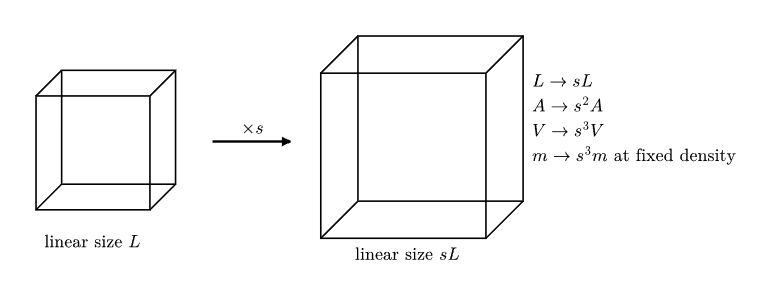
Figure 3. Geometrically similar objects scale differently in length, area, and volume. This
difference is the basis of many physical scaling laws.
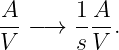
The surface-area-to-volume ratio therefore scales as
A larger similar object has less surface area per unit volume than a smaller one.
Scaling arguments are common in mechanics. For example, if a period has the form
then making the characteristic length four times larger makes the period twice as large.
7 Worked example 2: infer the pendulum-period dependence
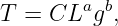
Suppose the small-amplitude period T of a pendulum depends only on pendulum length L and
gravitational acceleration g. Assume a power-law form
where C is dimensionless.
The dimensions are
and
Therefore
Matching the exponent of time gives
so
Matching the exponent of length gives
so
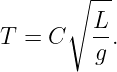
Hence dimensional analysis determines
The exact small-angle dynamics gives C = 2π, but dimensional analysis alone cannot determine
that dimensionless constant. This limitation is fundamental.
8 Dimensional analysis as a way to infer physical form
Suppose a quantity Q depends on several variables and no detailed equation is known. If the
relation is expected to be a product of powers, write
Replace every variable by its dimensions and equate the exponents of the independent base
dimensions. The result is a linear algebra problem for the unknown exponents.
This procedure cannot generally determine:
- dimensionless numerical coefficients such as 2, 1∕2, or 2π;
- additive structure, such as whether two terms should be added;
- dependence on a dimensionless function;
- signs or vector directions.
Nevertheless, the method can strongly constrain the possible form of a law.
9 Worked example 3: infer the speed scale of a circular orbit
Suppose an orbital speed v depends only on the gravitational constant G, central mass M, and
orbital radius r. Assume
The dimensions are
and
Thus
Matching powers gives
so
For mass,
so
For length,
so
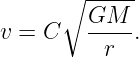
Therefore
Newtonian circular-orbit dynamics gives C = 1. Again, dimensions determine the dependence on
G, M, and r, while dynamics supplies the dimensionless coefficient.
10 Dimensionless quantities
A dimensionless quantity has dimension
Dimensionless quantities are important because they can be compared across systems with
different scales and units.
Examples include
and
The numerical value of a properly defined dimensionless quantity is independent of the coherent
unit system used to evaluate it.
11 Buckingham-Pi intuition
The Buckingham Pi theorem provides a systematic way to reorganize a dimensional problem. In
introductory form, the idea is:
If a physical relation contains n dimensional variables built from k independent
base dimensions, the relation can often be rewritten using n − k independent
dimensionless combinations.
A full proof belongs in a more advanced treatment, but the counting idea is already useful in
freshman mechanics.
Consider a drag force F that depends on fluid density ρ, speed v, characteristic size L, and
dynamic viscosity μ. There are five variables:
They use the three base dimensions M, L, and T. Buckingham counting therefore suggests
independent dimensionless groups.
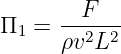
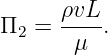
Two possible choices are
and
The second group is the Reynolds number. The original five-variable relation can then be written
schematically as
where Φ is a dimensionless function that dimensional analysis alone cannot determine.
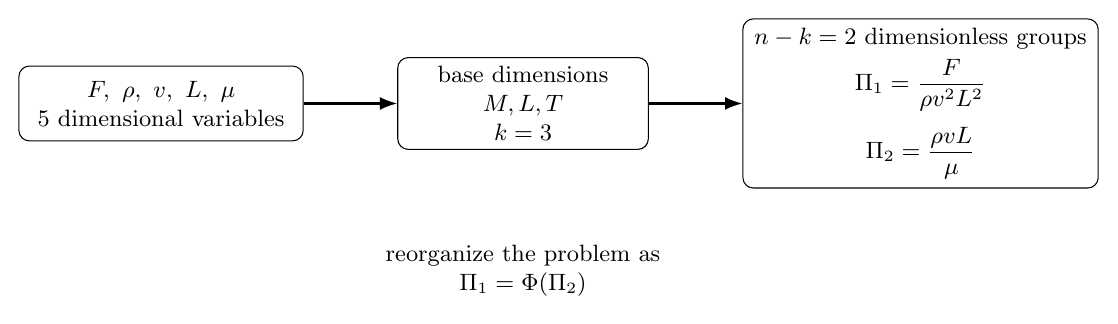
Figure 4. Buckingham-Pi reasoning reorganizes several dimensional variables into a smaller
number of dimensionless groups. The theorem constrains the structure of the physics but does not
determine the dimensionless function.
This viewpoint is the foundation of similarity testing, wind-tunnel modeling, fluid scaling, and
many engineering correlations.
12 Common mistakes
- Confusing a unit with a dimension. Meter and centimeter are different units of
the same dimension, length.
- Treating dimensional consistency as proof. A dimensionally correct equation may
still contain the wrong coefficient or wrong physical dependence.
- Adding unlike dimensions. A length cannot be added directly to a speed or energy.
- Forgetting powers in unit conversions. Converting m2 or m3 requires squaring or
cubing the conversion factor.
- Putting dimensional quantities inside sine, exponential, or logarithm
functions. Their arguments must be dimensionless.
- Dropping units too early. Carrying units through a numerical calculation is a
powerful error check.
- Expecting dimensional analysis to determine 2π. Pure numerical constants are
invisible to dimensional reasoning.
- Assuming every dimensionless quantity is unimportant. Dimensionless groups
often control the qualitative behavior of a system.
13 Problem-solving workflow
For a mechanics calculation, the following routine is effective:
- identify the physical quantity being sought;
- write the dimensions expected for the answer;
- carry units through the calculation;
- check that every additive term has the same dimensions;
- check that both sides of every physical equation have the same dimensions;
- convert to a consistent unit system before numerical substitution when necessary;
- after obtaining the result, verify units and inspect scaling or limiting behavior.
14 Practice problems
The following problems use stable mechanics identifiers. Short answers are supplied after the
practice set.
MECH-FOUND-001 — Dimensions of basic mechanical quantities
Starting from [x] = L, [m] = M, and [t] = T, derive the dimensions of velocity, acceleration, force,
kinetic energy, and power.
MECH-FOUND-002 — Check a kinematic equation
Determine whether
is dimensionally homogeneous.
MECH-FOUND-003 — Unit conversion
Convert 90 km∕h to m/s.
MECH-FOUND-004 — Area and volume scaling
Two geometrically similar solid objects are made of the same material. Every length of the second
object is three times the corresponding length of the first. By what factors do surface area, volume,
mass, and surface-area-to-volume ratio change?
MECH-FOUND-005 — Mass-spring period
Assume the period T of an ideal mass-spring oscillator depends only on mass m and spring
constant k. Given
use dimensional analysis to find the form of T up to a dimensionless constant.
MECH-FOUND-006 — Wave-speed scaling
The speed v of transverse waves on a stretched string depends on Tension F and linear mass
density μ, where [μ] = ML−1. Determine the dependence of v on F and μ up to a dimensionless
constant.
MECH-FOUND-007 — Pressure dimensions
Pressure is force per area. Derive its dimensions in M-L-T form and verify that the SI unit Pa is
equivalent to kg/(m s2).
MECH-FOUND-008 — Dimensionless exponential
A damped signal contains the factor
If m is a mass, determine the dimensions required for b.
MECH-FOUND-009 — Pendulum scaling
Two small-angle pendulums are in the same gravitational field. The second has nine times the
length of the first. What is the ratio of their periods?
MECH-FOUND-010 — Verify Buckingham groups
Using
and
verify that F∕(ρv2L2) and ρvL∕μ are dimensionless.
15 Short answer key
Practice problems:
- [v] = LT−1; [a] = LT−2; [F] = MLT−2; [K] = ML2T−2; [P] = ML2T−3.
- Yes. Both sides have dimensions L2T−2.
- 25 m∕s.
- Area ×9; volume ×27; mass ×27; A∕V becomes one third as large.
- T = C
 .
.
- v = C
 .
.
- [p] = ML−1T−2; Pa = kg/(m s2).
- [b] = MT−1.
- T2∕T1 = 3.
- Both groups reduce to M0L0T0.
16 Connections to later mechanics
Units and dimensional analysis are foundational topics. They reappear throughout mechanics:
- vector components must carry compatible units before they are added;
- derivatives introduce inverse powers of time and integrals introduce powers of time or
length;
- force laws and potential energies can be checked dimensionally;
- oscillation periods and wave speeds often admit useful scaling arguments;
- non-dimensionalization reveals control parameters in drag, oscillation, fluid, orbital,
and nonlinear problems;
- advanced perturbation and similarity methods frequently begin by identifying
appropriate dimensionless variables.
GRE-specific test strategy and speed questions are intentionally separated from this core article.
They are provided in the attachable companion entry M00-03G: GRE Physics Companion – Units
and Dimensional Analysis.
The natural next foundation article is Scalars and Vectors in Mechanics.
17 Source and license note
This PhysicsLibrary entry is an original synthesis written for the M00-03 mechanics curriculum
target. Its scope and terminology were benchmarked against the archived 2016 University Physics
Volume 1 clone distributed through BCcampus under CC BY 4.0, UCD Physics 9A Classical
Mechanics by Tom Weideman under CC BY-SA 4.0, and Jeffrey W. Schnick’s Calculus-Based
Physics I under CC BY-SA 3.0. No source figures are reproduced; all figures in this package are
original.
References
[1] OpenStax contributors, University Physics Volume 1, archived 2016 BCcampus
Pressbooks clone, sections “Units and Standards,” “Unit Conversion,” and “Dimensional
Analysis,” CC BY 4.0.
[2] T. Weideman, UCD Physics 9A – Classical Mechanics, section “Basics of Scientific
Measurement,” University of California, Davis / Physics LibreTexts, CC BY-SA 4.0.
[3] J. W. Schnick, Calculus-Based Physics I, CC BY-SA 3.0.
[4] J. R. Taylor, Classical Mechanics, University Science Books, 2005. Used as a scope
and notation reference only.



![[L ] = L.](https://images.physicslibrary.org/cache/objects/1298/make4ht/UnitsAndDimensionalAnalysisInMechanics2x.png)


![[Q ] = MaLbTc,](https://images.physicslibrary.org/cache/objects/1298/make4ht/UnitsAndDimensionalAnalysisInMechanics6x.png)



![[Q ] = [A ][B ].](https://images.physicslibrary.org/cache/objects/1298/make4ht/UnitsAndDimensionalAnalysisInMechanics10x.png)

![n
[Q ] = [A ].](https://images.physicslibrary.org/cache/objects/1298/make4ht/UnitsAndDimensionalAnalysisInMechanics12x.png)

![L- −1
[v] = T = LT .](https://images.physicslibrary.org/cache/objects/1298/make4ht/UnitsAndDimensionalAnalysisInMechanics14x.png)
![[ ]
dv- − 2
[a] = dt = LT .](https://images.physicslibrary.org/cache/objects/1298/make4ht/UnitsAndDimensionalAnalysisInMechanics15x.png)
![−2 −1
[J] = (MLT )(T) = MLT ,](https://images.physicslibrary.org/cache/objects/1298/make4ht/UnitsAndDimensionalAnalysisInMechanics17x.png)
![[x ] = L,](https://images.physicslibrary.org/cache/objects/1298/make4ht/UnitsAndDimensionalAnalysisInMechanics19x.png)
![[x0] = L,](https://images.physicslibrary.org/cache/objects/1298/make4ht/UnitsAndDimensionalAnalysisInMechanics20x.png)
![− 1
[v0t] = (LT )(T ) = L,](https://images.physicslibrary.org/cache/objects/1298/make4ht/UnitsAndDimensionalAnalysisInMechanics21x.png)
![[at2] = (LT −2)(T2) = L.](https://images.physicslibrary.org/cache/objects/1298/make4ht/UnitsAndDimensionalAnalysisInMechanics22x.png)


![[ωt ] = 1](https://images.physicslibrary.org/cache/objects/1298/make4ht/UnitsAndDimensionalAnalysisInMechanics25x.png)
![[ω ] = T −1.](https://images.physicslibrary.org/cache/objects/1298/make4ht/UnitsAndDimensionalAnalysisInMechanics26x.png)

![[x ] = L,
0](https://images.physicslibrary.org/cache/objects/1298/make4ht/UnitsAndDimensionalAnalysisInMechanics29x.png)
![[v0t] = LT −1T = L.](https://images.physicslibrary.org/cache/objects/1298/make4ht/UnitsAndDimensionalAnalysisInMechanics30x.png)
![[at] = (LT −2)(T ) = LT − 1.](https://images.physicslibrary.org/cache/objects/1298/make4ht/UnitsAndDimensionalAnalysisInMechanics31x.png)
![[at2] = L.](https://images.physicslibrary.org/cache/objects/1298/make4ht/UnitsAndDimensionalAnalysisInMechanics32x.png)










![[T ] = T,](https://images.physicslibrary.org/cache/objects/1298/make4ht/UnitsAndDimensionalAnalysisInMechanics46x.png)
![[L ] = L,](https://images.physicslibrary.org/cache/objects/1298/make4ht/UnitsAndDimensionalAnalysisInMechanics47x.png)
![[g] = LT− 2.](https://images.physicslibrary.org/cache/objects/1298/make4ht/UnitsAndDimensionalAnalysisInMechanics48x.png)





![[v] = LT− 1,](https://images.physicslibrary.org/cache/objects/1298/make4ht/UnitsAndDimensionalAnalysisInMechanics57x.png)
![[G ] = L3M −1T− 2,](https://images.physicslibrary.org/cache/objects/1298/make4ht/UnitsAndDimensionalAnalysisInMechanics58x.png)
![[M ] = M,](https://images.physicslibrary.org/cache/objects/1298/make4ht/UnitsAndDimensionalAnalysisInMechanics59x.png)
![[r] = L.](https://images.physicslibrary.org/cache/objects/1298/make4ht/UnitsAndDimensionalAnalysisInMechanics60x.png)







![[Π ] = 1.](https://images.physicslibrary.org/cache/objects/1298/make4ht/UnitsAndDimensionalAnalysisInMechanics69x.png)






![[k] = MT −2,](https://images.physicslibrary.org/cache/objects/1298/make4ht/UnitsAndDimensionalAnalysisInMechanics79x.png)

![[F ] = MLT −2,](https://images.physicslibrary.org/cache/objects/1298/make4ht/UnitsAndDimensionalAnalysisInMechanics81x.png)
![[ρ ] = ML −3,](https://images.physicslibrary.org/cache/objects/1298/make4ht/UnitsAndDimensionalAnalysisInMechanics82x.png)
![[v] = LT− 1,](https://images.physicslibrary.org/cache/objects/1298/make4ht/UnitsAndDimensionalAnalysisInMechanics83x.png)
![[μ ] = ML −1T −1,](https://images.physicslibrary.org/cache/objects/1298/make4ht/UnitsAndDimensionalAnalysisInMechanics84x.png)