Drag and terminal velocity
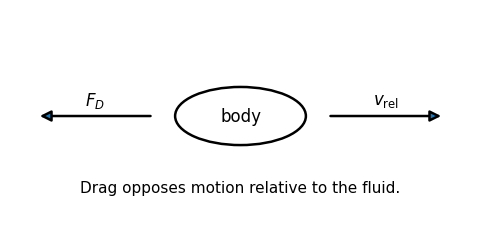
Drag is a resistive force exerted by a fluid on an object moving relative to that fluid. The drag
force acts opposite to the object’s velocity relative to the surrounding fluid. Unlike the simplest
dry-friction model, drag generally depends on speed and on properties of both the object and the
fluid.
If
then the drag force has a direction opposite to vrel.
Two especially useful models are
for linear drag and
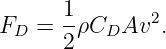
for quadratic drag.
Here ρ is the fluid density, CD is a dimensionless drag coefficient, and A is a reference area, usually
the projected frontal area.
1 Why drag depends on speed
Drag arises from interaction between a moving body and the surrounding fluid. Depending on the
geometry and flow regime, viscous shear, pressure differences, boundary-layer behavior, and wake
formation all contribute.
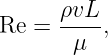
A useful dimensionless quantity is the Reynolds number,
where L is a characteristic length and μ is the dynamic viscosity.
At very small Reynolds number, viscous effects dominate and a linear drag model is often
appropriate. At larger Reynolds number, many bodies are better approximated over useful speed
ranges by a force proportional to v2. This distinction is not a sharp universal boundary: the drag
coefficient itself can vary with Reynolds number.
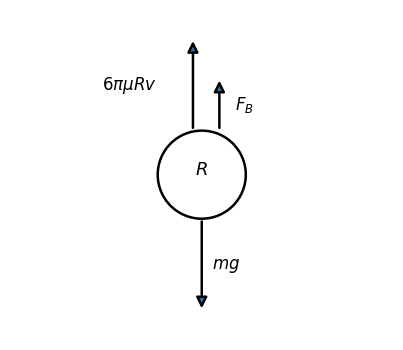
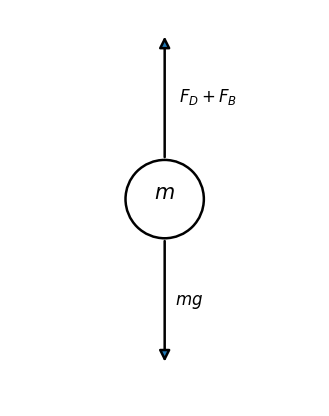
2 Free-body diagram for a falling body
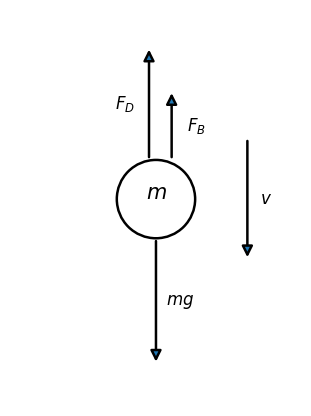
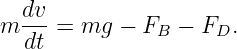
Consider an object falling vertically through a fluid. The principal forces are its Weight, the drag
force, and the buoyant force.
Taking downward as positive,
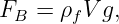
The buoyant force is
where ρf is the fluid density and V is the displaced volume.
In air, buoyancy is often small compared with the weight of a dense falling body and may be
neglected. In liquids, or for low-density objects, it can be important.
3 Terminal velocity
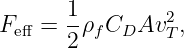
As a falling object speeds up, its drag generally increases. A steady speed is reached when the net
force vanishes:
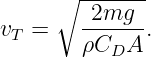
At this point,
The corresponding speed is the terminal speed. In a fixed vertical coordinate system its signed
value may be called the terminal velocity.
Terminal speed is better understood as an asymptotic steady speed than as a universal maximum
speed. If an object enters a fluid moving faster than its local terminal speed, drag can decelerate it
toward the same terminal state from above.
4 Linear drag
For linear drag,
where b has units of kg∕s.
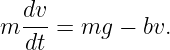
Ignoring buoyancy and taking downward as positive,
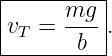
The terminal speed follows from dv∕dt = 0:
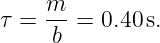
Define the time constant
Then the solution for arbitrary initial velocity v0 is
For release from rest,
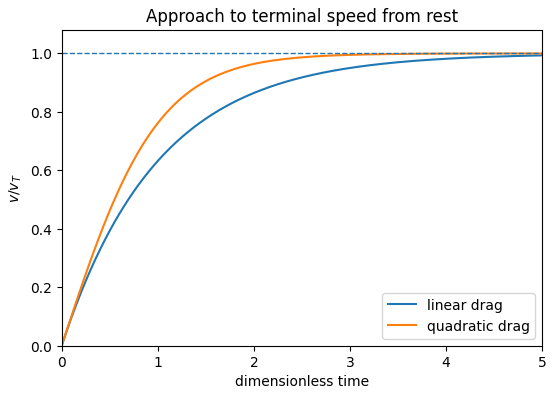
The speed approaches vT exponentially.
5 Quadratic drag
For quadratic drag,
with
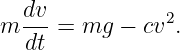
Ignoring buoyancy and taking downward as positive,
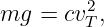
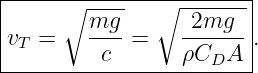
At terminal speed,
so
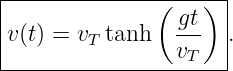
For an object released from rest, the exact solution is
Integrating once more gives the downward displacement from x(0) = 0:
Both the linear and quadratic models approach a steady terminal speed asymptotically, but their
time dependence is different.
6 Including buoyancy
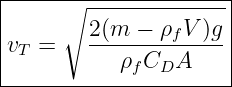
For a body of volume V and mass m falling through a fluid of density ρf, define
For quadratic drag,
so
for a body denser than the fluid.
If the body is less dense than the fluid, the steady motion may be upward rather than downward,
as for a rising bubble.
7 Stokes drag
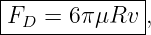
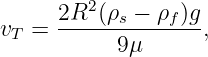
For a small sphere moving slowly through a viscous fluid in the creeping-flow regime,
Stokes’ law gives
where R is the sphere radius.
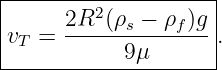
For a sphere of density ρs falling in a fluid of density ρf,
Therefore
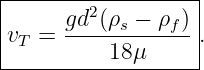
In terms of sphere diameter d = 2R,
8 Drag coefficient
The drag coefficient CD is not a universal constant for a particular material. It depends on body
shape, orientation, surface condition, and flow regime.
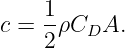
For quadratic drag,
The reference area must be stated consistently with the definition of CD. For a sphere it is
normally the projected circular area,
Because CD can vary with Reynolds number, the constant-CD quadratic model is an
approximation over a chosen operating range.
9 Scaling of terminal speed
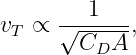
For quadratic drag without buoyancy,
Thus,
Increasing frontal area or drag coefficient lowers terminal speed, which is the central idea behind a
parachute.
10 Power dissipated by drag
The instantaneous mechanical power associated with drag is
Because drag opposes the velocity,
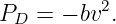
For linear drag,
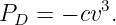
For quadratic drag,
At terminal speed, kinetic energy is no longer changing even though energy is continuously being
transferred to the surrounding fluid. Gravitational potential energy is then converted into thermal
energy, wake motion, sound, and other fluid disturbances.
11 Worked examples
Example 1: linear drag
A 0.20 kg object falls with linear drag coefficient b = 0.50 kg∕s. Neglect buoyancy.
The terminal speed is
The time constant is
Released from rest,
Example 2: speed after one time constant
For the preceding object,
Thus,
Example 3: quadratic terminal speed of a falling person
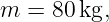
Consider a person of mass
with
Then
This is about
The number is only an estimate because CD, area, orientation, and air density can
vary.
Example 4: opening a parachute
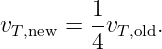
Suppose the effective product CDA increases by a factor of 16 when a parachute opens.
Since
the new terminal speed is
Example 5: small sphere in a viscous fluid
A small sphere has
and falls through a fluid with
Using Stokes’ terminal-speed result,
we obtain
Example 6: force balance at terminal speed
A falling object has weight
and buoyant force
At terminal speed,
so
12 Common mistakes
- Drawing drag in the wrong direction. Drag opposes motion relative to the fluid, not
necessarily motion relative to the ground.
- Treating CD as a universal constant independent of Reynolds number.
- Assuming all drag is proportional to v2.
- Forgetting buoyancy when the displaced-fluid weight is significant.
- Calling terminal speed the greatest speed an object can ever possess.
- Using total surface area when the drag formula requires projected reference area.
- Forgetting the absolute-value form in the vector quadratic-drag law when motion can
reverse.
- Applying Stokes’ law outside the low-Reynolds-number regime.
13 Practice exercises
- An object moves east through still air. In what direction does its drag force act?
- A body is carried east by a wind faster than the body moves east relative to the ground.
What direction can the drag force have?
- A 0.50 kg body has linear drag coefficient b = 0.20 kg∕s. Find its terminal speed.
- For the previous body, find the time constant.
- Show that an object released from rest with linear drag reaches 0.632vT after one time
constant.
- Derive the quadratic-drag terminal speed vT =
 .
.
- A skydiver doubles effective frontal area without changing CD. By what factor does
the quadratic-drag terminal speed change?
- A body enters a fluid at a downward speed greater than its terminal speed. State the
initial direction of its acceleration.
- Include buoyancy and derive the quadratic terminal speed of a body of volume V .
- Derive the Stokes terminal speed of a small sphere.
- For a sphere obeying Stokes’ law, how does terminal speed scale with radius?
- Estimate the drag Power dissipated at terminal speed for an 80 kg falling body when
buoyancy is negligible and vT = 40 m∕s.
- Explain why a single constant drag coefficient may fail over a very large range of speeds.
- Starting from
verify directly that
satisfies the equation for release from rest.
14 GRE-style speed checks
- For linear drag FD = bv, the SI units of b are (A) kg (B) kg∕s (C) N s2∕m (D)
m∕s. Answer: B.
- A falling object reaches terminal speed when (A) gravity vanishes (B) velocity
vanishes (C) the net force vanishes (D) drag vanishes. Answer: C.
- With quadratic drag and negligible buoyancy,
(A) m (B) m2 (C)  (D) 1∕m. Answer: C.
- If effective area is multiplied by four while all other quadratic-drag parameters remain
unchanged, terminal speed is multiplied by (A) 4 (B) 2 (C) 1∕2 (D) 1∕4. Answer:
C.
- At very small Reynolds number around a sphere, the standard drag law is (A) Coulomb
Friction (B) Stokes drag (C) Hooke’s law (D) inverse-square drag. Answer: B.
- An object moving faster than its terminal falling speed can (A) never slow down (B)
accelerate downward indefinitely (C) decelerate toward terminal speed (D) have
zero drag. Answer: C.
15 Source and licensing note
The general definitions of drag and terminal velocity were informed by the Wikipedia articles Drag
(physics) and Terminal velocity, whose text is available under a Creative Commons
Attribution–ShareAlike license.
The development here has been reorganized and expanded for PhysicsLibrary, including separate
linear- and quadratic-drag solutions, buoyancy, Stokes drag, energy dissipation, worked examples,
practice exercises, and GRE-style checks.
Standard Newtonian drag and terminal-speed formulas were cross-checked against openly available
Physics LibreTexts material.
All figures included with this entry were generated specifically for this PhysicsLibrary
article.
References
[1] Wikipedia contributors, “Drag (physics),” Wikipedia, The Free Encyclopedia. Drag
(physics)
[2] Wikipedia contributors, “Terminal velocity,” Wikipedia, The Free Encyclopedia.
Terminal velocity
[3] Physics LibreTexts, “Drag Force and Terminal Speed.” Physics LibreTexts
Unless otherwise noted, this PhysicsLibrary entry is intended for release under the Creative
Commons Attribution–ShareAlike 4.0 International license.











![|--------------------------|
| v2 [ ( gt) ] |
|x(t) = -T-ln cosh --- .
--------g------------vT----](https://images.physicslibrary.org/cache/objects/1088/make4ht/Drag20x.png)