|
|
|
|||||||
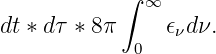
The finite quantity 𝜖ν is called the coefficient of emission of the medium for the frequency ν. It is a positive function of ν and refers to a plane polarized ray of definite color and direction. The total emission of the volume-element dτ may be obtained from this by integrating over all directions and all frequencies. Since 𝜖ν is independent of the direction, and since the integral over all conical elements dω is 4π, we get:
7. The coefficient of emission 𝜖 depends, not only on the frequency ν, but also on the condition of the emitting substance contained in the volume-element dτ, and, generally speaking, in a very complicated way, according to the physical and chemical processes which take place in the elements of time and volume in question. But the empirical law that the emission of any volume-element depends entirely on what takes place inside of this element holds true in all cases ( Prevost’s principle ). A body A at 1000 C. emits toward a body B at 00 C. exactly the same amount of radiation as toward an equally large and similarly situated body B′ at 10000 C. The fact that the body A is cooled by B and heated by B′ is due entirely to the fact that B is a weaker, B′ a stronger emitter than A. We shall now introduce the further simplifying assumption that the physical and chemical condition of the emitting substance depends on but a single variable, namely, on its absolute temperature T. A necessary consequence of this is that the coefficient of emission 𝜖 depends, apart from the frequency ν and the nature of the medium, only on the temperature T. The last statement excludes from our consideration a number of radiation phenomena, such as fluorescence, phosphorescence, electrical and chemical luminosity, to which E. Wiedemann has given the common name ”phenomena of luminescence.” We shall deal with pure ”temperature radiation” exclusively. A special case of temperature radiation is the case of the chemical nature of the emitting substance being invariable. In this case the emission takes place entirely at the expense of the heat of the body. Nevertheless, it is possible, according to what has been said, to have temperature radiation while chemical changes are taking place, provided the chemical condition is completely determined by the temperature. 8. Propagation. – The propagation of the radiation in a medium assumed to be homogeneous, isotropic, and at rest takes place in straight lines and with the same velocity in all directions, diffraction phenomena being entirely excluded. Yet, in general, each ray suffers during its propagation a certain weakening, because a certain fraction of its energy is continuously deviated from its original direction and scattered in all directions. This phenomenon of ”scattering,” which means neither a creation nor a destruction of radiant energy but simply a change in distribution, takes place, generally speaking, in all media differing from an absolute vacuum, even in substances which are perfectly pure chemically. The cause of this is that no substance is homogeneous in the absolute sense of the word. The smallest elements of space always exhibit some discontinuities on account of their atomic structure. Small impurities, as, for instance, particles of dust, increase the influence of scattering without, however, appreciably affecting its general character. Hence, so-called ”turbid” media, i.e., such as contain foreign particles, may be quite properly regarded as optically homogeneous, provided only that the linear dimensions of the foreign particles as well as the distances of neighboring particles are sufficiently small compared with the wave lengths of the rays considered. As regards optical phenomena, then, there is no fundamental distinction between chemically pure substances and the turbid media just described. No space is optically void in the absolute sense except a vacuum. Hence a chemically pure substance may be spoken of as a vacuum made turbid by the presence of molecules. A typical example of scattering is offered by the behavior of sunlight in the atmosphere. When, with a clear sky, the sun stands in the zenith, only about two-thirds of the direct radiation of the sun reaches the surface of the earth. The remainder is intercepted by the atmosphere, being partly absorbed and changed into heat of the air, partly, however, scattered and changed into diffuse skylight. This phenomenon is produced probably not so much by the particles suspended in the atmosphere as by the air molecules themselves. Whether the scattering depends on reflection, on diffraction, or on a resonance effect on the molecules or particles is a point that we may leave entirely aside. We only take account of the fact that every ray on its path through any medium loses a certain fraction of its intensity. For a very small distance, s, this fraction is proportional to s, say
where the positive quantity βν is independent of the intensity of radiation and is called the ”coefficient of scattering” of the medium. Inasmuch as the medium is assumed to be isotropic, βν is also independent of the direction of propagation and polarization of the ray. It depends, however, as indicated by the subscript ν, not only on the physical and chemical constitution of the body but also to a very marked degree on the frequency. For certain values of ν, βν may be so large that the straight-line propagation of the rays is virtually destroyed. For other values of ν, however, βν may become so small that the scattering can be entirely neglected. For generality we shall assume a mean value of βν. In the cases of most importance βν increases quite appreciable as ν increases, i.e., the scattering is noticeably larger for rays of shorter wave length; hence the blue color of diffuse skylight. The scattered radiation energy is propagated from the place where the scattering occurs in a way similar to that in which the emitted energy is propagated from the place of emission, since it travels in all directions in space. It does not, however, have the same intensity in all directions, and moreover is polarized in some special directions, depending to a large extent on the direction of the original ray. We need not, however, enter into any further discussion of these questions. 9. While the phenomenon of scattering means a continuous modification in the interior of the medium, a discontinuous change in both the direction and the intensity of a ray occurs when it reaches the boundary of a medium and meets the surface of a second medium. The latter, like the former, will be assumed to be homogeneous and isotropic. In this case, the ray is in general partly reflected and partly transmitted. The reflection and refraction may be ”regular,” there being a single reflected ray according to the simple law of reflection and a single transmitted ray, according to Snell’s law of refraction, or, they may be ”diffuse,” which means that from the point of incidence on the surface the radiation spreads out into the two media with intensities that are different in different directions. We accordingly describe the surface of the second medium as ”smooth” or ”rough” respectively. Diffuse reflection occurring at a rough surface should be carefully distinguished from reflections at a smooth surface of a turbid medium. In both cases part of the incident ray goes back to the first medium as diffuse radiation. But in the first case the scattering occurs on the surface, in the second in more or less thick layers entirely inside of the second medium. 10. When a smooth surface completely reflects all incident rays, as is approximately the case with many metallic surfaces, it is termed ”reflecting.” When a rough surface reflects all incident rays completely and uniformly in all directions, it is called ”white.” The other extreme, namely, complete transmission of all incident rays through the surface never occurs with smooth surfaces, at least if the two contiguous media are at all optically different. A rough surface having the property of completely transmitting the incident radiation is described as ”black.” In addition to ”black surfaces” the term ”black body” is also used. According to G. Kirchhoff it denotes a body which has the property of allowing all incident rays to enter without surface reflection and not allowing them to leave again. Hence it is seen that a black body must satisfy three independent conditions. First, the body must have a black surface in order to allow the incident rays to enter without reflection. Since, in general, the properties of a surface depend on both of the bodies which are in contact, this condition shows that the property of blackness as applied to a body depends not only on the nature of the body but also on that of the contiguous medium. A body which is black relatively to air need not be so relatively to glass, and vice versa. Second, the black body must have a certain minimum thickness depending on its absorbing power, in order to insure that the rays after passing into the body shall not be able to leave it again at a different point of the surface. The more absorbing a body is, the smaller the value of this minimum thickness, while in the case of bodies with vanishingly small absorbing power only a layer of infinite thickness may be regarded as black. Third, the black body must have a vanishingly small coefficient of scattering (Sec. 8). Otherwise the rays received by it would be partly scattered in the interior and might leave again through the surface. 11. All the distinctions and definitions mentioned in the two preceding paragraphs refer to rays of one definite color only. It might very well happen that, e.g., a surface which is rough for a certain kind of rays must be regarded as smooth for a different kind of rays. It is readily seen that, in general, a surface shows decreasing degrees of roughness for increasing wave lengths Now, since smooth non-reflecting surfaces do not exist (Sec. 10), it follows that all approximately black surfaces which may be realized in practice (lamp black, platinum black) show appreciable reflection for rays of sufficiently long wave lengths. 12. Absorption. –Heat rays are destroyed by ”absorption.” According to the principle of the conservation of energy the energy of heat radiation is thereby changed into other forms of energy (heat, chemical energy). Thus only material particles can absorb heat rays, not elements of surfaces, although sometimes for the sake of brevity the expression absorbing surfaces is used. Whenever absorption takes place, the heat ray passing through the medium under consideration is weakened by a certain fraction of its intensity for every element of path traversed. For a sufficiently small distance s this fraction is proportional to s, and may be written
Here αν is known as the ”coefficient of absorption” of the medium for a ray of frequency ν. We assume this coefficient to be independent of the intensity; it will, however, depend in general in non-homogeneous and anisotropic media on the position of s and on the direction of propagation and polarization of the ray (example: tourmaline). We shall, however, consider only homogeneous isotropic substances, and shall therefore suppose that αν has the same value at all points and in all directions in the medium, and depends on nothing but the frequency ν, the temperature T, and the nature of the medium. Whenever αν does not differ from zero except for a limited range of the spectrum, the medium shows ”selective” absorption. For those colors for which αν = 0 and also the coefficient of scattering βν = 0 the medium is described as perfectly ”transparent” or ”diathermanous.” But the properties of selective absorptions and of diathermancy may for a given medium vary widely with the temperature. In general we shall assume a mean value for αν. This implies that the absorption in a distance equal to a single wave length is very small, because the distance s, while small, contains many wave lengths (Sec. 2). 13. The foregoing considerations regarding the emission, the propagation, and the absorption of heat rays suffice for a mathematical treatment of the radiation phenomena. The calculation requires a knowledge of the value of the constants and the initial and boundary conditions, and yields a full account of the changes the radiation undergoes in a given time in one or more contiguous media of the kind stated, including the temperature changes cause by it. The actual calculation is usually very complicated. We shall, however, before entering upon the treatment of special cases discuss the general radiation phenomena from a different point of view, namely by fixing our attention not on a definite ray, but on a definite position in space. 14. Let dσ be an arbitrarily chosen, infinitely small element of area in the interior of a medium through which radiation passes. At a given instant rays are passing through this element in many different directions. The energy radiated through it in an element of time dt in a definite direction is proportional to the area dσ, the length of time dt and to the cosine of the angle 𝜃 made by the Normal of dσ with the direction of the radiation. If we make dσ sufficiently small, then, although this is only an approximation to the actual state of affairs, we can think of all points in dσ as being affected by the radiation in the same way. Then the energy radiated through dσ in a definite direction must be proportional to the solid angle in which dσ intercepts that radiation and this solid angle is measured by dσcos𝜃. It is readily seen that, when the direction of the element is varied relatively to the direction of the radiation, the energy radiated through it vanishes when
 Now in general a pencil of rays is propagated from every point of the element dσ in all directions, but with different intensities in different directions, and any two pencils emanating from two points of the element are identical save for differences of higher order. A single one of these pencils coming from a single point does not represent of finite quantity of energy, because a finite amount of energy is radiated only through a finite area. This holds also for the passage of rays through a so-called focus. For example, when sunlight passes through a converging lens and is concentrated in the focal plane of the lens, the solar rays do not converge to a single point, but each pencil of parallel rays forms a separate focus and all these foci together constitute a surface representing a small but finite image of the sun. A finite amount of energy does not pass through less than a finite portion of this surface. 15. Let us now consider quite generally the pencil, which is propagated from a point of the element dσ as vertex in all directions of space and on both sides of dσ. A certain direction may be specified by the angle 𝜃 (between 0 and π), as already used, and by an azimuth ϕ (between 0 and 2π). The intensity in this direction is the energy propagated in an infinitely thin cone limited by 𝜃 and 𝜃 + d𝜃 and ϕ and ϕ + dϕ. The solid angle of this cone is
Thus the energy radiated in time dt through the element of area dσ in the direction of the cone dω is:
The finite quantity K we shall term the ”specific intensity” or the ”brightness,” dω the ”solid angle” of the pencil emanating from a point of the element dσ in the direction (𝜃,ϕ) K is a positive function of position, time and the angles 𝜃 and ϕ. In general the specific intensities of radiation in different directions are entirely independent of one another. For example, on substituting π −𝜃 for 𝜃 and π + ϕ for ϕ in the function K, we obtain the specific intensity of radiation in the diametrically opposite direction, a quantity which in general is quite different from the preceding one. For the total radiation through the element of area dσ toward one side, say the one on which 𝜃 is
an acute angle, we get, by integrating with respect to ϕ from 0 to 2π and with respect to 𝜃 from 0
to
 Should the radiation be uniform in all directions and hence K be a constant, the total radiation on one side will be
16. In speaking of the radiation in a definite direction (𝜃,ϕ) one should always keep in mind that the energy radiated in a cone is not finite unless the angle of the cone is finite. No finite radiation of light or heat takes place in one definite direction only, or expressing it differently, in nature there is no such thing as absolutely parallel light or an absolutely plane wave front. From a pencil of rays called ”parallel” a finite amount of energy of radiation can only be obtained if the rays or wave normals of the pencil diverge so as to form a finite though perhaps exceedingly narrow cone. 17. The specific intensity K of the whole energy radiated in a certain direction may be further divided into the intensities of the separate rays belonging to the different regions of the spectrum which travel independently of one another. Hence we consider the intensity of radiation within a certain range of frequencies, say from ν to ν′. If the interval ν′− ν be taken sufficiently small and be denoted by dν, the intensity of radiation within the interval is proportional to dν, the intensity of radiation within the interval is proportional to dν. Such radiation is called homogeneous or monochromatic. A last characteristic property of a ray of definite direction, intensity, and color is its state of polarization. If we break up a ray, which is in any state of polarization whatsoever and which travels in a definite direction and has a definite frequency ν, into two plane polarized components, the sum of the intensities of the components will be just equal to the intensity of the ray as a whole, independently of the direction of the two planes, provided the two planes of polarization, which otherwise may be taken at random, are at right angles to each other. If their position be denoted by the azimuth ψ of one of the planes of vibration (plane of the electric vector), then the two components of the intensity may be written in the for
Herein K is independent of ψ. These expressions we shall call the ”components of the specific
intensity of radiation of frequency ν.” The sum is independent of ψ and is always equal to the
intensity of the whole ray Kν + Kν′. At the same time Kν and Kν′ represent respectively the
largest and smallest values which either of the components may have, namely, when ψ = 0 and
ψ =
where the positive quantities Kν and Kν′, the two principal values of the specific intensity of the radiation (brightness) of frequency ν, depend not only on ν but also on their position, the time, and on the angles 𝜃 and ϕ. By substitution in (6) the energy radiated in the time dt through the element of area dσ in the direction of the conical element dω assumes the value
and for monochromatic plane polarized radiation of brightness Kν:
For unpolarized rays Kν = Kν′, and hence
and the energy of a monochromatic ray of frequency ν will be:
When. moreover, the radiation is uniformly distributed in all directions, the total radiation through dσ toward one side may be found from (7) and (12); it is
18. Since in nature Kν can never be infinitely large, K will not have a finite value unless Kν differs from zero over a finite range of frequencies. Hence there exists in nature no absolutely homogeneous or monochromatic radiation of light or heat. A finite amount of radiation contains always a finite although possibly very narrow range of the spectrum. This implies a fundamental difference from the corresponding phenomena of acoustics, where a finite intensity of sound may correspond to a single definite frequency. This difference is, among other things, the cause of the fact that the second law of Thermodynamics has an important bearing on light and heat rays, but not on sound waves. This will be further discussed later on. 19. From equation (9) it is seen that the quantity Kν, the intensity of radiation of frequency ν, and the quantity K, the intensity of radiation of the whole spectrum, are of different dimensions. Further it is to be noticed that, on subdividing the spectrum according to wave lengths λ, instead of frequencies ν, the intensity of radiation Eλ of the wave lengths λ corresponding to the frequency ν is not obtained simply by replacing ν in the expression for Kν by the corresponding value of λ deduced from
where q is the velocity of propagation. For if dλ and dν refer to the same interval of the spectrum, we have, not Eλ = Kν, but Eλdλ = Kνdν. By differentiating (15) and paying attention to the signs of corresponding values of dλ and dν the equation
 is obtained. Hence we get by substitution:
This relation shows among other things that in a certain spectrum the maxima of Eλ and Kν lie at different points of the spectrum. 20. When the principal intensities Kν and Kν′ of all monochromatic rays are given at all points of the medium and for all directions, the state of radiation is known in all respects and all questions regarding it may be answered. We shall show this by one or two applications to special cases. Let us first find the amount of energy which is radiated through any element of area dσ toward any other element dσ′. The distance r between the two elements may be thought of as large compared with the linear dimensions of the elements dσ and dσ′ but still so small that no appreciable amount of radiation is absorbed or scattered along it. This condition is, of course, superfluous for diathermanous media. From any definite point of dσ rays pass to all points of dσ′. These rays form a cone whose vertex lies in dσ and whose solid angle is
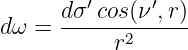 where ν′ denotes the normal of dσ′ and the angle (ν′,r) is to be taken as an acute angle. This value of dω is, neglecting small quantities of higher order, independent of the particular position of the vertex of the cone on dσ. If we further denote the normal to dσ by ν the angle 𝜃 of (14) will be the angle (ν,r) and hence from expression (6) the energy of radiation required is found to be:
For monochromatic plane polarized radiation of frequency ν the energy will be, according to equation (11),
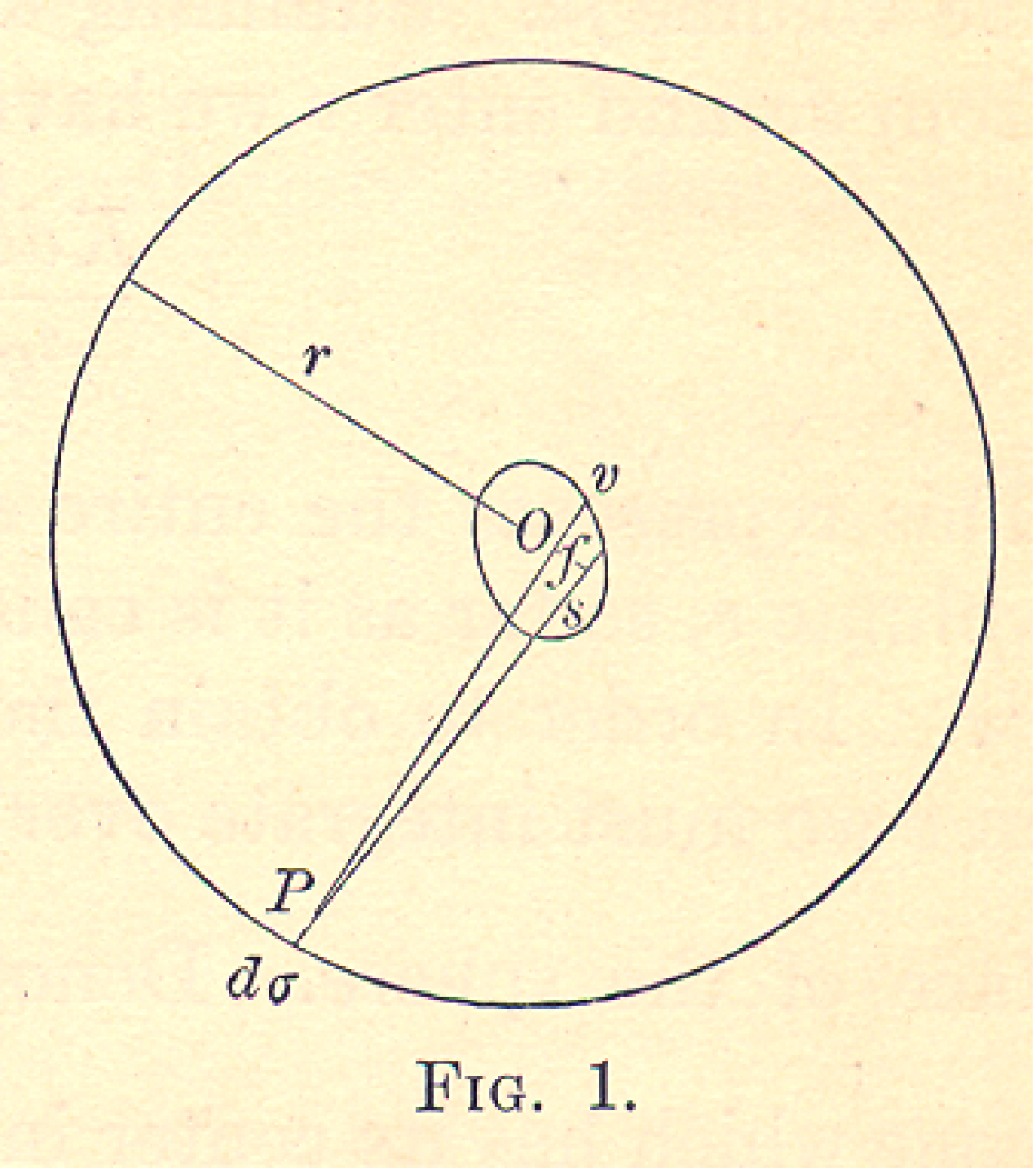
The relative size of the two elements dσ and dσ′ may have any value whatever. The may be assumed to be of the same or of a different order of magnitude, provided the condition remains satisfied that r is large compared with the linear dimensions of each of them. If we choose dσ small compared with dσ′, the rays diverge from dσ to dσ′, whereas they converge from dσ to dσ′, if we choose dσ large compared with dσ′. 21. Since every point of dσ is the vertex of a cone spreading out toward dσ′, the whole pencil of rays here considered, which is defined by dσ and dσ′, consists of a double infinity of point pencils or of a fourfold infinity of rays which must all be considered equally for the energy radiation. Similarly the pencil of rays may be thought of as consisting of the cones which, emanating from all points of dσ, converge in one pint of dσ′ respectively as a vertex. If we now imagine the whole pencil of rays to be cut by a plane at any arbitrary distance from the elements dσ and dσ′ and lying either between them or outside, then the cross-sections of any two point pencils on this plane will not be identical, not even approximately. In general they will partly overlap and partly lie outside of each other, the amount of overlapping being different for different intersecting planes. Hence it follows that there is no definite cross-section of the pencil of rays so far as the uniformity of radiation is concerned. If , however, the intersecting plane coincides with either dσ or dσ′, then the pencil has a definite cross-section. Thus these two planes show an exceptional property. We shall call them the two ”focal planes” of the pencil. In the special case already mentioned above, namely, when one of the two focal planes is infinitely small compared with the other, the whole pencil of rays shows the character of a point pencil inasmuch as its form is approximately that of a cone having its vertex in that focal plane which is small compared with the other. In that case the ”cross-section” of the whole pencil at a definite point has a definite meaning. Such a pencil of rays, which is similar to a cone, we shall call an elementary pencil, and the small focal plane we shall call the first focal plane of the elementary pencil. The radiation may be either converging toward the first focal plane or diverging from the first focal plane. All the pencils of rays passing through a medium may be considered as consisting of such elementary pencils, and hence we may base our future considerations on elementary pencils only, which is a great convenience, owing to their simple nature. As quantities necessary to define an elementary pencil with a given first focal plane dσ, we may choose not the second focal plane dσ′ but the magnitude of that solid angle dω under which dσ′ is seen from dσ. On the other hand, in the case of an arbitrary pencil, that is, when the two focal planes are of the same order of magnitude, the second focal plane in general cannot be replaced by the solid angle dω without the pencil changing markedly in character. For if, instead of dσ′ being given, the magnitude and direction of dω, to be taken as constant for all points of dσ, is given, then the rays emanating from dσ do not any longer form the original pencil, but rather an elementary pencil whose first focal plane is dσ and whose second focal plane lies at an infinite distance. 22. Since the energy radiation is propagated in the medium with a finite velocity q, there must be in a finite space a finite amount of energy. We shall therefore speak of the ”space density of radiation,” meaning thereby the ratio of the total quantity of energy of radiation contained in a volume-element to the magnitude of the latter. Let us now calculate the space density of radiation u at any arbitrary point of the medium. When we consider an infinitely small element of volume v at the point in question, having any shape whatsoever, we must allow for all rays passing through the volume-element v. For this purpose we shall construct about any point O of v as center a sphere of radius r, r being large compared with the linear dimension of v but still so small that no appreciable absorption or scattering of the radiation takes place in the distance r (Fig. 1).
Every ray which reaches v must then come from some point on the surface of the sphere. If, then, we at first consider only all the rays that come from the points of an infinitely small element of area dσ on the surface of the sphere, and reach v, and then sum up for all elements of the spherical surface, we shall have accounted for all rays and not taken any one more than once. Let us then calculate first the amount of energy which is contributed to the energy contained in v b
the radiation sent from such an element dσ to v. We choose dσ so that its linear dimensions
are small compared with those of v and consider the cone of rays which, starting at a
point of dσ meets the volume v. This cone consists of an infinite number of conical
elements with the common vertex at P, a point of dσ, each cutting out of the volume
v a certain element of length, say s. The solid angle of such a conical element is
 From expression (6) we may find the energy radiated through a certain element of area. In the
present case dω =
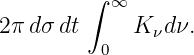
This energy enters the conical element in v and spreads out into the volume fs. Summing up over all conical elements that start from dσ and enter v we have
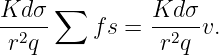 This represents the entire energy of radiation contained in the volume v, so far as it is caused by
radiation through the element dσ. In order to obtain the total energy of radiation contained in v
we must integrate over all elements dσ contained in the surface of the sphere. Denoting by dω the
solid angle
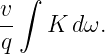 The volume density of radiation required is found from this by dividing by v. It is
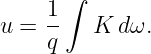
Since in this expression r has disappeared, we can think of K as the intensity of radiation at the point O itself. In integrating it is to be noted that K in general depends on the direction (𝜃,ϕ). For radiation that is uniform in all directions K is a constant and on integration we get:
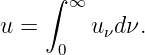
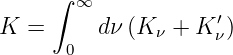
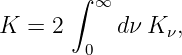
23. A meaning similar to that of the volume density of the total radiation u is attached to the volume density of radiation of a definite frequency uν. Summing up for all parts of the spectrum we get:
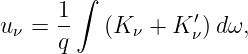
Further by combining equations (9) and (20) we have:
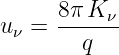
and finally for unpolarized radiation uniformly distributed in all directions:
0.2 ReferencesThis entry is a derivative of [1], a public domain work. [1] Planck, M. ”The theory of heat radiation” Translation by Morton Masius, P. Blakiston’s Son & CO., Philadephia, 1914. "General Introduction" is owned by bloftin. This object's parent. Cross-references: the theory of heat radiation, work, domain, volume density, relation, Thermodynamics, monochromatic radiation, plane wave, brightness, Normal, spectrum, position, glass, law of refraction, regular, boundary, resonance, zenith, atomic structure, scattering, luminosity, absolute temperature, function, volume element, magnitude, frequency, solid, particles, molecule, velocity, periodic, amplitude, phase, vibration, unit, energy, Powers, volume, dimensions, period, color, light, vector, trace, gradient, temperature, radiation, conduction, heat There is 1 reference to this object. This is version 17 of General Introduction, born on 2006-02-01, modified 2006-03-02. Object id is 111, canonical name is TheoryOfHeatRadiationPart1. Accessed 3275 times total. Classification:
|
|
|
|
Pending Errata and AddendaNone.
|
DiscussionNo messages.
|
Interact |
![[parent]](https://images.physicslibrary.org/images/uparrow.png)








 . Hence we call these values the ”principal values of the intensities,” or the ”principal
intensities,” and the corresponding planes of vibration we call the ”principle planes of
vibration” of the ray. Of course both, in general, vary with the time. Thus we may write
generally
. Hence we call these values the ”principal values of the intensities,” or the ”principal
intensities,” and the corresponding planes of vibration we call the ”principle planes of
vibration” of the ray. Of course both, in general, vary with the time. Thus we may write
generally







 where
where  and
and 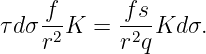
 of a cone which has its center in