GRE Physics Companion: Uniform Circular Motion
This companion is designed for rapid review after M01-08. GRE style circular motion questions are
usually solved fastest by deciding which angular or linear quantities are given, converting
revolutions or periods immediately, and then using the shortest equivalent form of the centripetal
acceleration relation.
1 Fast triage
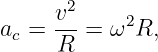
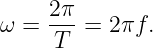
The key relations are
and
If a rotation rate is given in revolutions per minute, convert to revolutions per second
first:
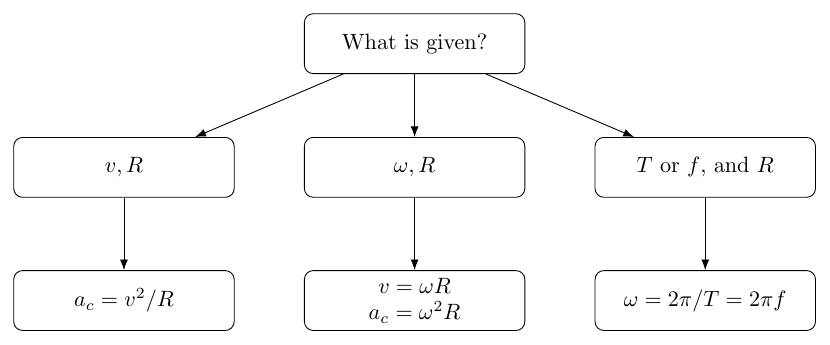
Figure 1. GRE speed equation triage for uniform circular motion. Choose the form that uses the
quantities already supplied.
2 Common traps
Constant speed does not imply zero acceleration. The velocity vector changes direction
continuously.
The velocity is tangent to the circle; the centripetal acceleration points toward the center.
At fixed radius,
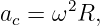
At fixed angular speed,
Do not add a separate “centripetal force” to a Free-body diagram. The real forces must combine to
produce the required inward net force.
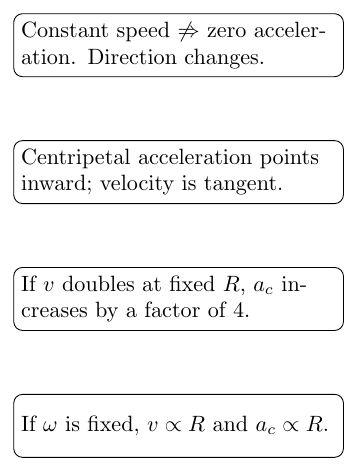
Figure 2. Common circular motion traps: constant speed with nonzero acceleration, tangent
velocity, inward acceleration, and the distinction between fixed radius and fixed angular speed
scaling.
3 Worked GRE example 1: scaling with speed
A particle moves in a circle of fixed radius R. Its speed is doubled. By what factor does its
centripetal acceleration change?
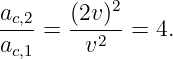
Because
and R is fixed,
The centripetal acceleration increases by a factor of 4.
4 Worked GRE example 2: two points on one rotating disk
Points A and B lie on the same rigid disk at radii R and 2R. The disk rotates with constant
angular speed ω. Compare their speeds and centripetal accelerations.
Since
we have
Since
we also have
The acceleration ratio is 2, not 4, because the two points have the same angular speed rather than
the same linear speed.
5 GRE speed questions
- A particle moves at constant speed around a circle. Its acceleration points (A) tangent
to the circle (B) outward (C) inward (D) along the velocity.
- If the speed of a particle in a circle of fixed radius triples, its centripetal acceleration
changes by a factor of (A) 3 (B) 6 (C) 9 (D) 27.
- A wheel rotates at 180 rpm. Its frequency is (A) 0.5 Hz (B) 3 Hz (C) 30 Hz (D) 180
Hz.
- Two points on the same rigid disk are at radii R and 4R. Their centripetal accelerations
are in the ratio (A) 1 : 1 (B) 1 : 2 (C) 1 : 4 (D) 1 : 16.
- A particle moves uniformly in a circle with period T. If the period is halved while the
radius is unchanged, the centripetal acceleration changes by a factor of (A) 1∕4 (B)
1∕2 (C) 2 (D) 4.
- Which statement is true for uniform circular motion? (A) v ∥ a (B) v⋅a = 0 (C) a = 0
(D) the velocity vector is constant.
6 Answers and rationales
- C. The centripetal acceleration always points toward the center.
- C. At fixed R, ac ∝ v2.
- B. 180 revolutions per minute is 3 revolutions per second.
- C. At common ω, ac = ω2R, so acceleration is proportional to radius.
- D. Since ac = 4π2R∕T2, halving T multiplies a
c by 4.
- B. The tangent velocity and inward acceleration are perpendicular.
References
[1] PhysicsLibrary, M01-08, Uniform Circular Motion.
[2] S. J. Ling, J. Sanny, and W. Moebs, University Physics, Volume 1, OpenStax, 2016.

![[parent]](https://images.physicslibrary.org/images/uparrow.png)