Sidereal time is a system of timekeeping used especially by astronomers. Using sidereal time and
the celestial coordinate system, it is easy to locate the positions of celestial objects in the night
sky. Sidereal time is a ”time scale that is based on Earth’s rate of rotation measured relative to the
fixed stars”.[5]
Viewed from the same location, a star seen at one position in the sky will be seen at the same
position on another night at the same time of day (or night), if the day is defined as a sidereal day
(also known as the sidereal rotation period). This is similar to how the time kept by a sundial
(solar time) can be used to find the location of the Sun. Just as the Sun and Moon appear to rise
in the east and set in the west due to the rotation of Earth, so do the stars. Both solar time and
sidereal time make use of the regularity of Earth’s rotation about its polar axis: solar
time is reckoned according to the position of the Sun in the sky while sidereal time
is based approximately on the position of the fixed stars on the theoretical Celestial
Sphere.
More exactly, sidereal time is the angle, measured along the Celestial Equator, from the observer’s
meridian to the great circle that passes through the March equinox (the northern hemisphere’s
vernal equinox) and both Celestial Poles, and is usually expressed in hours, minutes, and
seconds. (In the context of sidereal time, ”March equinox” or ”equinox” or ”first point of
Aries” is currently a direction, from the center of the Earth along the line formed by the
intersection of the Earth’s equator and the Earth’s orbit around the Sun, toward the
Constellation Pisces; during ancient times it was toward the constellation Aries.)[6]
Common time on a typical clock (using mean solar time) measures a slightly longer
cycle, affected not only by Earth’s axial rotation but also by Earth’s orbit around the
Sun.
The March equinox itself precesses slowly westward relative to the fixed stars, completing one
revolution in about 25,800 years, so the misnamed ”sidereal” day (”sidereal” is derived from the
Latin sidus meaning ”star”) is 0.0084 seconds shorter than the stellar day, Earth’s actual period of
rotation relative to the fixed stars.[6] The slightly longer stellar period is measured as the Earth
rotation angle (ERA), formerly the stellar angle.[3] An increase of 360∘ in the ERA is a full
rotation of the Earth.
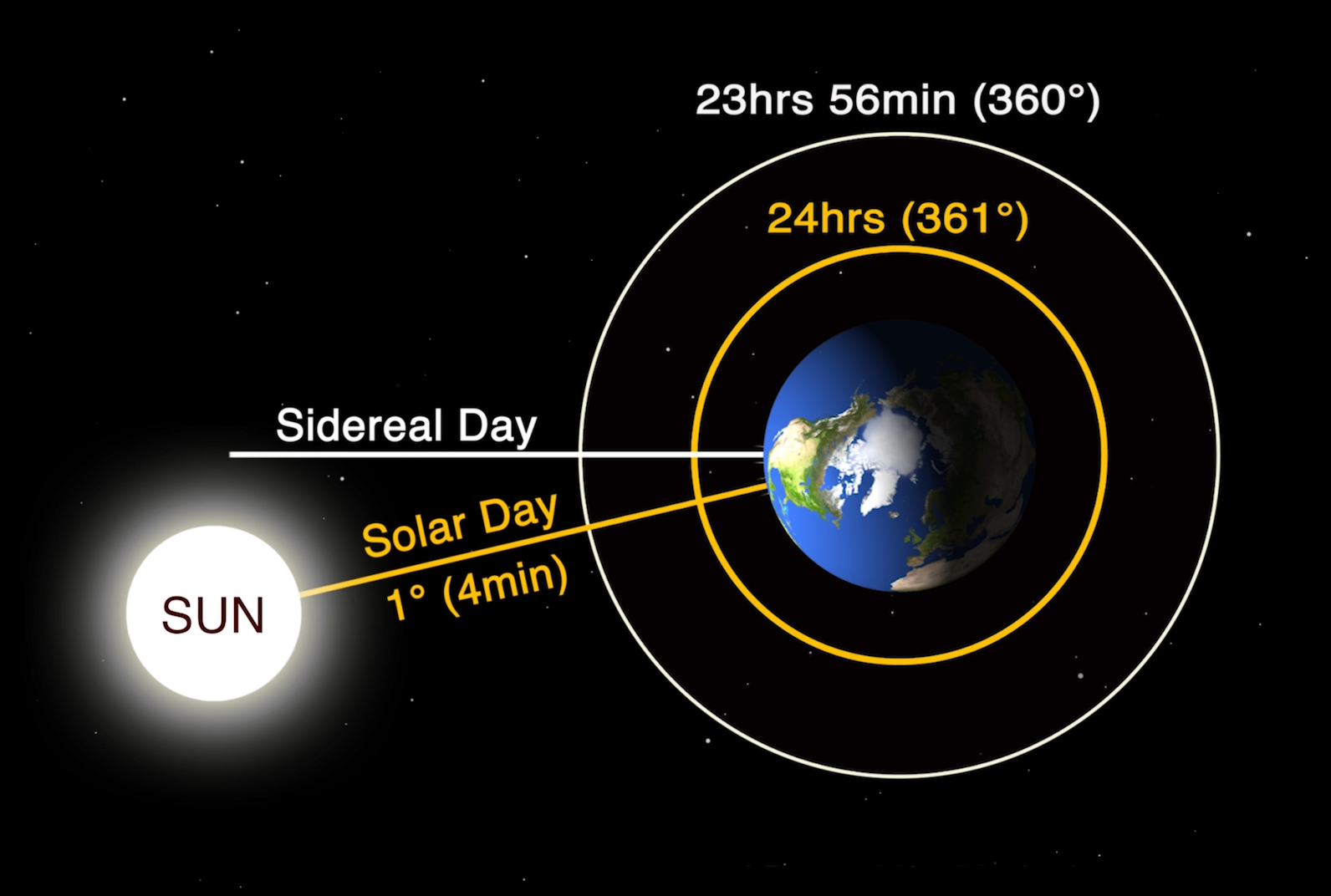
A sidereal day on Earth is approximately 86164.0905 seconds (23 h 56 min 4.0905 s or 23.9344696
h). (Seconds are defined as per International System of units and are not to be confused with
ephemeris seconds.) Each day, the sidereal time at any given place and time will be about
four minutes shorter than local civil time (which is based on solar time), so that for
a complete year the number of sidereal ”days” is one more than the number of solar
days.
Figure 1: A sidereal day is 1 Earth rotation relative to the stars; a solar day is 1 Earth rotation relative to the Sun. The Earth rotates 366 times per’Normal’ 365-day year relative to the stars, so Earth’s sidereal day is 4 minutes shorter than Earth’s solar day. (Angle exaggerated for
visibility.)
References
This article is a derivative work of the creative commons share alike with attribution.[7]
[1] Astronomical Almanac for the Year 2017. Washington and Taunton: US Government
Printing Office and The UK Hydrographic Office. 2016. ISBN 978-0-7077-41666. [2] Bakich, Michael E. (2000). The Cambridge Planetary Handbook. Cambridge
University Press. ISBN 0-521-63280-3. [3] ”Earth Rotation Angle”. International Earth Rotation and Reference System Service.
2013. Retrieved 20 March 2018. [4] Explanatory Supplement to the Ephemeris. London: Her Majesty’s Stationery Office.
1961. [5] ”Time and Frequency from A to Z, S to So”. National Institute of Standards and
Technology. 12 May 2010. [6] Urban, Sean E.; Seidelmann, P. Kenneth, eds. (2013). Explanatory Supplement to
the Astronomical Almanac (3rd ed.). Mill Valley, CA: University Science Books. ISBN
978-1-891389-85-6. [7] Wikipedia contributors, ”Sidereal time,” Wikipedia, The Free Encyclopedia
This is version 5 of sidereal time, born on 2025-03-29, modified 2025-03-30.
Object id is 993, canonical name is SiderealTime.
Accessed 2252 times total.