Tension and Massless Strings
Strings, ropes, and cables transmit forces between bodies. In elementary mechanics this
transmitted force is called tension. Tension is not a new Fundamental interaction; it is a useful
macroscopic description of the internal forces in a flexible connector.
Three ideas should be kept separate:
- A taut string pulls on each attached body along the local direction of the string.
- A massless string segment has zero net force in the ideal model, which is why the
tension magnitude is the same at both ends of that segment when no other tangential
force acts on it.
- An inextensible string has fixed length, which creates a kinematic constraint between
the motions of the attached bodies.
The second and third statements are different assumptions. A string can be modeled as massless
without explicitly imposing inextensibility, and it can be approximately inextensible while still
having nonzero mass.
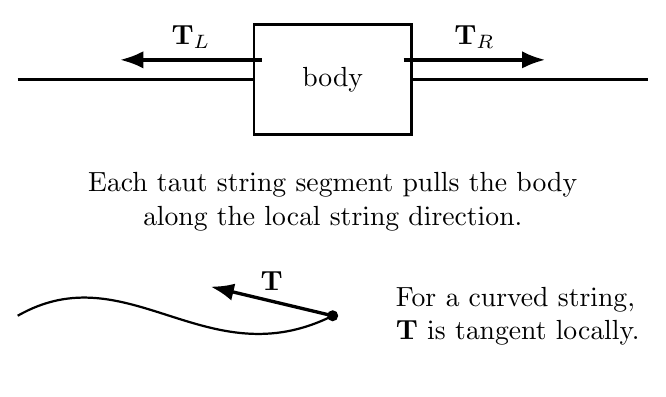
Figure 1. A taut string pulls along its local direction. On each attached body, the tension force
points away from the body along the string. A flexible string does not push, so a slack string
carries no tensile force.
1 What tension represents
Consider a body attached to a taut string. The string is made from matter whose neighboring
pieces exert internal forces on one another. Instead of modeling every microscopic interaction, we
represent the net force transmitted across a cut in the string by a tension force.
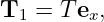
For a straight string attached to a body, the force exerted by the string on the body can be
written
where es points from the body along the string and
The nonnegative magnitude reflects the fact that an ordinary flexible string can sustain tension but
cannot sustain a compressive push. If the connector goes slack, the ideal string model
gives
A rigid rod is different because it can transmit either tension or compression.
2 Direction of the tension force
The direction rule is geometric:
At an attachment point, the string pulls the attached body toward the rest of the string. Thus the
tension arrow on the body’s free body diagram points away from the body along the
string.
If the string is curved, the local direction changes from point to point. The local tension force still
lies tangent to the string. A guide or pulley can supply additional contact forces that bend the
string; those interactions are developed further in M02-06.
3 Newton’s third law at an attachment
Suppose a string pulls a block with force
Newton’s third law gives
These forces act on different bodies. The tension arrow drawn on the block is therefore
not paired with another tension arrow on the same block. This distinction becomes
important when connected bodies are analyzed separately and then as one combined
system.
4 Why a massless string has uniform tension in the ideal model
Take a small straight segment of string. Let the tension magnitude at its left end be TL and at its
right end be TR. Choose the positive axis to the right.
The right part of the string pulls the segment to the right with force TR. The left part pulls the
segment to the left with force TL. Newton’s second law gives
where ms is the mass of the chosen string segment.
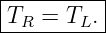
For the ideal massless string,
Therefore
and hence
Because the same argument can be applied to any portion of a straight massless string that has no
other tangential force acting on it, the tension magnitude is uniform along that ideal
segment.
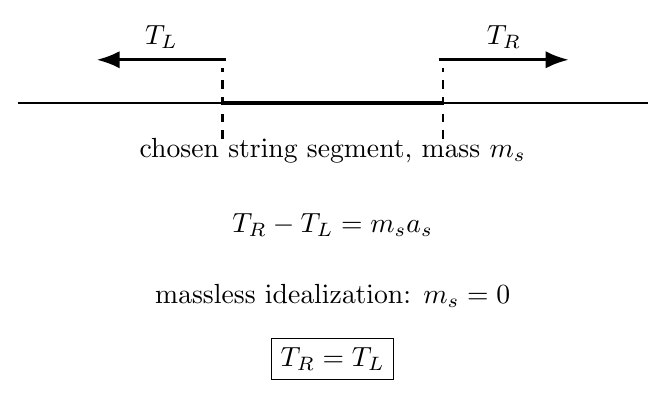
Figure 2. A small string segment is pulled outward by the neighboring parts of the string.
Newton’s second law gives TR − TL = msas. In the massless idealization, ms = 0, so the two
tension magnitudes are equal.
5 What the massless assumption does not mean
A common shortcut is to say “the tension is the same everywhere because the string is massless.”
That statement needs conditions.
Uniform tension follows for a massless segment when there is no additional tangential force on that
segment. If a connector interacts with a rough surface, a driven device, or some other distributed
tangential force, the tension can change across the interaction even if the connector’s own mass is
neglected.
Likewise, a change in direction does not by itself imply a change in tension magnitude. A smooth
frictionless guide can redirect a string while preserving the tension magnitude, because the guide
supplies a Normal contact force. Frictional contact can change the magnitude. M02-06 will
specialize these ideas to ideal pulleys.
6 Massless and inextensible are different assumptions
The word massless concerns dynamics. For a massless segment,
must hold in the ideal model because the segment has no inertia.
The word inextensible concerns geometry and kinematics. If the total string length is fixed, then
changes in the positions of attached bodies must satisfy a length constraint.
For two bodies connected by a straight inextensible string of fixed length L, a simple one
dimensional geometry may give
Differentiating with respect to time,
and again,
Thus the bodies have equal velocity and acceleration components along the string for this simple
geometry. The equality of accelerations comes from the fixed length constraint, not from the string
being massless.
More complicated pulley geometries produce different constraint equations; that is the main
subject of M02-06.
7 Tension is not automatically equal to weight
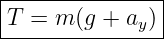
A hanging body of mass m has Weight mg downward. If the string tension is upward, Newton’s
second law gives
Therefore
when upward is positive.
Only when
is
So T = mg is a special equilibrium or constant velocity result, not a general tension
law.
8 Connected bodies: analyze the system and the parts
Consider two blocks of masses m1 and m2 connected by a taut massless inextensible
string on a frictionless horizontal surface. A horizontal external force F pulls block
2.
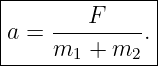
For the combined two block system, the tension forces are internal. They cancel from the system
force balance, leaving
Hence
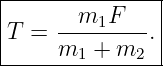
Now isolate block 1. Its only horizontal force is the tension:
Substituting the system acceleration,
This two step strategy is often the fastest way to solve connected body problems:
- use the combined system to find the common acceleration;
- isolate one body to find the internal tension.
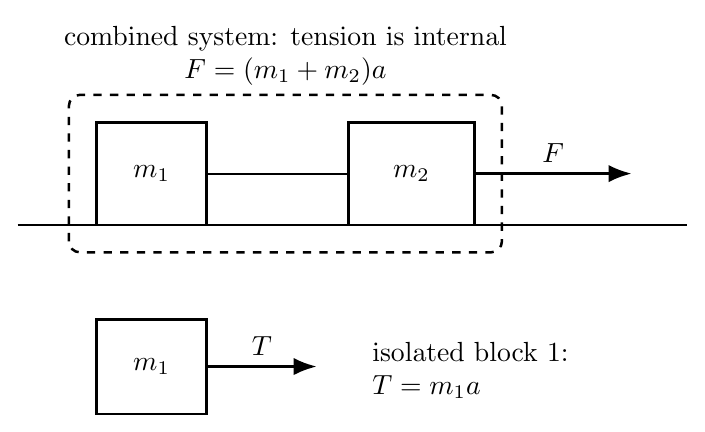
Figure 3. For the combined two block system, tension is internal and cancels. After the common
acceleration is found from the external force, isolate one block to determine the tension.
9 The same string can exert forces in opposite directions on different bodies
For two bodies joined by one taut straight string, the string pulls each body toward the other.
Therefore the tension force on the left body points right, while the tension force on the right body
points left.
The tension magnitudes may be equal in the massless string model even though the vectors are
opposite:
This is a geometric consequence of applying the same tensile force along one string to bodies on
opposite ends. It should not be confused with saying that “tension is one vector everywhere.” The
local force vector depends on which body is being considered.
10 Multiple strings can have different tensions
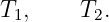
If a body is attached to two different strings, there is no general reason for the two tension
magnitudes to be equal. Label them separately, for example
Their values are determined by the force balance and the geometry.
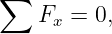
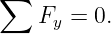
For a sign supported by two cables, equilibrium requires
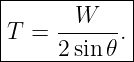
If the two cables are symmetric and each makes angle 𝜃 above the horizontal, horizontal
components cancel and the vertical equation becomes
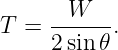
Thus
As 𝜃 becomes small, the required tension becomes large. Nearly horizontal support cables can
therefore carry surprisingly large tensile forces.
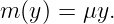
11 A massive rope: why tension can vary with position
The uniform tension result depends on the massless idealization. Consider a vertical rope of length
L, uniform linear mass density μ, and negligible end load. Let y measure upward from the free
lower end.
A cut at height y must support the rope below that cut. The mass below is
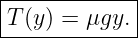
For static equilibrium,
so
At the free lower end,
while at the top,
The upper part of a real massive rope must support more rope, so its tension is larger.
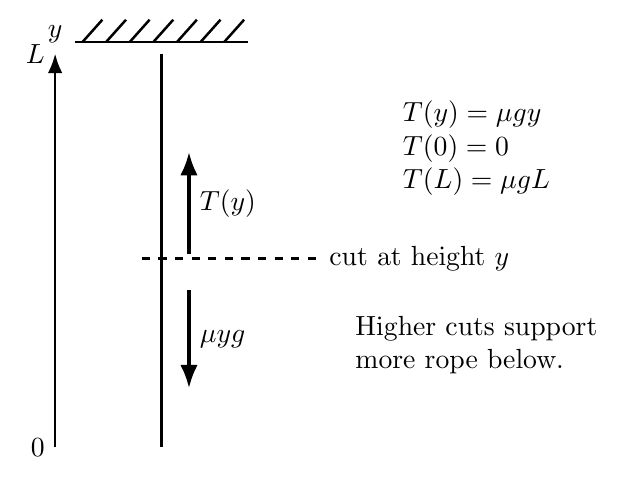
Figure 4. A massive vertical rope does not have uniform tension. A cut higher on the rope must
support more rope below it, giving T(y) = μgy when y is measured upward from the free end.
12 A systematic procedure for tension problems
- Choose the body or system to analyze.
- Draw a free body diagram for that choice only.
- Draw each tension force along the corresponding string and away from the attached
body.
- Give different strings different symbols unless an ideal model proves their tensions
equal.
- Write Newton’s second law for the chosen body or system.
- If the connector is inextensible, write the geometric length constraint and derive the
needed velocity or acceleration relation.
- If the connector is massless and has no additional tangential interaction, use equal
tension magnitude along that ideal segment.
- Check whether the final answer is compatible with a taut string. A string cannot
provide compression; if the assumed solution requires it, the string must go slack and
the model changes.
13 Worked example 1: an accelerating hanging mass
A 5.00 kg mass is pulled upward by a vertical string and accelerates upward at
Taking upward as positive,
Therefore
Using g = 9.81 m∕s2,
so
The tension is greater than the weight because the net force must point upward.
14 Worked example 2: two blocks pulled on a frictionless surface
Two blocks of masses
are connected by a massless inextensible string on a frictionless horizontal surface. A horizontal
force
pulls block 2 to the right.
For the combined system,
Thus
Now isolate block 1:
Therefore
The external force is 24 N, but the string transmits only the force needed to accelerate block
1.
15 Worked example 3: a sign supported by two symmetric cables
A sign has weight
and is supported at rest by two identical cables. Each cable makes an angle
above the horizontal.
The horizontal components cancel by symmetry. Vertical equilibrium gives
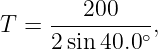
Hence
Substituting,
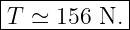
which gives
Each cable tension is smaller than the full weight here, but the sum of their vertical components
equals the weight.
16 Worked example 4: tension in a massive hanging rope
A uniform rope has length
and total mass
It hangs vertically at rest from its upper end. Find the tension at the top and at the
midpoint.
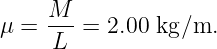
The linear mass density is
At a height y above the free lower end,
At the top, y = L = 4.00 m:
so
At the midpoint, y = 2.00 m:
so
The tension varies because the rope has mass. The top supports the entire rope, while the
midpoint supports only the lower half.
17 Practice problems
- A 4.00 kg mass hangs motionless from a Light vertical string. Find the tension.
- A 7.00 kg mass moves downward while accelerating downward at 1.50 m/s2. Find the
tension in the vertical string.
- Two blocks of masses 2.00 kg and 6.00 kg are connected by a massless inextensible
string on a frictionless table. A 32.0 N force pulls the 6.00 kg block. Find the common
acceleration and the tension.
- Repeat Problem 3 if the 32.0 N force is instead applied to the 2.00 kg block on the
opposite end of the pair. Does the common acceleration change? Does the tension
change?
- A 300 N sign is supported symmetrically by two cables, each making 30.0∘ above the
horizontal. Find the tension in each cable.
- A 100 N lamp is supported by two cables. The left cable makes 30.0∘ above the
horizontal and the right cable makes 60.0∘ above the horizontal. Find the two cable
tensions.
- A flexible string between two bodies goes slack. What is the tension in the ideal string
model while it remains slack?
- Explain why an ideal massless string segment with no other tangential force has equal
tension magnitude at its two ends.
- A uniform 6.00 m rope of mass 3.00 kg hangs vertically at rest. Find the tension at
the top and at a point 2.00 m above the free lower end.
- State which assumption, massless or inextensible, is responsible for each statement:
(a) equal tension magnitude along an ideal straight segment with no other tangential
force; (b) a fixed length relation between the positions of connected bodies.
18 Answer check
- T = mg = (4.00)(9.81) = 39.2 N.
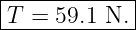
- Taking upward as positive, ay = −1.50 m/s2, so T = m(g − 1.50) = 58.2 N.
- a = 32.0∕(2.00 + 6.00) = 4.00 m/s2. The tension accelerating the 2.00 kg block is
T = (2.00)(4.00) = 8.00 N.
- The system acceleration remains 4.00 m/s2 because the same external force acts
on the same total mass. Now the string must accelerate the 6.00 kg block, so
T = (6.00)(4.00) = 24.0 N.
- 2T sin 30.0∘ = 300 N, so T = 300 N.
- Horizontal equilibrium gives TL cos 30∘ = T
R cos 60∘. Vertical equilibrium gives
TL sin 30∘ + T
R sin 60∘ = 100 N. Solving gives T
L = 50.0 N and TR = 86.6 N.
- T = 0.
- For the segment, TR − TL = msas. With ms = 0 and no additional tangential force,
TR = TL.
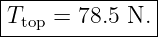
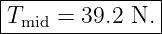
- The linear density is μ = 0.500 kg/m. At the top, T = μgL = 29.4 N. At y = 2.00 m
above the free end, T = μgy = 9.81 N.
- (a) Massless. (b) Inextensible.
19 Summary
Tension is the force transmitted by a taut flexible connector. On an attached body it acts
along the local string direction and pulls away from the body toward the rest of the
string.
For a string segment,
The massless idealization therefore gives
when no additional tangential force acts on that segment.
The inextensible assumption is separate. It fixes the string length and supplies the kinematic
relation among the connected bodies.
For connected body problems, the most efficient pattern is often to use the full system to
determine acceleration and then isolate one body to determine tension. The next article, M02-06,
applies these ideas to pulleys and Atwood machines.
References
[1] PhysicsLibrary, M02-01, Newton’s Laws of Motion.
[2] PhysicsLibrary, M02-02, Free Body Diagrams.
[3] PhysicsLibrary, M02-03, Common Forces in Mechanics.
[4] PhysicsLibrary, M02-04, Weight and Normal Force.
[5] J. Moore et al., Mechanics Map, CC BY-SA 4.0. Used as an open reference for force
modeling, tension, and connected body diagrams.
[6] University of California, Davis, Physics 9A: Classical Mechanics, CC BY-SA 4.0.
[7] Archived 2016 revision of University Physics, Volume 1, CC BY 4.0.