Electromagnetic Waves, Antennas, and RF: Ampere–Maxwell Law and Displacement Current -
Exercises and Complete Worked Solutions
This companion article extends EM14 with a more demanding self-study problem set on charging
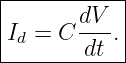
capacitors, displacement current, the integral and differential Ampere–Maxwell laws, charge
continuity, and the first direct derivation of electromagnetic wave equations. All exercises are
stated first. Complete worked solutions follow in Part II.
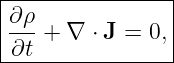
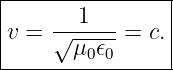
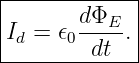
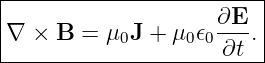
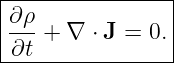
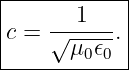
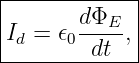
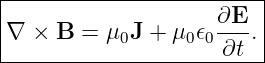
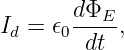
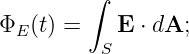
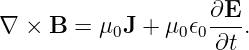
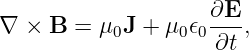
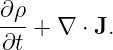
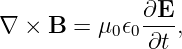
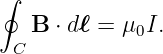
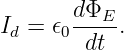
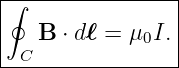
The central relations are
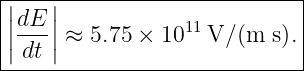
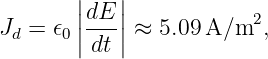
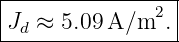
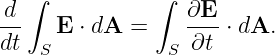
and
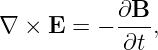
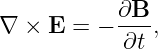
Together with Faraday’s law,
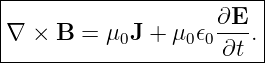
the vacuum form of the Ampere–Maxwell equation provides the second dynamical curl relation
required for electromagnetic waves [1, 2, 3, 4, 5].
How to use this problem set
Attempt all exercises in Part I before consulting Part II. In the capacitor problems, keep three
quantities distinct: conduction current in material Conductors, displacement current associated
with changing electric flux, and the magnetic circulation around a chosen contour. In the
differential-law problems, write the vector-calculus identity or theorem used at each step
rather than treating the transition from integral to differential form as a formal symbol
change.
Part I: Exercises
Exercise 1: the charging-capacitor surface paradox
A capacitor is charging with a steady instantaneous wire current I. A closed contour C circles one
lead wire.
Two different surfaces share the same boundary C:
- S1 cuts through the wire;
- S2 bulges outward and passes through the capacitor gap without crossing the wire.
For each surface:
- state the enclosed conduction current;
- state what the original magnetostatic Ampere law would predict for
- explain why the two predictions cannot both be correct;
- identify the additional quantity that restores surface independence.
Your explanation should distinguish conduction current from changing electric flux.
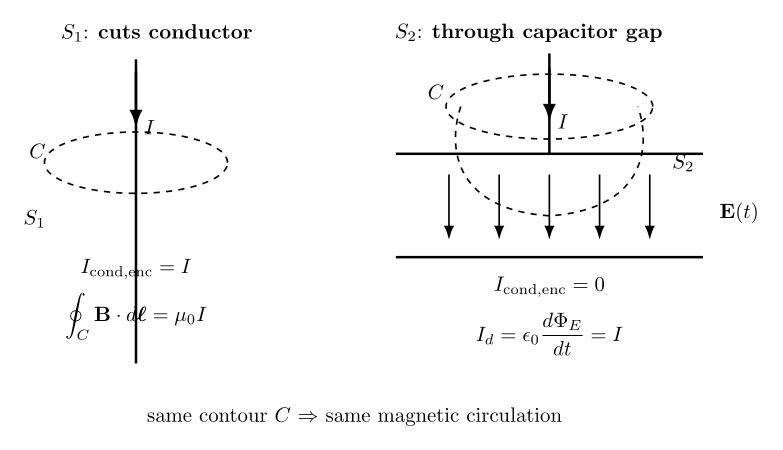
Figure. The same contour C can bound a surface cutting the conduction current or a
surface passing through the capacitor gap. Ampere–Maxwell restores surface-independent
circulation.
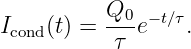
Exercise 2: time-dependent charging current from Q(t)
The charge on a capacitor plate is
where
Find:
- the conduction current Icond(t) = dQ∕dt;
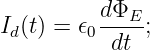
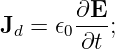
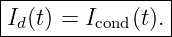
- the displacement current Id(t) in the ideal capacitor gap;
- the numerical value of both currents at t = τ;
- the limiting values as t → 0+ and t →∞.
Explain physically why the displacement current decreases as the capacitor approaches its final
charge.
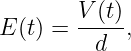
Exercise 3: derive displacement current from the capacitor field
A vacuum parallel-plate capacitor has plate area A, separation d, and voltage V (t).
Assume a uniform electric field between the plates and neglect fringing.
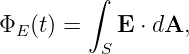
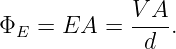
Starting from
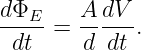
derive, in sequence,
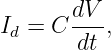
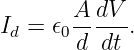
and finally
where
Then explain why this equals the conduction current in the wires for an ideal charging
capacitor.
Exercise 4: displacement current for a nonuniform electric field
A circular surface of radius R lies in a time-varying electric field
Find:
- the electric flux
- the displacement current
- the peak displacement-current magnitude.
Do not replace the field by an average value before performing the surface integral.
Exercise 5: conduction and displacement current in the integral law
For a chosen surface bounded by contour C, suppose the enclosed conduction current
is
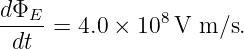
while the electric flux changes at the rate
Find:
- the displacement current Id;
- the total effective current
- the magnetic circulation
State explicitly why the conduction and displacement-current terms are added before multiplying
by μ0.
Exercise 6: derive the magnetic field in a charging capacitor gap
An ideal circular parallel-plate capacitor has plate radius R and carries charging current I.
Assume the displacement-current density is uniform across the plate area and neglect
fringing.
Using a circular Amperian contour of radius r centered on the capacitor axis:
- derive the enclosed displacement current for r < R;
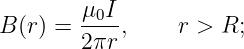
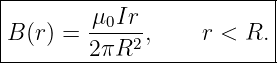
- derive
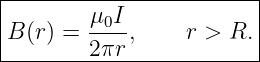
- derive
- show that the two expressions agree at r = R;
- describe how B(r) scales with r on each side of R.
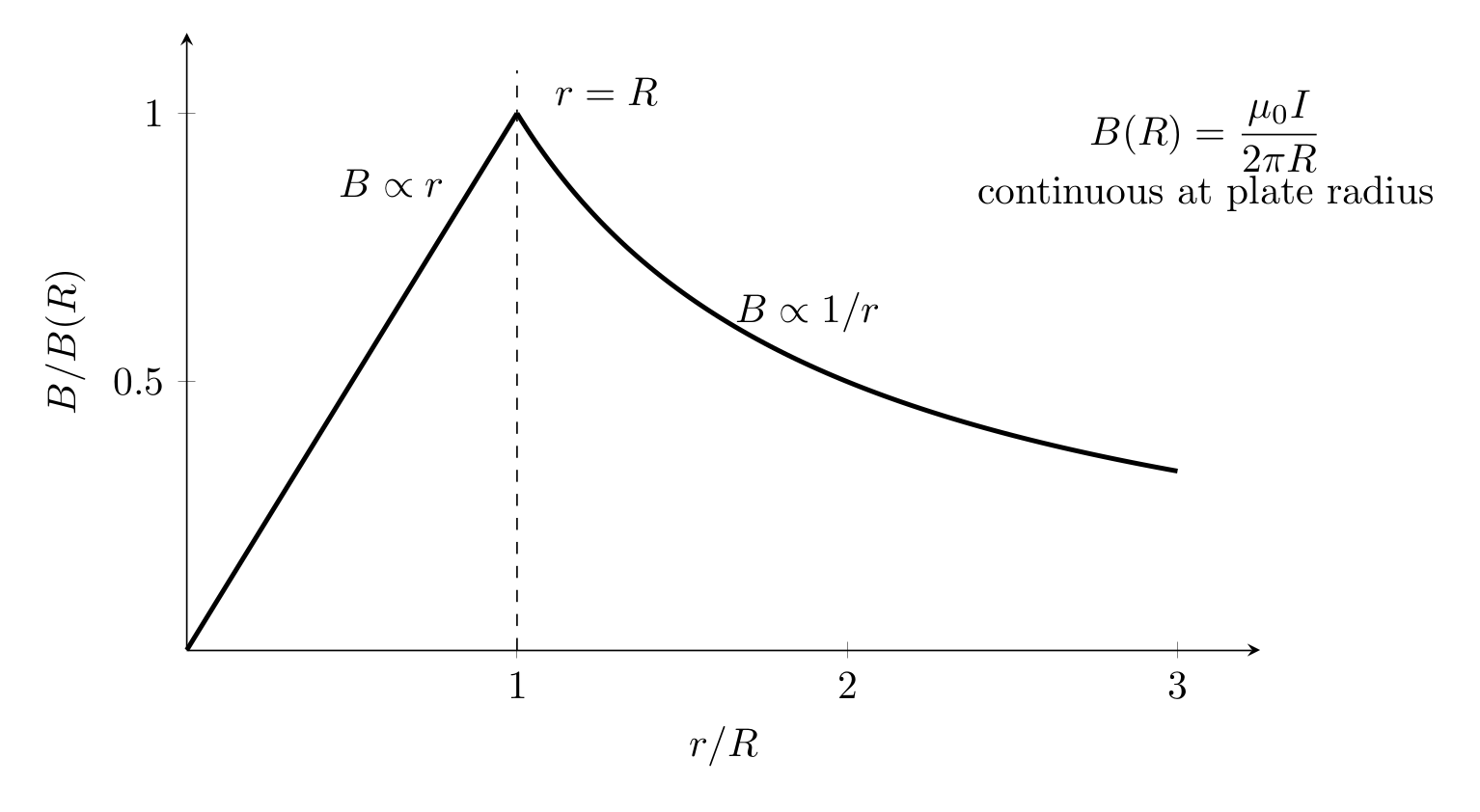
Figure. Idealized radial magnetic-field profile for a uniformly charging circular capacitor:
B ∝ r inside the plate radius and B ∝ 1∕r outside.
Exercise 7: infer the changing electric field from a measured magnetic field
Inside an ideal circular capacitor gap, an Amperian circle of radius
has measured magnetic-field magnitude
Assume the electric field is spatially uniform over the enclosed area and there is no conduction
current through the gap.
Use the Ampere–Maxwell law to find
Then determine the corresponding displacement-current density magnitude
Exercise 8: vector form of displacement-current density
The electric field in a region is
Find:
- ∂E∕∂t;
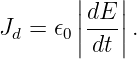
- the displacement-current density
- |Jd| at t = 0;
- the direction of Jd at t = 0.
Explain why displacement current is a vector field, not merely a scalar circuit current.
Exercise 9: derive the differential Ampere–Maxwell equation
Begin with the integral law for a fixed surface S bounded by C:
Use Stokes’ theorem and the fixed-surface assumption to derive
At each step, identify which integral or differential theorem justifies the transformation.
Exercise 10: local evaluation of the differential law
At one instant and location,
and
Find:
- the conduction-current contribution μ0J;
- the displacement-current contribution
- the total
- the ratio of the displacement contribution to the conduction contribution.
Use the result to comment on why displacement current can become important for rapidly varying
fields.
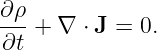
Exercise 11: derive the charge-continuity equation
Starting from
take the divergence of both sides.
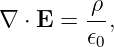
Use
and Gauss’s Law,
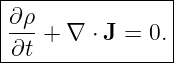
to derive
Then repeat the argument after deleting Maxwell’s displacement-current term and explain exactly
where the inconsistency appears for a time-varying charge density.
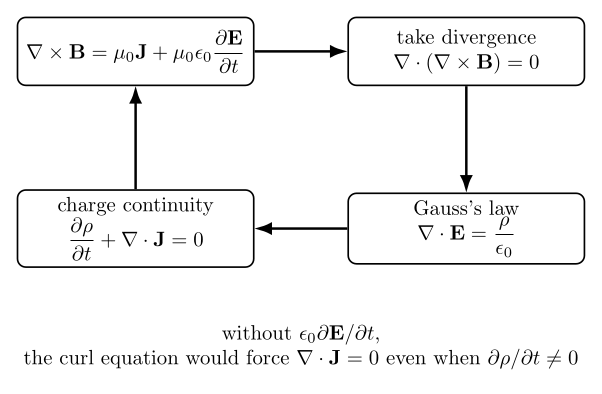
Figure. The Maxwell correction links the magnetic curl equation to Gauss’s law so that
local charge continuity follows identically.
Exercise 12: verify charge continuity for a model charge and current distribution
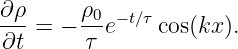
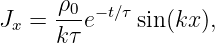
Suppose
and
Calculate:
- ∂ρ∕∂t;
- ∇⋅ J;
- the sum
Determine whether this model satisfies local charge conservation.
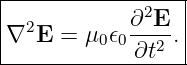
Exercise 13: bridge to the electromagnetic wave equation for E
This exercise extends the closing discussion of EM14.
In a source-free vacuum region,
Use
and
Take the curl of Faraday’s law and use the Vector Identity
to derive
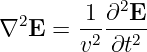
Compare this with the standard wave-equation form
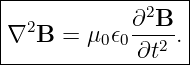
and identify the propagation speed v.
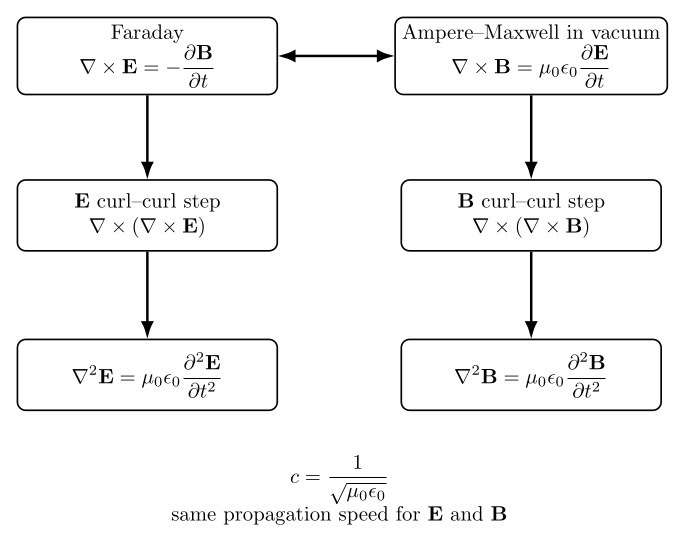
Figure. Curl–curl workflow in source-free vacuum. Faraday and Ampere–Maxwell combine
with the divergence equations to produce wave equations for both E and B.
Exercise 14: magnetic wave equation and electromagnetic speed
Continue the source-free vacuum analysis.
- take the curl of the Ampere–Maxwell equation;
- use Faraday’s law and
to derive
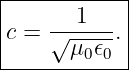
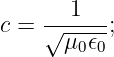
- show that both E and B propagate at
- using
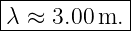
find the wavelength of a vacuum electromagnetic wave with frequency
Conclude by explaining, in one or two sentences, why Maxwell’s displacement-current term is
essential to the existence of the magnetic-field wave equation.
Part II: Complete Worked Solutions
Solution 1: the charging-capacitor surface paradox
For S1,
and the magnetostatic law gives
For S2, no conduction charge crosses the capacitor gap, so
The uncorrected law would therefore predict zero circulation, which is impossible because the
geometrical contour C is unchanged. During charging, the electric flux changes. Maxwell’s
additional source term is
For an ideal charging capacitor, Id = I, so either surface gives
Conduction current is transport of mobile charge through a material cross section; displacement
current is the magnetic-source contribution associated with changing electric flux.
Solution 2: time-dependent charging current from Q(t)
Differentiate
to obtain
With Q0 = 24 μC and τ = 2.0 ms,
For an ideal capacitor,
At t = τ,
Thus
Also,
As the plate charge approaches its final value, dQ∕dt tends to zero, so the electric field and electric
flux stop changing and Id tends to zero.
Solution 3: derive displacement current from the capacitor field
For a uniform field normal to the plates,
Differentiate:
Therefore,
Since C = 𝜖0A∕d,
For fixed C, Q = CV gives Icond = dQ∕dt = C dV∕dt = Id.
Solution 4: displacement current for a nonuniform electric field
Here dA = 2πr dr, so
| ΦE(t) | = 2πE0 cos(ωt) ∫
0R dr dr | (21)
|
| = 2πE0 cos(ωt)![[r2 r4 ]
-- − --2-
2 4R](https://images.physicslibrary.org/cache/objects/1236/make4ht/LectromagneticWavesAmpereMaxwellLawAndDisplacementCurrentExercisesAndCompleteWorkedSolutions69x.png) 0R 0R | (22)
|
| =  cos(ωt). cos(ωt). | (23) |
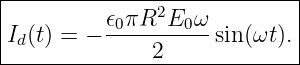
Therefore,
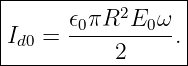
The peak magnitude is
Solution 5: conduction and displacement current in the integral law
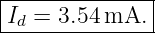
| Id | = 𝜖0 | (26)
|
| = (8.854 × 10⁻¹²)(4.0 × 10⁸) | (27)
|
| = 3.54 × 10⁻³ A. | (28) |
Thus
The effective enclosed source is
Hence
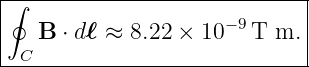
| ∮
CB ⋅ dℓ | = μ0Ieff | (31)
|
| ≈ (1.256637 × 10⁻⁶)(6.54 × 10⁻³) | (32)
|
| ≈ 8.22 × 10⁻⁹ T m. | (33) |
So
Both source terms have units of amperes and enter additively before the common factor
μ0.
Solution 6: derive the magnetic field in a charging capacitor gap
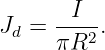
Uniform displacement-current density gives
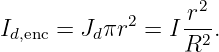
For r < R,
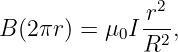
Ampere–Maxwell then gives
so
For r > R, the full displacement current is enclosed:
At r = R, both expressions give μ0I∕(2πR), so B is continuous. Thus B ∝ r inside and B ∝ 1∕r
outside.
Solution 7: infer the changing electric field from a measured magnetic field
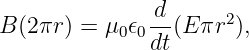
Inside the uniform changing-field region,
so
With B = 8.0 × 10⁻⁸ T, r = 2.5 × 10⁻² m, and μ
0𝜖0 ≈ 1.113 × 10⁻¹⁷ s2∕m2,
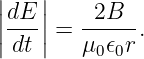
Then
so
Solution 8: vector form of displacement-current density
Differentiate componentwise:
Therefore,
At t = 0,
so
The local displacement-current density is vector-valued because it inherits direction from ∂E∕∂t;
scalar current follows only after a surface integral.
Solution 9: derive the differential Ampere–Maxwell equation
Apply Stokes’ theorem:
For a fixed surface,
Therefore,
Because this holds for arbitrary fixed surfaces,
Solution 10: local evaluation of the differential law
The conduction contribution is
The displacement contribution is
Hence
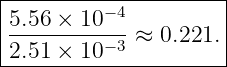
The ratio is
So here the displacement contribution is about 22.1% of the conduction contribution; sufficiently
rapid field variation can make it comparable or dominant.
Solution 11: derive the charge-continuity equation
Take the divergence:
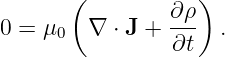
Using Gauss’s law ∇⋅ E = ρ∕𝜖0,
Therefore,
If Maxwell’s term is omitted, taking the divergence of ∇× B = μ0J forces ∇⋅ J = 0. Continuity
would then require ∂ρ∕∂t = 0, so the uncorrected law fails whenever charge accumulates or
depletes locally.
Solution 12: verify charge continuity for a model charge and current distribution
For
Also,
so
Therefore,
and the model satisfies local charge conservation exactly.
Solution 13: bridge to the electromagnetic wave equation for E
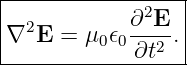
In source-free vacuum, ∇⋅ E = 0 and J = 0. Take the curl of Faraday’s law:
Use the vacuum Ampere–Maxwell law:
The identity
reduces to −∇2E because ∇⋅ E = 0. Hence
Comparing with ∇2E = (1∕v2)∂2E∕∂t2 gives
Solution 14: magnetic wave equation and electromagnetic speed
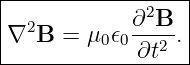
Take the curl of the vacuum Ampere–Maxwell law:
Faraday’s law gives
Using
and ∇⋅ B = 0 yields
Thus both fields propagate at
For f = 100 MHz = 1.00 × 10⁸ Hz,
Hence
Without Maxwell’s displacement-current term, the vacuum Ampere law would reduce to
∇× B = 0 rather than coupling B to ∂E∕∂t, so the curl–curl derivation would lose the
time-derivative term needed for the magnetic wave equation.
Common mistakes
- Treating displacement current as ordinary charges crossing the vacuum gap.
- Applying the steady-current Ampere law to a charging capacitor without the
electric-flux term.
- Forgetting that the same closed contour may be spanned by many surfaces but must
have one unique line integral.
- Replacing a nonuniform electric field by its center value instead of integrating E ⋅ dA.
- Confusing the scalar displacement current Id with the vector displacement-current
density Jd.
- Forgetting the fixed-surface assumption when moving d∕dt through a surface integral.
- Forgetting that ∇⋅ (∇× B) = 0 identically.
- Dropping ∇⋅ E = 0 or ∇⋅ B = 0 without first stating that the region is source-free
vacuum.
- Losing a minus sign in a curl–curl wave-equation derivation.
Reinforcement summary
The central Maxwell correction is
It upgrades Ampere’s magnetostatic law to
Together with Gauss’s law, this is consistent with
In vacuum it also couples the magnetic field to a changing electric field, and together with
Faraday’s law produces wave equations propagating at
References
[1] David J. Griffiths, Introduction to Electrodynamics, 4th ed., Cambridge University
Press, 2017.
[2] Edward M. Purcell and David J. Morin, Electricity and Magnetism, 3rd ed.,
Cambridge University Press, 2013.
[3] Samuel J. Ling, Jeff Sanny, and William Moebs, University Physics, Volume
2, OpenStax, 2016, sections on displacement current, Maxwell’s equations, and
electromagnetic waves.
[4] Richard P. Feynman, Robert B. Leighton, and Matthew Sands, The Feynman Lectures
on Physics, Volume II, Addison-Wesley, 1964, chapters on Maxwell’s equations and
electromagnetic radiation.
[5] Massachusetts Institute of Technology, 8.02 Physics II: Electricity and Magnetism,
MIT OpenCourseWare, materials on Ampere–Maxwell law, displacement current,
capacitors, charge conservation, and electromagnetic waves.

![[parent]](https://images.physicslibrary.org/images/uparrow.png)





































![|------------------------------------|
|Jd = 𝜖0E0ω [− sin(ωt)ˆx + 2 cos(ωt)ˆy].|
--------------------------------------](https://images.physicslibrary.org/cache/objects/1236/make4ht/LectromagneticWavesAmpereMaxwellLawAndDisplacementCurrentExercisesAndCompleteWorkedSolutions88x.png)



![∫ [ ]
∂E-
S ∇ × B − μ0J − μ0 𝜖0∂t ⋅ dA = 0.](https://images.physicslibrary.org/cache/objects/1236/make4ht/LectromagneticWavesAmpereMaxwellLawAndDisplacementCurrentExercisesAndCompleteWorkedSolutions93x.png)