|
|
|
|||||||
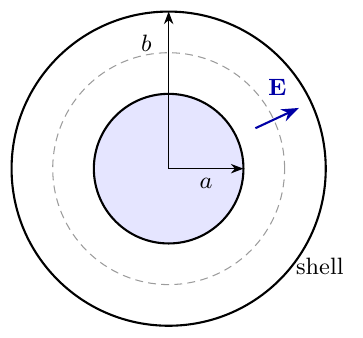
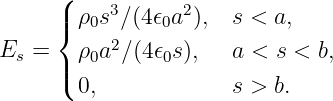
The full cylinder has λc = πρ0a2∕2. A coaxial Gaussian surface gives E s = λenc∕(2π𝜖0s). Hence
The field is outward for ρ0 > 0 where it is nonzero. Check. The two interior formulas agree at a. The jump at b is −λc∕(2πb𝜖0), consistent with the shell’s surface charge density.
3 Practice variationPlace only half the balancing negative charge on the shell. Solution. The interior and gap fields stay fixed. The outside encloses λc∕2, so Es = λc∕(4π𝜖0s) there.
4 Explain the cylindrical Gaussian surfaceEnclosed charge per unit length means the enclosed charge of a coaxial segment divided by its axial length ℓ. Translational symmetry makes the axial position irrelevant, and rotation about the axis plus reflection in an axial plane leaves only the radial component. The curved side contributes Es(2πsℓ) and each cap contributes zero because its Normal is axial. For a shell density, use the positive area per unit length 2πb, so σb = −λc∕(2πb). An outward jump from the gap to the exterior gives 𝜖0[0 − λc∕(2π𝜖0b)] = σb.
5 Worked example 2: find the axis-to-shell voltageLet V (b) = 0. From the shell toward a gap radius s, the signed potential is
For 0 ≤ s < a, keep the gap contribution at a and integrate the cubic interior field from s to a:
The potential is finite at the axis and continuous at both boundaries. At b its derivative jumps because the shell carries surface charge.
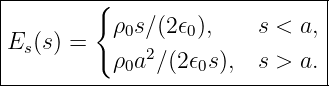
6 Additional worked example 3: uniform solid cylinderA nonconducting cylinder of radius a extends indefinitely along its axis and has constant volume density ρ0 > 0. For a coaxial Gaussian cylinder of radius s < a and length ℓ, the enclosed charge is Qenc = ρ0πs2ℓ. Only the curved side contributes flux, so
For s > a, the enclosed charge per unit length has saturated at ρ0πa2, giving
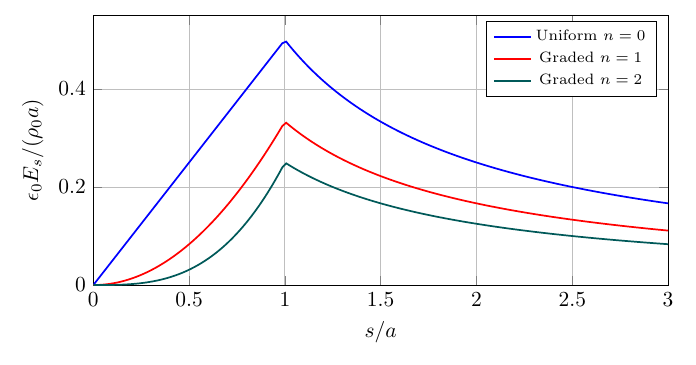
The field joins continuously at s = a. The interior slope differs from the cubic law of the supplied graded-cylinder problem because the enclosed charge of a uniform cylinder grows as s2, not s4.
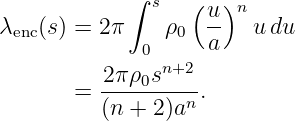
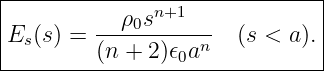
7 Additional worked example 4: the power-law family ρ(s) ∝ snLet ρ(s) = ρ0(s∕a)n for 0 ≤ s < a, with n > −2 so the enclosed integral is finite at the axis. The transverse area element per unit length is 2πsds. Thus
Divide by the curved-surface flux factor 2π𝜖0s:
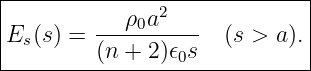
The full line charge of the cylinder is λc = 2πρ0a2∕(n + 2), so outside
For n = 0 the uniform-cylinder result is recovered; for n = 2 one recovers the original graded-cylinder result.
8 Additional worked example 5: a numerical coaxial cylinderTake a uniform cylinder with a = 0.020 m and ρ0 = 2.0 × 10⁻⁶ C∕m3. At s = 0.010 m, the interior field is
At s = 0.040 m the exterior field is
The two magnitudes happen to match, but the points lie in different source regions. Verify the equality directly from the analytic formulas; it does not indicate the field is uniform.
Figure 2. Normalized radial fields for a uniform cylinder and two power-law charge profiles. Each source has its own total line charge for the same ρ0 and a.
9 More practice with solutionsExercise 3. For ρ(s) = ρ0(s∕a), find the interior field and exterior field. Solution. Set n = 1 above: Es = ρ0s2∕(3𝜖 0a) inside, Es = ρ0a2∕(3𝜖 0s) outside. Exercise 4. For a neutralized cylinder, the coaxial shell at b > a has λshell = −λc. Find V (0) − V (b) for a uniform solid cylinder. Solution. With V (b) = 0, V (0)−V (b) = ∫ 0a[ρ 0s∕(2𝜖0)] ds+∫ ab[ρ 0a2∕(2𝜖 0s)] ds = ρ0a2∕(4𝜖 0)+[ρ0a2∕(2𝜖 0)] ln(b∕a).
10 ExercisesExercise 1. What fraction of the solid cylinder charge lies within s = a∕2? Solution. The enclosed per-length charge scales as s4, giving a fraction (1∕2)4 = 1∕16. Exercise 2. Add back the half-strength negative shell only. Can you set V (∞) = 0 for the total system? Solution. The nonzero enclosed charge per length leaves an exterior 1∕s field. Its voltage integral to infinity diverges logarithmically, so use a finite reference radius.
References
References
"Gauss's Law for a Graded Cylinder and a Coaxial Shell" is owned by bloftin.
This object's parent. Cross-references: voltage, system, magnitudes, volume density, boundaries, Normal, position, enclosed charge, negative charge, surface charge density, formulas, flux, enclosed charge per unit length, Gaussian surface, section, solid, unit, charge This is version 1 of Gauss's Law for a Graded Cylinder and a Coaxial Shell, born on 2026-11-27. Object id is 1622, canonical name is GausssLawForAGradedCylinderAndACoaxialShell. Accessed 3 times total. Classification:
|
|
|
|
Pending Errata and AddendaNone.
|
DiscussionNo messages.
|
Interact |