
|
|
|
|||||||
For a rectangle fixed on all four edges,
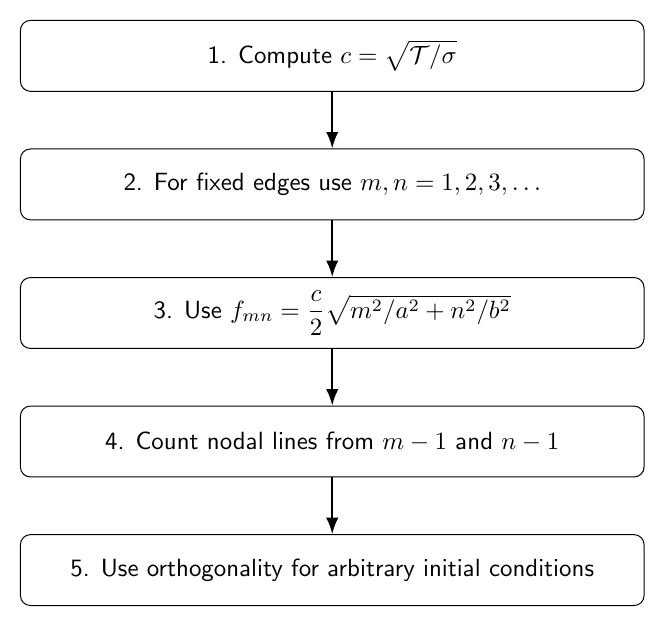
Figure 1. A compact strategy: determine wave speed, apply the fixed-edge mode indices, compute the frequency, count nodal lines, and use orthogonality for general initial conditions.
1 High-value GRE facts
Part I: Original GRE-style problems
Problem 1: membrane wave speedA membrane has
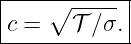
The wave speed is closest to
Problem 2: lowest modeThe lowest nontrivial mode of a rectangle fixed on all four edges is
Problem 3: fundamental frequencyFor
the fundamental frequency is closest to
Problem 4: nodal linesA (4, 3) mode has how many interior nodal lines in total?
Problem 5: square degeneracyWhich pair is necessarily degenerate on a square membrane?
Problem 6: tension scalingIf 𝒯 is multiplied by four with everything else fixed, every frequency is multiplied by
Problem 7: density scalingIf σ is multiplied by four with everything else fixed, every frequency becomes
Problem 8: fixed-edge mode shapeWhich mode shape satisfies all four fixed boundaries?
Problem 9: orthogonalityThe membrane integral of ΦmnΦpq is zero when
Problem 10: nonsquare rectangleFor a≠b, the frequencies f21 and f12
Problem 11: initial displacement coefficientAn Amn coefficient is obtained by
Problem 12: modal equationEach ideal modal coordinate satisfies
Part II: Complete worked solutions
Solution 1
Answer: (D).
Solution 2A zero index makes one sine factor vanish everywhere, so the first nontrivial mode is (1, 1). Answer: (D).
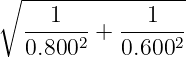
Solution 3
Answer: (C).
Solution 4A (4, 3) mode has 3 vertical and 2 horizontal interior nodal lines, for a total of 5. Answer: (C).
Solution 5For a square, fmn depends on m2 + n2, so interchanging m and n leaves the frequency unchanged. Answer: (B).
Solution 6Since fmn ∝
Solution 7Since fmn ∝ 1∕
Solution 8The fixed boundaries require sine factors in both coordinates. Answer: (B).
Solution 9Orthogonality gives
The integral vanishes whenever either index differs. Answer: (C).
Solution 10For a≠b, interchanging m and n generally changes
Answer: (B).
Solution 11Orthogonality extracts the coefficient by projection:
Answer: (B).
Solution 12Each normal coordinate is an independent simple harmonic oscillator:
Answer: (B).
2 GRE checklist
References
References
[1] PhysicsLibrary, M06-16, Wave Equations in Two and Three Dimensions and Spherical Waves. [2] PhysicsLibrary, M06-08, Continuous Strings, Standing Waves, and Normal Modes. [3] A. P. French, Vibrations and Waves, W. W. Norton, 1971. [4] G. B. Arfken, H. J. Weber, and F. E. Harris, Mathematical Methods for Physicists, 7th ed., Academic Press, 2013. "GRE Physics Companion: Separation of Variables, Membranes, and Two-Dimensional Normal Modes" is owned by bloftin.
This object's parent. Cross-references: simple harmonic oscillator, normal coordinate, displacement, tension, boundaries, mode shape, fundamental frequency, simple harmonic motion, modal coordinate, square, surface mass density, units, membrane tension per unit length, nodal lines, frequency, speed This is version 1 of GRE Physics Companion: Separation of Variables, Membranes, and Two-Dimensional Normal Modes, born on 2026-10-24. Object id is 1536, canonical name is GREPhysicsCompanionSeparationOfVariablesMembranesAndTwoDimensionalNormalModes. Accessed 1 times total. Classification:
|
|
|
|
Pending Errata and AddendaNone.
|
DiscussionNo messages.
|
Interact |


 .
 .




 , multiplying tension by four multiplies frequency by two.
 , multiplying surface density by four halves the frequency.



