|
|
|
|||||||
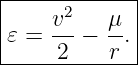
The sign of
classifies gravitational motion.
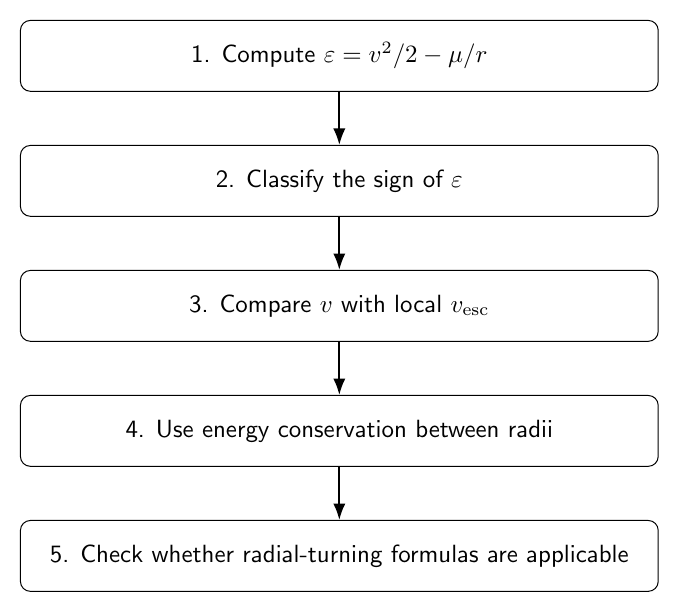
Figure 1. A compact orbital-energy strategy: compute specific energy, classify its sign, compare speed with local escape speed, and use energy conservation to relate speeds at different radii.
1 High-value GRE facts
Part I: Original GRE-style problems
Problem 1: circular specific energyFor a circular orbit of radius r, the specific orbital energy is
Problem 2: bound classificationA trajectory with 𝜀 < 0 is
Problem 3: escape thresholdAt the minimum escape condition, 𝜀 equals
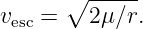
Problem 4: escape speedThe escape speed at radius r is
Problem 5: escape/circular ratioAt one radius, vesc∕vcirc equals
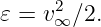
Problem 6: positive specific energyFor an unbound orbit with asymptotic speed v∞, 𝜀 is
Problem 7: local unbound speedFor an unbound trajectory, v2 equals
Problem 8: escape-speed scalingIf radius increases by a factor of four, escape speed changes by a factor
Problem 9: radial turning pointFor purely radial bound motion, at the outer turning point the
Problem 10: circular-to-escape incrementThe ideal instantaneous speed increment from circular speed to local escape speed is
Problem 11: exact two-body parameterFor exact relative motion of masses m1 and m2, the gravitational parameter is
Problem 12: conic-energy classificationIn the ideal inverse-square two-body problem, positive specific energy corresponds to
Part II: Complete worked solutions
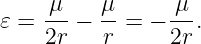
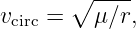
Solution 1For circular motion,
Therefore
Answer: (C).
Solution 2Negative total energy means the body cannot reach infinity with real speed. Answer: (B).
Solution 3Minimum escape arrives at infinity with zero final speed and therefore zero total specific energy. Answer: (C).
Solution 4Set 𝜀 = 0:
Answer: (B).
Solution 5Since
the ratio is
Solution 6At infinity the potential term vanishes, so
Answer: (C).
Solution 7Energy conservation gives
Answer: (B).
Solution 8Since vesc ∝ r−1∕2, multiplying radius by four divides speed by two. Answer: (D).
Solution 9For purely radial motion, all velocity is radial. At the outer turning point the radial speed, and therefore total speed, is zero. Answer: (A).
Solution 10The required change is
Answer: (B).
Solution 11The relative acceleration depends on the sum of the masses, giving
Answer: (C).
Solution 12Positive specific energy corresponds to an unbound hyperbola. Answer: (D).
2 GRE checklist
References
References
"GRE Physics Companion: Orbital Energy, Escape Speed, and Bound versus Unbound Motion" is owned by bloftin.
This object's parent. Cross-references: angular momentum, formula, acceleration, velocity, hyperbolic orbit, parabolic orbit, elliptic orbit, parameter, masses, potential energy, turning point, relative motion, energy conservation, escape speed, speed, energy, specific orbital energy This is version 1 of GRE Physics Companion: Orbital Energy, Escape Speed, and Bound versus Unbound Motion, born on 2026-10-31. Object id is 1558, canonical name is GREPhysicsCompanionOrbitalEnergyEscapeSpeedAndBoundVersusUnboundMotion. Accessed 6 times total. Classification:
|
|
|
|
Pending Errata and AddendaNone.
|
DiscussionNo messages.
|
Interact |


 .


 .