Physics Library
 An open source physics library
Encyclopedia | Forums | Docs | Random  

[parent] GRE Physics Companion: Newton's Law of Universal Gravitation

(Example)

GRE Physics Companion: Newton’s Law of Universal Gravitation

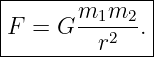
The essential magnitude law is

|-------m1m2---|
|F =  G ---2--.|
----------r----|
(1)

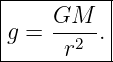
For a test mass outside a spherical source mass,

|----------|
|    GM--- |
|g =  r2  .|
-----------
(2)

PIC

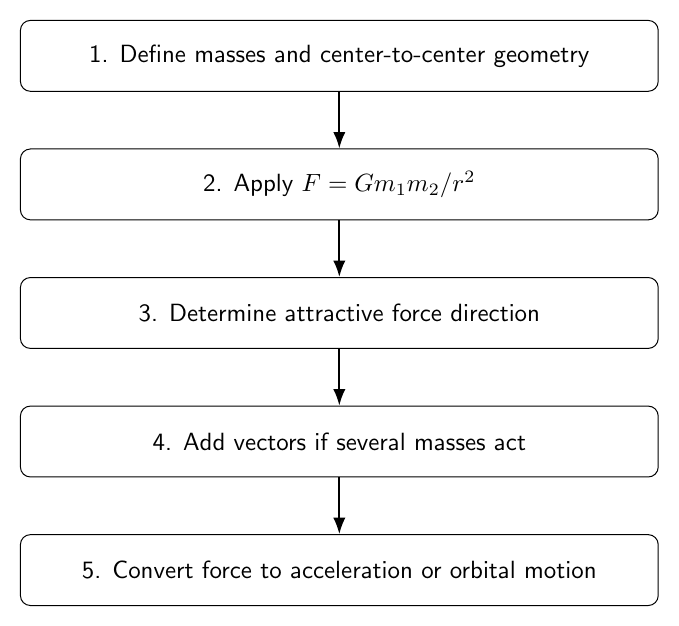
Figure 1. A compact gravitation strategy: define the geometry, apply inverse-square scaling, determine the force direction, use vector superposition when needed, and convert force to acceleration or orbital motion.

1 High-value GRE facts

  1. Gravity is attractive.
  2. F ∝ m1m2∕r2.
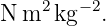
  3. [G] = N m2 kg−2.
  4. Equal-and-opposite forces do not imply equal accelerations.
  5. For free fall, test mass cancels from a = GM∕r2.
  6. Use center-to-center separation, not altitude alone.
  7. Multiple gravitational forces add as vectors.
  8. μ = GM is the gravitational parameter.
  9. Circular orbital speed is v = ∘GM----∕r-.
  10. Circular orbital period obeys T2 = 4π2r3∕(GM).

Part I: Original GRE-style problems

Problem 1: inverse-square scaling

If the separation between two masses doubles while the masses remain fixed, the gravitational force becomes

  1. twice as large
  2. unchanged
  3. one half as large
  4. one fourth as large
  5. one eighth as large

Problem 2: changing mass and distance

If m1 is doubled and the separation is tripled, the new force relative to the original is

  1. 2∕3
  2. 2∕9
  3. 3∕2
  4. 6
  5. 18

Problem 3: action and reaction

Two unequal masses attract gravitationally. The force magnitude on mass 1 due to mass 2 is

  1. greater than the force on mass 2
  2. less than the force on mass 2
  3. equal to the force on mass 2
  4. zero if mass 1 is smaller
  5. proportional only to mass 1

Problem 4: acceleration ratio

If m2 = 4m1, the ratio of acceleration magnitudes is

a ∕a
 1  2
(3)

equal to

  1. 1∕4
  2. 1∕2
  3. 1
  4. 2
  5. 4

Problem 5: free fall

Ignoring air resistance, two test objects of different mass at the same location near a source body have gravitational accelerations that are

  1. proportional to their masses
  2. inversely proportional to their masses
  3. equal
  4. zero for the lighter object
  5. equal only if their volumes match

Problem 6: altitude

At altitude h = RE above Earth’s surface, the spherical-Earth gravitational acceleration is

  1. g0
  2. g0∕2
  3. g0∕3
  4. g0∕4
  5. g0∕8

Problem 7: symmetric superposition

Two equal source masses are placed symmetrically on opposite sides of a test mass. At the exact midpoint the net gravitational force is

  1. toward the left mass
  2. toward the right mass
  3. zero
  4. infinite
  5. twice one individual force

Problem 8: gravitational parameter

The gravitational parameter of a body is

  1. G∕M
  2. GM
  3. G∕M2
  4. M∕G
  5. Gr

Problem 9: circular orbit

The circular orbital speed around a much larger central mass is

  1. GM∕r
  2. √ ------
  GM  r
  3. ∘ -------
  GM  ∕r
  4. 2πGM∕r
  5. GM∕r2

Problem 10: circular period scaling

For circular orbits around the same central mass,

T
(4)

scales with radius as

  1. T ∝ r−2
  2. T ∝ r−1∕2
  3. T ∝ r
  4. T ∝ r3∕2
  5. T ∝ r2

Problem 11: vector direction

If

r12 = r2 − r1,
(5)

the force on mass 1 due to mass 2 points

  1. along +r12
  2. along −r12
  3. perpendicular to r12
  4. in an arbitrary direction
  5. opposite to both positions

Problem 12: dimensions of G

The dimensions of G are

  1. N mkg−1
  2. N m2 kg−2
  3. N kg−2
  4. ms−2
  5. kg m2 s−2

Part II: Complete worked solutions

Solution 1

Because

F ∝  1∕r2,
(6)

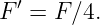
doubling distance gives

F′ = F ∕4.
(7)

Answer: (D).

Solution 2

The mass change contributes a factor 2, while tripling distance contributes 1∕9:

 ′
F ∕F =  2∕9.
(8)

Answer: (B).

Solution 3

Newton’s third law requires the interaction forces to have equal magnitude and opposite direction. Answer: (C).

Solution 4

Equal force magnitudes give

a1 =  F∕m1,      a2 = F∕(4m1 ).
(9)

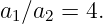
Thus

a1∕a2 = 4.
(10)

Answer: (E).

Solution 5

The test mass cancels:

              2
ma  = GM  m ∕r
(11)

so

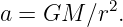
          2
a = GM  ∕r .
(12)

Answer: (C).

Solution 6

At h = RE, the center-to-center distance is 2RE, so

                 2
g∕g0 = (RE ∕2RE )  = 1∕4.
(13)

Answer: (D).

Solution 7

The equal force vectors point in opposite directions and cancel. Answer: (C).

Solution 8

By definition,

μ = GM.
(14)

Answer: (B).

Solution 9

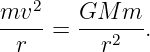
Equate gravitational force to centripetal force:

mv2     GM  m
-----=  ---2--.
  r       r
(15)

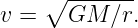
Therefore

    ∘ -------
v =   GM  ∕r.
(16)

Answer: (C).

Solution 10

Kepler’s circular-orbit result is

 2    3
T  ∝ r ,
(17)

so

      3∕2
T ∝  r  .
(18)

Answer: (D).

Solution 11

The vector r12 points from mass 1 toward mass 2, exactly the direction of the attractive force on mass 1. Answer: (A).

Solution 12

From

G =  Fr2∕(m1m2  ),
(19)

the units are

N  m2 kg−2.
(20)

Answer: (B).

2 GRE checklist

  1. Use center-to-center distance.
  2. Apply inverse-square scaling before doing full arithmetic when possible.
  3. Distinguish equal forces from unequal accelerations.
  4. Use vectors for multiple source masses.
  5. Cancel the test mass in free-fall acceleration.
  6. Use μ = GM when orbital formulas are written compactly.
  7. Derive circular speed by equating gravity and centripetal force.

References

References

[1]   PhysicsLibrary, M07-01, Newton’s Law of Universal Gravitation.

[2]   J. R. Taylor, Classical Mechanics, University Science Books, 2005.

[3]   D. Kleppner and R. Kolenkow, An Introduction to Mechanics, 2nd ed., Cambridge University Press, 2014.


"GRE Physics Companion: Newton's Law of Universal Gravitation" is owned by bloftin.
(view preamble)
View style:
Other names:  M07-01G
Keywords:  GRE physics, Newtonian gravitation, inverse-square law, gravitational constant, gravitational acceleration, superposition, circular orbit % Level: GRE Physics preparation / introductory classical mechanics review

This object's parent.

Cross-references: formulas, units, centripetal force, dimensions, positions, volumes, resistance, period, speed, parameter, acceleration, superposition, vector, force, mass, magnitude

This is version 1 of GRE Physics Companion: Newton's Law of Universal Gravitation, born on 2026-10-31.
Object id is 1550, canonical name is GREPhysicsCompanionNewtonsLawOfUniversalGravitation.
Accessed 11 times total.

Classification:
Physics Classification: 45.20.Dd (Newtonian mechanics)
 45.50.-j (Dynamics and kinematics of a particle and a system of particles)

Pending Errata and Addenda

None.

Discussion

No messages.

Interact