Physics Library
 An open source physics library
Encyclopedia | Forums | Docs | Random  

[parent] GRE Physics Companion: Helmholtz Equation, Boundary-Value Problems, and Eigenfunction Expansions

(Example)

GRE Physics Companion: Helmholtz Equation, Boundary-Value Problems, and Eigenfunction Expansions

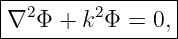
The key spatial equation is

|----------------|
-∇2-Φ-+-k2Φ-=--0,|
(1)

or

|------------------------------|
-−-∇2-Φn-=-λn-Φn,-----λn-=-k2n.-|
(2)

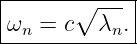
For waves,

|------------|
|      ∘ --- |
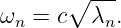
-ωn-=-c--λn.--
(3)

PIC

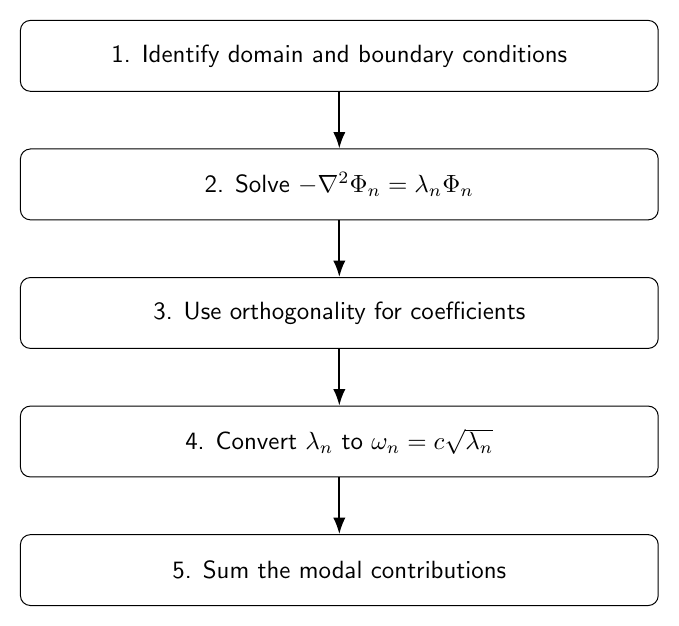
Figure 1. A compact strategy: identify the domain and boundary conditions, solve the Laplacian eigenvalue problem, use orthogonality to obtain coefficients, and convert spatial eigenvalues into wave frequencies.

1 High-value GRE facts

  1. harmonic time dependence gives the Helmholtz equation.
  2. Dirichlet conditions specify field value.
  3. Neumann conditions specify Normal derivative.
  4. Homogeneous Dirichlet Laplacian eigenvalues are positive.
  5. Homogeneous Neumann problems can contain a zero mode.
  6. Distinct eigenvalues give orthogonal eigenfunctions for self-adjoint boundary conditions.
  7. Rectangular Dirichlet eigenfunctions are products of sine functions.
  8. Circular Dirichlet eigenfunctions involve Bessel functions.
  9. Expansion coefficients are obtained by projection.
  10. Wave frequencies satisfy ωn = c√ ---
  λn.

Part I: Original GRE-style problems

Problem 1: Helmholtz equation

If

ψ(r,t) = Φ(r)cos ωt,
(4)

then the wave equation gives

  1. ∇2Φ − k2Φ = 0
  2. ∇2Φ + k2Φ = 0
  3. ∇Φ + kΦ = 0
  4. Φtt + k2Φ = 0
  5. ∇2Φ = 0 for all ω

Problem 2: Dirichlet condition

A homogeneous Dirichlet condition is

  1. ∂Φ∕∂n = 0
  2. Φ = 0
  3. ∇2Φ = 0
  4. Φt = 0
  5. Φ = constant everywhere

Problem 3: Neumann condition

A homogeneous Neumann condition is

  1. Φ = 0
  2. ∂Φ∕∂n = 0
  3. ∇Φ = 0 everywhere
  4. Φtt = 0
  5. k = 0

Problem 4: fixed interval eigenvalues

On 0 < x < L with Φ(0) = Φ(L) = 0, the eigenvalues are

  1. λn = nπ∕L
  2. λn = (nπ∕L)2
  3. λn = n∕L2
  4. λn = 2πn∕L
  5. λn = 0 for all n

Problem 5: Neumann zero mode

For homogeneous Neumann conditions on a closed interval, the n = 0 mode is

  1. forbidden
  2. a constant eigenfunction with λ = 0
  3. a sine function
  4. always singular
  5. a mode with infinite frequency

Problem 6: orthogonality

If λm≠λn for a self-adjoint Laplacian problem, then

  1. Φm = Φn
  2. ∫ ΦmΦn dV = 0
  3. λm + λn = 0
  4. both eigenfunctions vanish everywhere
  5. both eigenfunctions are constant

Problem 7: square degeneracy

For a square Dirichlet membrane, the pair (1, 2) and (2, 1)

  1. has different eigenvalues
  2. is degenerate
  3. contains a zero mode
  4. exists only for Neumann boundaries
  5. is forbidden

Problem 8: projection coefficient

For an orthogonal basis, the coefficient of Φn in f is

  1. ⟨f, Φn⟩
  2. ⟨f, Φn⟩∕⟨Φn, Φn⟩
  3. ⟨Φn, Φn⟩∕⟨f, Φn⟩
  4. λnf
  5. ωnf

Problem 9: wave frequency

If a spatial eigenvalue is λn, the corresponding wave angular frequency is

  1. λn∕c
  2. cλn
  3. c√ ---
  λn
  4. ∘ -----
  c∕λn
  5. 1∕λn

Problem 10: rectangular eigenvalue

For a rectangle with Dirichlet boundaries,

λmn
(5)

is

  1. π(m∕a + n∕b)
  2. π2(m2∕a2 + n2∕b2)
  3. (m + n)2
  4. m2n2∕(ab)
  5. independent of geometry

Problem 11: circular geometry

For a circular Dirichlet domain, radial eigenvalues are selected by

  1. sin(ka) = 0 for every angular order
  2. Jm(ka) = 0
  3. Y m(ka) = 0 only
  4. ka = m + n
  5. k = 0 only

Problem 12: boundary conditions

Changing boundary conditions while keeping the same differential operator generally

  1. leaves the spectrum unchanged
  2. changes the allowed eigenfunctions and eigenvalues
  3. changes the spatial dimension
  4. removes orthogonality in every case
  5. forces k = 0

Part II: Complete worked solutions

Solution 1

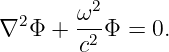
Substitution gives

         2
∇2 Φ +  ω-Φ  = 0.
        c2
(6)

With k = ω∕c,

∇2 Φ + k2Φ =  0.
(7)

Answer: (B).

Solution 2

Homogeneous Dirichlet means the field itself vanishes on the boundary. Answer: (B).

Solution 3

Homogeneous Neumann means the outward normal derivative vanishes. Answer: (B).

Solution 4

The fixed interval gives

kn =  nπ,
      L
(8)

so

           (    )
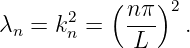
λ  =  k2 =   nπ- 2.
  n    n     L
(9)

Answer: (B).

Solution 5

The constant function satisfies the Neumann boundary condition and has zero Laplacian. Answer: (B).

Solution 6

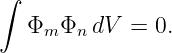
Self-adjointness gives orthogonality for distinct eigenvalues:

∫

   Φm Φn dV  = 0.
(10)

Answer: (B).

Solution 7

On a square,

         2    2
λmn ∝  m  + n  .
(11)

Therefore (1, 2) and (2, 1) have the same eigenvalue. Answer: (B).

Solution 8

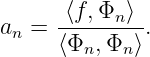
Projection onto an orthogonal but not necessarily normalized basis gives

       ⟨f, Φ ⟩
an =  -----n--.
      ⟨Φn,Φn ⟩
(12)

Answer: (B).

Solution 9

Since

λn = k2n
(13)

and

ωn = ckn,
(14)

      ∘ ---
ωn = c  λn.
(15)

Answer: (C).

Solution 10

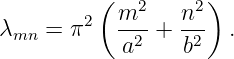
Separation in a rectangle gives

          (   2    2)
λ    = π2   m--+  n-- .
  mn        a2    b2
(16)

Answer: (B).

Solution 11

regular circular eigenfunctions use Jm(kr), and the fixed rim requires Jm(ka) = 0. Answer: (B).

Solution 12

The boundary conditions are part of the eigenvalue problem and therefore change the allowed spectrum. Answer: (B).

2 GRE checklist

  1. Convert wave problems to Helmholtz form only after assuming harmonic time dependence.
  2. Distinguish field value from normal derivative at a boundary.
  3. Keep track of the sign convention in −∇2Φ = λΦ.
  4. Remember the Neumann zero mode.
  5. Use self-adjointness to justify orthogonality.
  6. Use projection divided by mode norm for expansion coefficients.
  7. Convert spatial eigenvalues to wave frequencies with ω = c√ --
  λ.

References

References

[1]   PhysicsLibrary, M06-18, Circular Membranes, Bessel Functions, and Radial-Angular Modes.

[2]   PhysicsLibrary, M06-17, Separation of Variables, Membranes, and Two-Dimensional Normal Modes.

[3]   G. B. Arfken, H. J. Weber, and F. E. Harris, Mathematical Methods for Physicists, 7th ed., Academic Press, 2013.


"GRE Physics Companion: Helmholtz Equation, Boundary-Value Problems, and Eigenfunction Expansions" is owned by bloftin.
(view preamble)
View style:
Other names:  M06-19G
Keywords:  GRE physics, Helmholtz equation, boundary conditions, eigenfunctions, eigenvalues, orthogonality, modal expansion, Laplacian

This object's parent.

Cross-references: norm, regular, Neumann boundary condition, forces, dimension, spectrum, operator, angular frequency, square, wave equation, Bessel functions, functions, zero mode, Laplacian, Normal, Helmholtz equation, harmonic, frequencies, Laplacian eigenvalue problem, boundary, domain

This is version 1 of GRE Physics Companion: Helmholtz Equation, Boundary-Value Problems, and Eigenfunction Expansions, born on 2026-10-31.
Object id is 1546, canonical name is GREPhysicsCompanionHelmholtzEquationBoundaryValueProblemsAndEigenfunctionExpansions.
Accessed 4 times total.

Classification:
Physics Classification: 45.50.-j (Dynamics and kinematics of a particle and a system of particles)
 45.05.+x (General theory of classical mechanics of discrete systems)

Pending Errata and Addenda

None.

Discussion

No messages.

Interact