Physics Library
 An open source physics library
Encyclopedia | Forums | Docs | Random  

[parent] GRE Physics Companion: Energy Methods for Rigid Bodies

(Example)
GRE Physics Companion: Energy Methods for Rigid Bodies

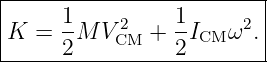
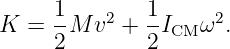
The central rigid-body energy relation is

|------------------------|
|K =  1M  V2CM +  1ICM ω2.|
------2----------2--------
(1)

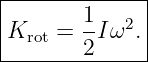
For fixed-axis rotation,

|-------------|
|       1  2  |
Krot =  2Iω . |
---------------
(2)

For pure rolling,

|-----------|
VCM--=-R-ω.--
(3)

PIC

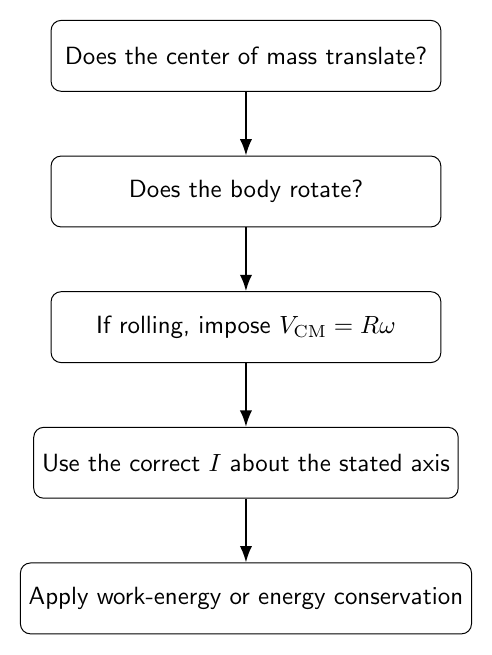
Figure 1. A compact strategy for rigid-body energy problems. Decide whether the motion is translation, fixed-axis rotation, or rolling, then include every kinetic-energy term that is present.

1 High-value GRE facts

  1. Translation contributes 1
2MV CM2.
  2. Rotation about the center of mass contributes 1
2ICMω2.
  3. Pure rolling contains both terms.
  4. For no slip, V CM = Rω.
  5. Torque work is W = ∫ τ d𝜃.
  6. Constant torque gives W = τΔ𝜃.
  7. rotational power is P = τω.
  8. static friction can be nonzero while doing zero work in ideal rolling on a fixed surface.
  9. A smaller I∕(MR2) gives greater rolling speed after the same vertical drop.
  10. For a fixed offset axis, use the parallel-axis theorem.

Part I: Original GRE-style problems

Problem 1: rotational kinetic energy

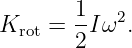
A rigid body has moment of inertia I and angular speed ω. Its rotational kinetic energy is

  1. Iω
  2. Iω2
  3. 1
2Iω
  4. 1
2Iω2
  5. 2Iω2

Problem 2: rolling disk energy

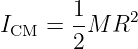
A solid disk of mass M rolls without slipping at speed v. Since

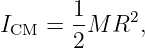
I   =  1M R2,
 CM    2
(4)

its total kinetic energy is

  1. 1
4Mv2
  2. 1
2Mv2
  3. 3
4Mv2
  4. Mv2
  5. 3
2Mv2

Problem 3: torque work

A constant torque of 8 N m turns a shaft through 5 rad. The work is

  1. 1.6 J
  2. 13 J
  3. 40 J
  4. 64 J
  5. 200 J

Problem 4: rotational power

A shaft transmits torque 50 N m at angular speed 100 rad∕s. The power is

  1. 0.5 kW
  2. 2.0 kW
  3. 5.0 kW
  4. 50 kW
  5. 500 kW

Problem 5: pure rolling relation

For a wheel of radius R rolling without slipping,

  1. V CM = ω∕R
  2. V CM = Rω
  3. V CM = R∕ω
  4. V CM = Rω2
  5. V CM = 0

Problem 6: hoop rolling downhill

A hoop rolls without slipping from rest through vertical drop h. Its final speed satisfies

  1. v2 = gh
  2. v2 = 2gh
  3. v2 = 4gh∕3
  4. v2 = 10gh∕7
  5. v2 = gh∕2

Problem 7: solid sphere rolling downhill

A solid sphere rolls without slipping from rest through vertical drop h. Its final speed satisfies

  1. v2 = gh
  2. v2 = 4gh∕3
  3. v2 = 10gh∕7
  4. v2 = 2gh
  5. v2 = 5gh∕2

Problem 8: ranking rolling objects

A hoop, solid disk, and solid sphere of equal mass and radius roll without slipping from the same height. Which reaches the bottom with the greatest center-of-mass speed?

  1. hoop
  2. solid disk
  3. solid sphere
  4. all have the same speed
  5. cannot be determined

Problem 9: static friction in pure rolling

For ideal pure rolling on a fixed surface, the static-friction force at the contact point

  1. must always do positive work
  2. must always do negative work
  3. can be nonzero while doing zero instantaneous work
  4. must vanish
  5. always increases kinetic energy

Problem 10: fixed-axis energy

A body rotates about a fixed axis through point O. Its kinetic energy is

  1. 1
2IOω2
  2. 1
2ICMω2 only
  3. IOω
  4. Mω2
  5. τω

Problem 11: constant torque from rest

A flywheel with I = 4 kg m2 starts from rest. A constant torque 10 N m acts through 8 rad. The final angular speed is

  1. 2 rad∕s
  2. 4 rad∕s
  3. √ ---
  20 rad∕s
  4.   ---
√ 40 rad∕s
  5. 20 rad∕s

Problem 12: rolling energy fraction

For a hoop rolling without slipping, what fraction of its total kinetic energy is rotational?

  1. 1∕4
  2. 1∕3
  3. 1∕2
  4. 2∕3
  5. 3∕4

Part II: Complete worked solutions

Solution 1

Rotational kinetic energy is

        1- 2
Krot =  2Iω .
(5)

Answer: (D).

Solution 2

For rolling,

     1    2   1     2
K =  -M  v +  -ICM ω .
     2        2
(6)

For a solid disk,

ICM =  1M  R2
       2
(7)

and

     v
ω =  --.
     R
(8)

Thus

K = 1
--
2Mv2 + 1
--
2( 1      )
  --M R2
  2v2
--2
R (9)
= 1-
2Mv2 + 1-
4Mv2 (10)
= 3
--
4Mv2. (11)

Answer: (C).

Solution 3

For constant torque,

W   = τΔ 𝜃.
(12)

Therefore

W  =  (8)(5 ) = 40 J.
(13)

Answer: (C).

Solution 4

Use

P = τ ω.
(14)

Thus

P  = (50)(100) = 5000 W  = 5.0 kW.
(15)

Answer: (C).

Solution 5

Pure rolling requires

VCM  = R ω.
(16)

Answer: (B).

Solution 6

For a hoop,

ICM  = M  R2.
(17)

Energy conservation gives

                         2
        1-   2   1-   2 v--
M  gh = 2 M v  + 2M  R  R2.
(18)

Thus

M  gh = M v2,
(19)

so

v2 = gh.
(20)

Answer: (A).

Solution 7

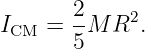
For a solid sphere,

       2
ICM =  -M R2.
       5
(21)

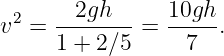
Therefore

v2 = --2gh---=  10gh-.
     1 + 2∕5      7
(22)

Answer: (C).

Solution 8

For rolling,

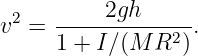
 2   -----2gh-----
v  = 1 + I∕ (M  R2) .
(23)

The smallest value of I∕(MR2) gives the largest speed.

For the three objects,

hoop : 1, (24)
disk : 1-
2, (25)
sphere : 2
5-. (26)

Thus the solid sphere is fastest.

Answer: (C).

Solution 9

In ideal rolling on a fixed surface, the contact point is instantaneously at rest.

Thus

Pf  = fs ⋅ vcontact = 0.
(27)

Static friction can still be nonzero and supply torque.

Answer: (C).

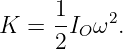
Solution 10

For fixed-axis rotation about O,

K =  1I  ω2.
     2 O
(28)

Answer: (A).

Solution 11

The torque work is

W  =  τΔ 𝜃 = (10)(8) = 80J.
(29)

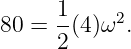
Starting from rest,

      1    2
80 =  -(4)ω .
      2
(30)

Therefore

ω2  = 40,
(31)

so

     √ ---
ω =    40rad∕s.
(32)

Answer: (D).

Solution 12

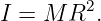
For a hoop,

I = M R2.
(33)

Thus

Ktrans = 1-
2Mv2, (34)
Krot = 1
--
2MR2v2
-2-
R = 1
--
2Mv2. (35)

The two parts are equal, so half of the total kinetic energy is rotational.

Answer: (C).

2 GRE checklist

For rigid-body energy problems:

  1. Include translational kinetic energy if the center of mass moves.
  2. Include rotational kinetic energy if the body rotates.
  3. For rolling, use both terms and apply V CM = Rω.
  4. Use the correct moment of inertia for the stated axis.
  5. For torque work, integrate τ d𝜃.
  6. For rotational power, use P = τω.
  7. Use the parallel-axis theorem for an offset fixed axis.
  8. Do not assume static friction dissipates energy in ideal pure rolling.

References

References

[1]   J. R. Taylor, Classical Mechanics, University Science Books, 2005.

[2]   D. Kleppner and R. Kolenkow, An Introduction to Mechanics, 2nd ed., Cambridge University Press, 2014.

[3]   OpenStax, University Physics, Volume 1, Rice University, 2016.


"GRE Physics Companion: Energy Methods for Rigid Bodies" is owned by bloftin.
(view preamble)
View style:
Other names:  M03-09G
Keywords:  GRE physics, rigid body, rotational kinetic energy, moment of inertia, torque work, rotational power, rolling without slipping, energy conservation, center of mass

This object's parent.

Cross-references: translational kinetic energy, force, power, kinetic energy, mass, solid, rotational kinetic energy, moment of inertia, rigid body, theorem, speed, static friction, rotational power, work, center of mass, motion, relation, energy

This is version 1 of GRE Physics Companion: Energy Methods for Rigid Bodies, born on 2026-10-03.
Object id is 1386, canonical name is GREPhysicsCompanionEnergyMethodsForRigidBodies.
Accessed 9 times total.

Classification:
Physics Classification: 45.20.Dd (Newtonian mechanics)
 45.50.-j (Dynamics and kinematics of a particle and a system of particles)
Pending Errata and Addenda
None.
Discussion
Style: Expand: Order:

No messages.

Interact
rate | post | correct | update request | add example | add (any)