|
|
|
|||||||
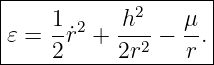
the radial energy equation is
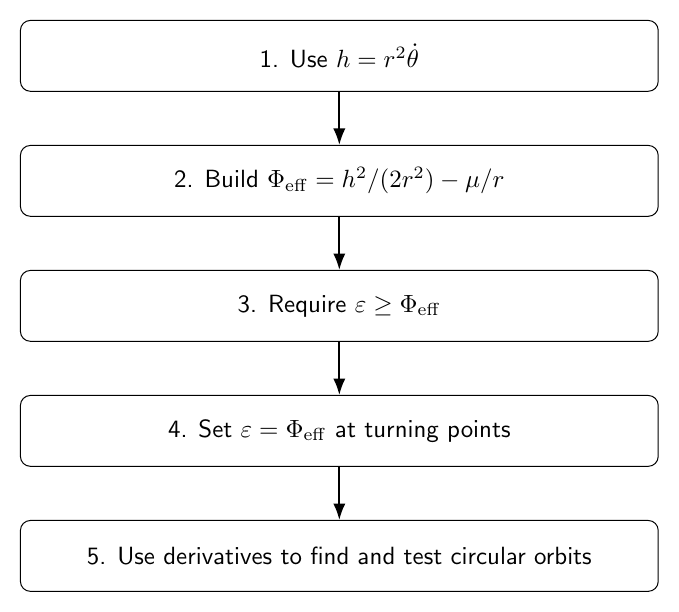
Figure 1. A compact effective-potential strategy: use conserved angular momentum, build Φeff, compare it with the energy level, locate turning points, and test circular-orbit stability.
1 High-value GRE facts
Part I: Original GRE-style problems
Problem 1: effective potentialThe specific effective potential for Newtonian gravity is
Problem 2: allowed regionRadial motion is allowed where
Problem 3: turning pointAt a radial turning point,
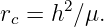
Problem 4: circular radiusFor fixed h, the circular-orbit radius is
Problem 5: circular energyAt the circular-orbit radius,
is
Problem 6: stabilityThe Newtonian circular orbit is radially stable because at rc
Problem 7: barrierFor nonzero h, as r → 0 the specific effective potential
Problem 8: zero angular momentumIf h = 0, the effective potential becomes
Problem 9: radial accelerationThe radial equation can be written
Problem 10: two bound turning pointsFor fixed nonzero h, a negative energy above the effective-potential minimum generally gives
Problem 11: periapsis speedAt periapsis for nonzero angular momentum,
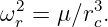
Problem 12: small radial oscillation frequencyFor a Newtonian circular orbit,
for small radial oscillations is
Part II: Complete worked solutions
Solution 1Angular-momentum conservation converts the transverse kinetic energy into
so
Answer: (B).
Solution 2Since
the right-hand side must be nonnegative. Answer: (C).
Solution 3A radial turning point is defined by
For nonzero angular momentum, transverse motion can remain. Answer: (A).
Solution 4Set
This gives
and therefore
Answer: (C).
Solution 5At the circular minimum,
Answer: (C).
Solution 6The second derivative is
The extremum is therefore a minimum. Answer: (C).
Solution 7The positive term
dominates over
at sufficiently small radius. Answer: (C).
Solution 8When
the angular term disappears and only
remains. Answer: (B).
Solution 9Differentiating the effective potential gives
Answer: (A).
Solution 10A horizontal negative-energy line above the minimum intersects the effective-potential curve twice. Answer: (C).
Solution 11At periapsis,
but
is generally nonzero. Answer: (B).
Solution 12The curvature of the effective potential at the circular minimum is
Thus
Answer: (A).
2 GRE checklist
References
References
"GRE Physics Companion: Effective Potential and Radial Motion in Central Gravity" is owned by bloftin.
This object's parent. Cross-references: kinetic energy, oscillations, acceleration, potential energy, radial velocity, effective potential, specific effective potential, radial equation, speed, radial turning points, turning points, angular momentum, energy, specific angular momentum This is version 1 of GRE Physics Companion: Effective Potential and Radial Motion in Central Gravity, born on 2026-10-31. Object id is 1560, canonical name is GREPhysicsCompanionEffectivePotentialAndRadialMotionInCentralGravity. Accessed 5 times total. Classification:
|
|
|
|
Pending Errata and AddendaNone.
|
DiscussionNo messages.
|
Interact |