GRE Physics Companion: Dynamics of Circular Motion
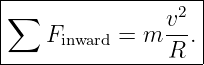
This companion collects fast solution patterns for circular-motion questions. The governing idea is
always
Do not add a separate centripetal force. Instead, identify which real forces have inward
components.
1 Fast triage
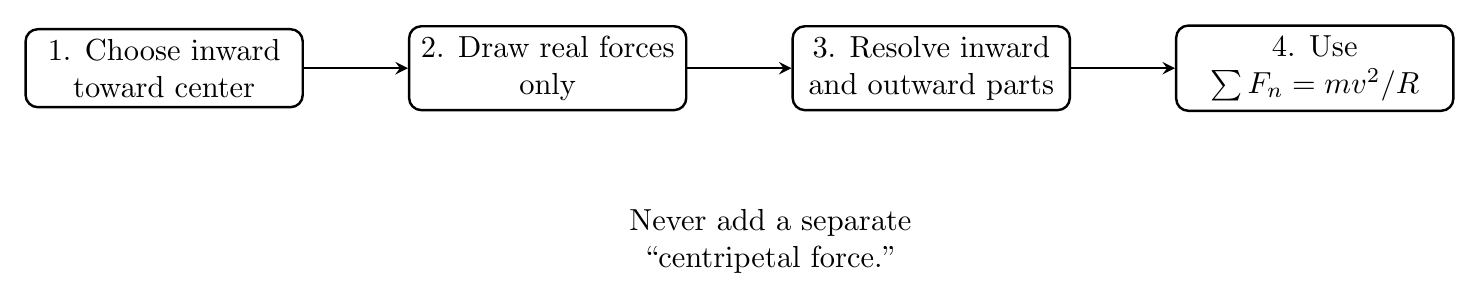
Figure 1. GRE circular-motion triage. First choose inward, then identify the real force
components that point inward or outward, and finally apply the radial equation.
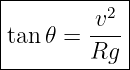
The most useful standard forms are
for a frictionless banked turn, and
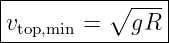
for local contact at the top of an inside vertical loop.
2 Scaling shortcuts
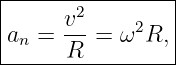
From an = v2∕R:
- doubling v multiplies an and the required inward force by 4;
- doubling R at fixed v halves them;
- at fixed angular speed, an = ω2R grows linearly with radius.
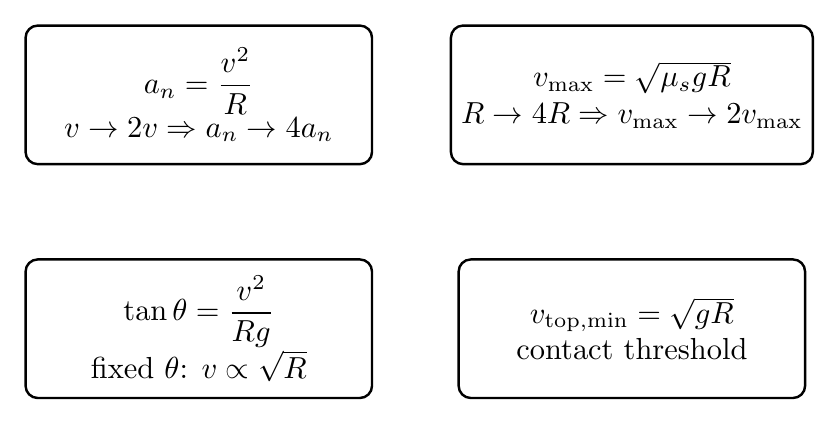
Figure 2. High-value scaling relations for circular motion. The quadratic dependence on speed is a
common source of GRE distractors.
3 Worked GRE example 1: flat curve scaling
A CAR can just round a level curve of radius R at speed v without slipping. On the same surface,
what is the maximum speed on a curve of radius 4R?
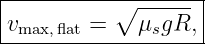
The flat-curve limit is
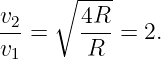
With the same surface, μs is unchanged. Therefore
Hence
The speed scales with the square root of radius, not directly with radius.
4 Worked GRE example 2: top of a loop
A cart moves on the inside of a vertical loop. At the top its speed is exactly  . What is the
Normal force there?
. What is the
Normal force there?
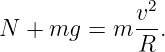
At the top, inward is downward:
Since v2 = 2gR,
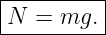
Therefore
The common trap is to set N = mv2∕R and forget that gravity also contributes inward.
5 GRE practice questions
- A particle’s speed around a fixed-radius circle is tripled. By what factor does the
required inward net force change?
- A car turns on a level road at speed v. The coefficient of static friction is doubled
while the curve radius is unchanged. By what factor does the maximum possible no-slip
speed change?
- A frictionless banked curve is designed for speed v and radius R. If the radius is
quadrupled while the bank angle is unchanged, what is the new design speed?
- A rider moves through the bottom of a circular dip. Which is larger there: the normal
force or the rider’s Weight? Assume nonzero speed.
- A car moves over the top of a convex hill. As its speed increases while R remains fixed,
what happens to the normal force?
- A cart is at the top of an inside vertical loop with speed v =
 . What is the normal
force?
. What is the normal
force?
- A conical pendulum is held at a larger angle from the vertical while its string length
remains fixed. Does its angular speed increase, decrease, or remain unchanged?
6 Answers
- Factor of 9.
- Factor of
 .
.
- Factor of 2.
- The normal force is larger than the weight because N − mg = mv2∕R > 0.
- It decreases according to N = mg − mv2∕R and reaches zero at contact loss.
- Zero. Gravity alone supplies the required inward force.
- It increases, because ω2 = g∕(L cos 𝜃) and cos 𝜃 decreases.
7 Final checklist
- Choose the inward direction before writing signs.
- Draw only real forces.
- Use ∑
Fn = mv2∕R for the normal direction.
- Use ∑
Ft = mdv∕dt only when the speed is changing.
- Remember that N cannot be negative for passive contact.
- Check the v2 scaling before accepting an answer choice.
References
[1] PhysicsLibrary, M02-11, Dynamics of Circular Motion.
[2] OpenStax, University Physics, Volume 1, sections on uniform circular motion and
dynamics, CC BY 4.0.

![[parent]](https://images.physicslibrary.org/images/uparrow.png)