Physics Library
 An open source physics library
Encyclopedia | Forums | Docs | Random  

[parent] GRE Physics Companion: Diatomic Oscillator Chains and Acoustic and Optical Branches

(Example)

GRE Physics Companion: Diatomic Oscillator Chains and Acoustic and Optical Branches

The diatomic-chain dispersion relation is

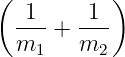
ω±2 = κ(          )
  -1-   -1-
  m  +  m
    1     2 (1)
± κ∘ ----------------------------------
  (  1     1 )2      4       ( ka)
    ---+  ---   − ------ sin2   ---
    m1    m2      m1m2         2. (2)

PIC

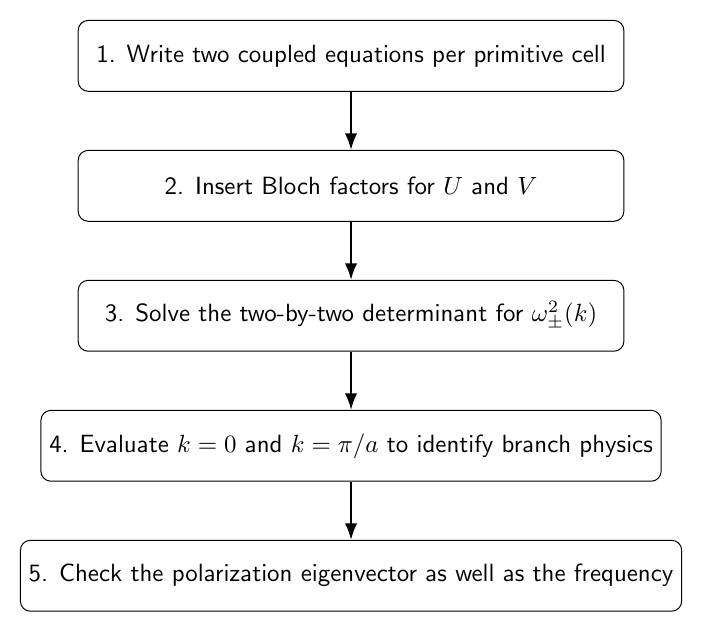
Figure 1. A compact diatomic-chain strategy: write two equations per cell, insert Bloch factors, solve the two-by-two determinant, then examine the k = 0 and zone-edge limits to identify the acoustic and optical branches.

1 High-value GRE facts

  1. Two displacement degrees of freedom per primitive cell produce two branches.
  2. The lower branch is acoustic; the upper branch is optical.
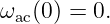
  3. ωac(0) = 0.
  4. At acoustic k = 0, U = V .
  5. At optical k = 0, m1U + m2V = 0.
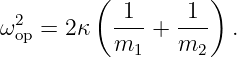
  6. ωop2(0) = 2κ(1∕m 1 + 1∕m2).
  7. For m1 > m2, the zone-edge branch values are 2κ∕m1 and 2κ∕m2 in squared frequency.
  8. Unequal masses create a frequency gap.
  9. Equal masses close the gap.
  10. In the equal-mass limit, the two branches are a zone-folded monatomic dispersion relation.

Part I: Original GRE-style problems

Problem 1: number of branches

A one-dimensional primitive cell contains two independent scalar displacements. The number of normal-mode branches is

  1. one
  2. two
  3. three
  4. four
  5. dependent on k

Problem 2: acoustic k = 0 frequency

At

k = 0,
(3)

the acoustic frequency is

  1. 0
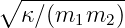
  2. ∘ ------
  κ∕m1
  3. ∘ ------
  κ∕m2
  4. ∘2-κ-(1-∕m--+-1∕m--)-
          1      2
  5. infinite

Problem 3: acoustic k = 0 polarization

At

k = 0
(4)

on the acoustic branch,

  1. U = V
  2. U = −V
  3. U = 0
  4. V = 0
  5. m1U + m2V = 0

Problem 4: optical k = 0 polarization

At

k = 0
(5)

on the optical branch,

  1. U = V
  2. m1U + m2V = 0
  3. U = 0 always
  4. V = 0 always
  5. both masses are stationary

Problem 5: optical k = 0 frequency

The optical squared frequency at

k = 0
(6)

is

  1. 0
  2. κ(1∕m1 + 1∕m2)
  3. 2κ(1∕m1 + 1∕m2)
  4. 2κ∕(m1 + m2)
  5. 4κ∕(m1 + m2)

Problem 6: acoustic sound speed

The long-wavelength acoustic speed is

  1. a∘ -------------
  κ ∕(m1 + m2 )
  2. a∘ ---------------
  κ ∕[2(m1  + m2 )]
  3. a∘ --------------
  2κ ∕(m1 + m2 )
  4. ∘ ----------
  κ∕ (m1m2  )
  5. aκ∕(m1 + m2)

Problem 7: zone-edge acoustic frequency

Assume

m1 >  m2.
(7)

At

k =  π∕a,
(8)

the acoustic squared frequency is

  1. 2κ∕m1
  2. 2κ∕m2
  3. κ∕(m1 + m2)
  4. 2κ(1∕m1 + 1∕m2)
  5. zero

Problem 8: zone-edge polarization

For

m1 >  m2,
(9)

the acoustic zone-edge mode has

  1. only the lighter sublattice moving
  2. only the heavier sublattice moving
  3. both moving equally
  4. both moving oppositely with equal amplitude
  5. no motion

Problem 9: frequency gap

For unequal masses, the frequency gap occurs between

  1. the two k = 0 frequencies only
  2. the acoustic maximum and optical minimum at the zone edge
  3. k = 0 and k = π∕a
  4. positive and negative k
  5. two identical acoustic branches

Problem 10: equal masses

When

m1 =  m2,
(10)

the frequency gap

  1. doubles
  2. remains unchanged
  3. vanishes
  4. becomes infinite
  5. moves to k = 0

Problem 11: numerical optical frequency

Let

m1  = 2kg,   m2 =  1kg,   κ = 100 N ∕m.
(11)

Then

ωop(0)
(12)

is closest to

  1. 10.00 rad/s
  2. 14.14 rad/s
  3. 17.32 rad/s
  4. 20.00 rad/s
  5. 30.00 rad/s

Problem 12: equal-mass interpretation

When the two masses become identical, the two reduced-zone branches are best interpreted as

  1. two unrelated oscillator systems
  2. a monatomic dispersion curve folded into a smaller Brillouin zone
  3. two optical branches
  4. two acoustic branches with different sound speeds
  5. evidence that the normal-mode count has doubled physically

Part II: Complete worked solutions

Solution 1

The number of branches equals the number of independent displacement degrees of freedom in the primitive cell. Two displacements give two branches. Answer: (B).

Solution 2

The lower branch begins at

ωac(0) = 0.
(13)

This is uniform translation. Answer: (A).

Solution 3

At

k = 0,
(14)

the acoustic mode does not stretch the springs. Therefore

U  = V.
(15)

Answer: (A).

Solution 4

The optical mode keeps the cell center of mass fixed:

m1U  +  m2V  = 0.
(16)

Answer: (B).

Solution 5

At

k = 0,
(17)

         (  1     1 )
ω2op = 2 κ  --- + ---  .
           m1    m2
(18)

Answer: (C).

Solution 6

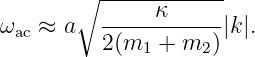
The small-k acoustic branch is

        ∘ ------------
ωac ≈ a   -----κ------|k |.
          2(m1 +  m2 )
(19)

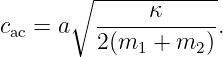
Thus

       ∘ ------------
c  = a   -----κ------.
 ac      2(m1  + m2 )
(20)

Answer: (B).

Solution 7

For

m1 >  m2,
(21)

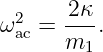
the lower zone-edge branch is associated with the heavier mass:

ω2 =  2κ-.
 ac   m1
(22)

Answer: (A).

Solution 8

At the zone boundary the off-diagonal coupling terms vanish. The lower frequency belongs to the heavier mass, so only that sublattice moves. Answer: (B).

Solution 9

For unequal masses, the top of the acoustic branch and bottom of the optical branch occur at the zone edge and are separated in frequency. Answer: (B).

Solution 10

When

m1 =  m2,
(23)

the two zone-edge frequencies become equal. The gap closes. Answer: (C).

Solution 11

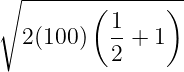
ωop(0) =   ----------------
∘        (      )
  2(100 )  1-+ 1
           2 (24)
= √ ----
  300 (25)
≈ 17.32 rad∕s. (26)

Answer: (C).

Solution 12

Equal masses make the two-mass cell nonprimitive. The apparent two branches arise by folding the monatomic curve into the reduced zone. Answer: (B).

2 GRE checklist

  1. Count the independent displacements in the primitive cell before counting branches.
  2. Keep the two Bloch amplitudes separate.
  3. Use the lower sign for the acoustic branch and upper sign for the optical branch.
  4. Evaluate k = 0 and k = π∕a before attempting complicated algebra.
  5. Remember that optical k = 0 motion keeps the cell center of mass fixed.
  6. For unequal masses at the zone edge, the heavy mass belongs to the lower branch.
  7. Do not confuse a frequency gap with a forbidden interval of wave number.
  8. In the equal-mass limit, recognize zone folding rather than a genuinely new second physical branch.

References

References

[1]   PhysicsLibrary, M06-06, Discrete Oscillator Chains and Dispersion.

[2]   PhysicsLibrary, M06-05, Small Oscillations and the Normal-Mode Eigenvalue Problem.

[3]   A. P. French, Vibrations and Waves, W. W. Norton, 1971.

[4]   C. Kittel, Introduction to Solid State Physics, 8th ed., Wiley, 2005.


"GRE Physics Companion: Diatomic Oscillator Chains and Acoustic and Optical Branches" is owned by bloftin.
(view preamble)
View style:
Other names:  M06-07G
Keywords:  GRE physics, diatomic chain, acoustic branch, optical branch, dispersion relation, Brillouin zone, frequency gap, polarization, zone folding, lattice dynamics

This object's parent.

Cross-references: zone folding, boundary, center of mass, systems, oscillator, amplitude, speed, acoustic branch, scalar, frequency gap, masses, frequency, primitive cell, degrees of freedom, displacement, optical branches, determinant, dispersion relation

This is version 1 of GRE Physics Companion: Diatomic Oscillator Chains and Acoustic and Optical Branches, born on 2026-10-18.
Object id is 1501, canonical name is GREPhysicsCompanionDiatomicOscillatorChainsAndAcousticAndOpticalBranches.
Accessed 3 times total.

Classification:
Physics Classification: 45.50.-j (Dynamics and kinematics of a particle and a system of particles)
 45.05.+x (General theory of classical mechanics of discrete systems)

Pending Errata and Addenda

None.

Discussion

No messages.

Interact